
News · Markets · Global
SpaceX Wants Record Valuations. The Risks Say Otherwise
SpaceX is preparing to debut at a staggering $1.75 trillion valuation — the largest IPO in U.S. history. The company has genuine competitive advantages and an impressive track record, but at 94 times revenue, the asking price leaves almost no margin for error. Investors should look past the mythology and focus on four underappreciated risks: declining Starlink ARPU, Starship execution delays, the growing drag from xAI losses, and Musk’s ironclad governance structure that leaves little room for minority shareholders.
The most anticipated IPO in years asks public shareholders to pay for a future that hasn't arrived yet. The engineering is real. The price demands scrutiny.
SpaceX filed to go public at a $1.75 trillion valuation, and the number landed with the weight of inevitability. Elon Musk's rocket company has earned its mythology: 9,600 satellites in orbit, 10.3 million Starlink subscribers across 164 countries, a lock on NASA's lunar lander program, and a launch cadence no competitor can touch. The S-1, filed May 20, disclosed $18.7 billion in 2025 revenue and $6.6 billion in adjusted EBITDA.
Impressive numbers, all of them. The price tag still dwarfs what they can support.
At $1.75 trillion, SpaceX would enter the public markets at 94 times revenue and 266 times EBITDA, a multiple that only works if every business line executes at the top of its range, simultaneously, for a decade. Independent analysis by Icarus Asia Research pegs fair value between $700 billion and $900 billion, with a central estimate around $684 billion. The gap between what SpaceX is asking and what the fundamentals can defend is roughly $600 billion, or about 34 percent of the IPO target.
The moat is real and worth spelling out.
SpaceX holds roughly $22 billion in cumulative U.S. government contracts across NASA - National Aeronautics and Space Administration, the Space Force, the NRO, and the Space Development Agency. Starlink runs at 63 percent EBITDA margins, roughly double what most listed satellite operators achieve. No public competitor can match SpaceX's vertical integration across launch vehicles, satellite manufacturing, and broadband delivery. These are durable advantages.
For investors weighing whether to participate, the quality of the company was never in doubt. Whether this is a sensible price to pay for it very much is.
The Starlink Problem Nobody Wants to Talk About
Starlink is the crown jewel.
It generated $11.4 billion in revenue last year and $4.4 billion in operating income. No other satellite broadband operator comes close. Subscriber growth has been ferocious, roughly doubling every year since 2022.
But buried inside that growth story is a number heading the wrong direction. Average revenue per user fell from about $99 in 2022 to $66 by early 2026. That decline reflects a deliberate trade: SpaceX swapped pricing power for geographic reach, pushing into markets where customers can't or won't pay North American rates.
The math gets uncomfortable quickly.
As an illustration of the sensitivity: every $5 move in blended monthly ARPU across a subscriber base in the 10-to-15 million range equates to $600–900 million in annualized revenue. At a 25x revenue multiple, that single variable swings equity value by $15 billion to $22 billion. The spread between a $62 bear-case ARPU and a $72 bull case implies a valuation gap on the order of $40 billion to $45 billion, larger than the combined market capitalizations of Iridium and Viasat.
The bull case says ARPU doesn't need to return to $99. It just needs to stop falling, stabilized by a richer mix of enterprise, government, and maritime customers. The bear case says the cheapest geographies will keep dragging the average down, and SpaceX will face a choice between growth and margins that the IPO prospectus doesn't honestly confront.
India: The Upside That Isn't Upside Yet
India is the single most important swing market for Starlink's long-term story. The population is massive, fixed-line penetration is low, and SpaceX has signed distribution agreements with both airtel and Jio.
But as of mid-2026, Starlink still hasn't launched commercial service in India. All required licenses were obtained by July 2025. Then came security compliance reviews, gateway build-out delays, and an unresolved question over permanent Ka-band and Ku-band spectrum assignments. As of the S-1 filing, the Department of Telecommunications had yet to confirm permanent spectrum assignments.
There's also the affordability problem.
Starlink hardware in India costs roughly 33,000 to 34,000 rupees (about $390), and monthly plans run 3,000 to 8,600 rupees. In a country where Jio offers 4G data for less than $2 a month, Starlink's addressable market is far smaller than India's 1.4 billion people might suggest. Reasonable near-term subscriber estimates range from 500,000 to 2 million, not the tens of millions that the most promotional narratives imply.
Icarus Asia applies a 50 to 70 percent penetration haircut and a 20 to 35 percent ARPU haircut to the India opportunity. India is upside. Capitalizing it at full value before commercial service begins is a different kind of bet.
Starship: The $600 Billion Variable
Starship is the rocket that makes the entire long-term thesis work. It's designed to carry heavier payloads at lower cost, deploy next-generation Starlink satellites more efficiently, and open commercial opportunities that Falcon 9 physically cannot reach. If Starship achieves routine commercial cadence, the economics of everything SpaceX does get meaningfully better.
The word "if" is doing a lot of work in that sentence.
As of June 2026, Starship had completed 12 integrated flight tests. The record includes genuine milestones: the first "chopstick" booster catch in October 2024, successful payload deployment simulations, and a rapid test cadence through 2025. It also includes the IFT-12 mishap on May 22, 2026, which lost the booster and triggered an FAA grounding that remained in effect at the time of the S-1 filing.
The program's flight history tells a story of real but uneven progress.
IFT-9 lost both stages. IFT-10 and IFT-11 succeeded. IFT-12 deployed 20 Starlink simulators, then lost the booster on a new vehicle variant. Public markets will ultimately judge Starship not by the ambition of each test flight but by the dullest possible metric: how many consecutive flights go right, how quickly they follow one another, and when "test" becomes "routine."
Routine operations, not heroic individual flights, will ultimately determine whether Starship becomes the economic multiplier the bull case requires.
A 12-to-18-month delay in Starship commercial readiness wouldn't destroy the thesis. It would push Starlink Gen3 deployment to the right, extend reliance on Falcon 9, and delay the ARPU recovery that the bull case depends on. A multi-year delay would do real damage, weakening the Gen3 economics, repricing NASA's Human Landing System contract expectations, and forcing investors to re-examine whether the IPO price ever had a defensible anchor.
IFT-13 matters more than any slide in the roadshow deck. A clean flight narrows the gap between theory and evidence. Another mishap widens it.
The xAI Problem
The S-1 revealed something that private-market investors could politely ignore: SpaceX consolidated xAI, Musk's artificial intelligence venture, into the company's financial statements. The AI segment reported $3.2 billion in revenue and $6.4 billion in operating losses for fiscal 2025. First-quarter 2026 losses came in at $2.5 billion, an annualized burn rate above $9 billion.
Capital expenditure tells the same story. Of SpaceX's $20.7 billion in 2025 capex, $12.7 billion went to AI and xAI infrastructure, more than triple the $4.2 billion spent on Starlink and the $3.8 billion on Starship. SpaceX reported a GAAP net loss of $4.94 billion for fiscal 2025, reversing a $791 million profit the year before. The swing was almost entirely attributable to AI.
The xAI consolidation changes the character of the equity. What was a profitable communications platform with strategic optionality is now also a capital-hungry AI infrastructure play carrying deep losses and uncertain returns.
What was a profitable communications platform with strategic optionality is now also a capital-hungry AI infrastructure play carrying deep losses and uncertain returns
xAI might eventually become valuable. But public shareholders are being asked to fund the experiment at a starting valuation that already assumes it will.
Governance: The Fine Print That Matters
Musk controls roughly 85 percent of SpaceX's voting power with about 42 percent economic ownership, through a dual-class share structure where Class B shares carry 10 votes each. SpaceX qualifies as a controlled company under Nasdaq rules, exempting it from certain board independence requirements.
Minority shareholders need to understand what that means in practice.
The board doesn't have to include a majority of independent directors. Capital allocation decisions, including how much cash goes to Starship versus xAI versus debt repayment, rest with someone whose interests may diverge from those of a public shareholder focused on per-share returns. That structure worked for private-market investors who bought in at $100 billion. Public shareholders will discover whether it still works when quarterly results disappoint.
Then there's dilution.
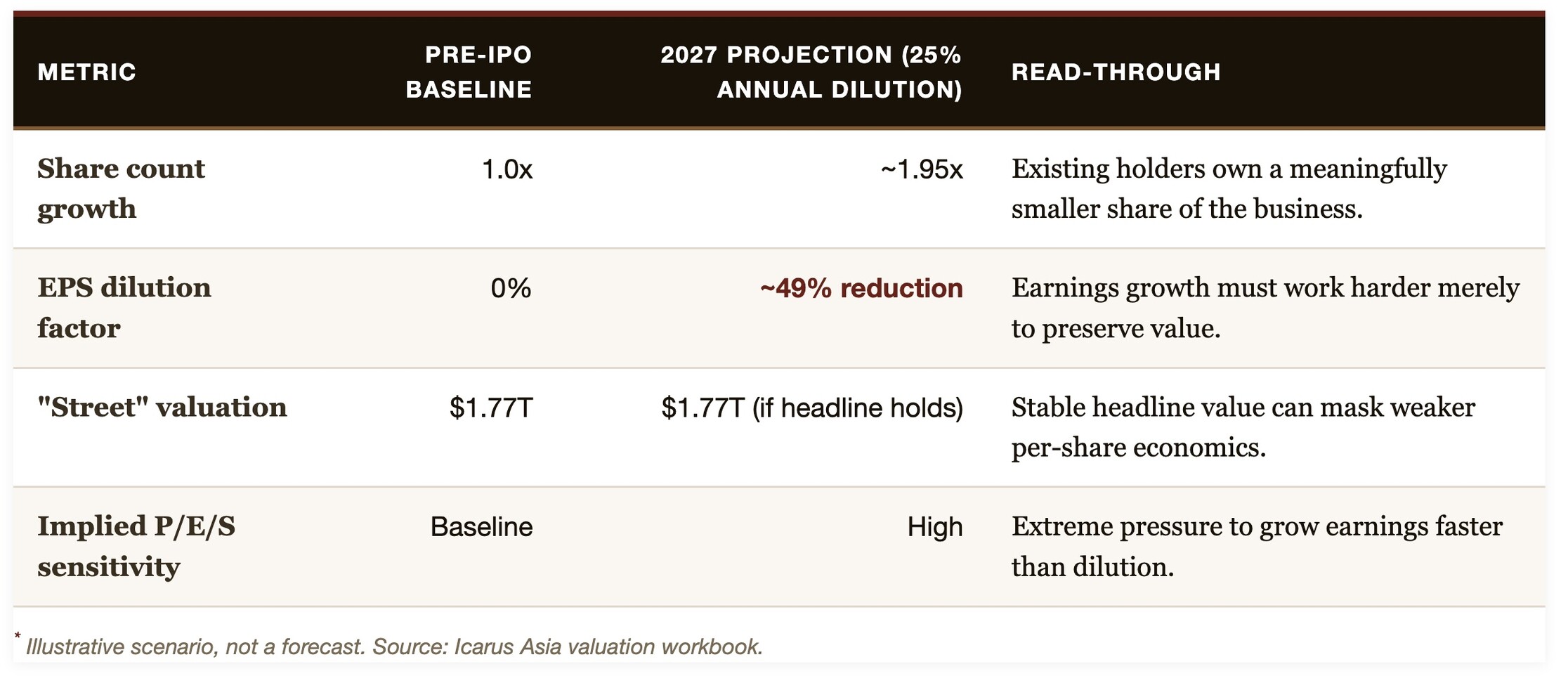
Stock-based compensation and periodic equity issuance are standard at founder-led growth companies. But under a high-dilution scenario, Icarus Asia estimates that 25 percent annual dilution through 2027 would produce a cumulative share-count multiple of about 1.95x, reducing the per-share claim by roughly 49 percent. Earnings growth would have to work considerably harder just to hold value steady, never mind create it.
The balance sheet adds its own wrinkle.
Total long-term debt stands at $29.1 billion, including roughly $5 billion in xAI infrastructure bonds and a $4.5 billion AI chip lease through Valor Equity. Cash is $24.7 billion, substantial but not fully discretionary when you account for the commitments sitting against it.
One billion "Mars performance shares" are tied to an extreme long-dated milestone. The near-term probability is low. The signal it sends about how incentives are framed is worth noting.
The Lockup Overhang
There's a practical detail that deserves more attention than it usually gets in IPO coverage. Many early employees and pre-IPO investors acquired their SpaceX shares at effective valuations between $100 billion and $200 billion. At a $1.75 trillion IPO, those stakes have appreciated by roughly 10 to 17 times.
If the lockup structure involves staggered expirations over 6 to 12 months, each wave creates a supply overhang. The incentive for insiders to take profit at these levels is considerable. Early post-IPO trading may be supported by scarcity mechanics and index-inclusion demand, but that support has a shelf life.
The incentive for insiders to take profit at these levels is considerable
What the Comparables Actually Say
SpaceX's IPO valuation doesn't have a natural peer. At 94x revenue, it trades at roughly 10 times the multiple of Tesla, 27 times that of Palantir, and 40 times that of Iridium, the closest public LEO satellite operator. Traditional satellite companies like Eutelsat, SES, and Viasat trade between 0.7x and 3.5x revenue.
The implied argument is that SpaceX belongs in a category of one, a company so dominant across launch, broadband, and government services that conventional multiples don't apply. There's truth to that claim — but not enough to justify 94x revenue. Starlink operates at 63 percent EBITDA margins; listed satellite peers like SES and Eutelsat run between 20 and 55 percent. No listed competitor can replicate SpaceX's vertical integration across launch, manufacturing, and service delivery.
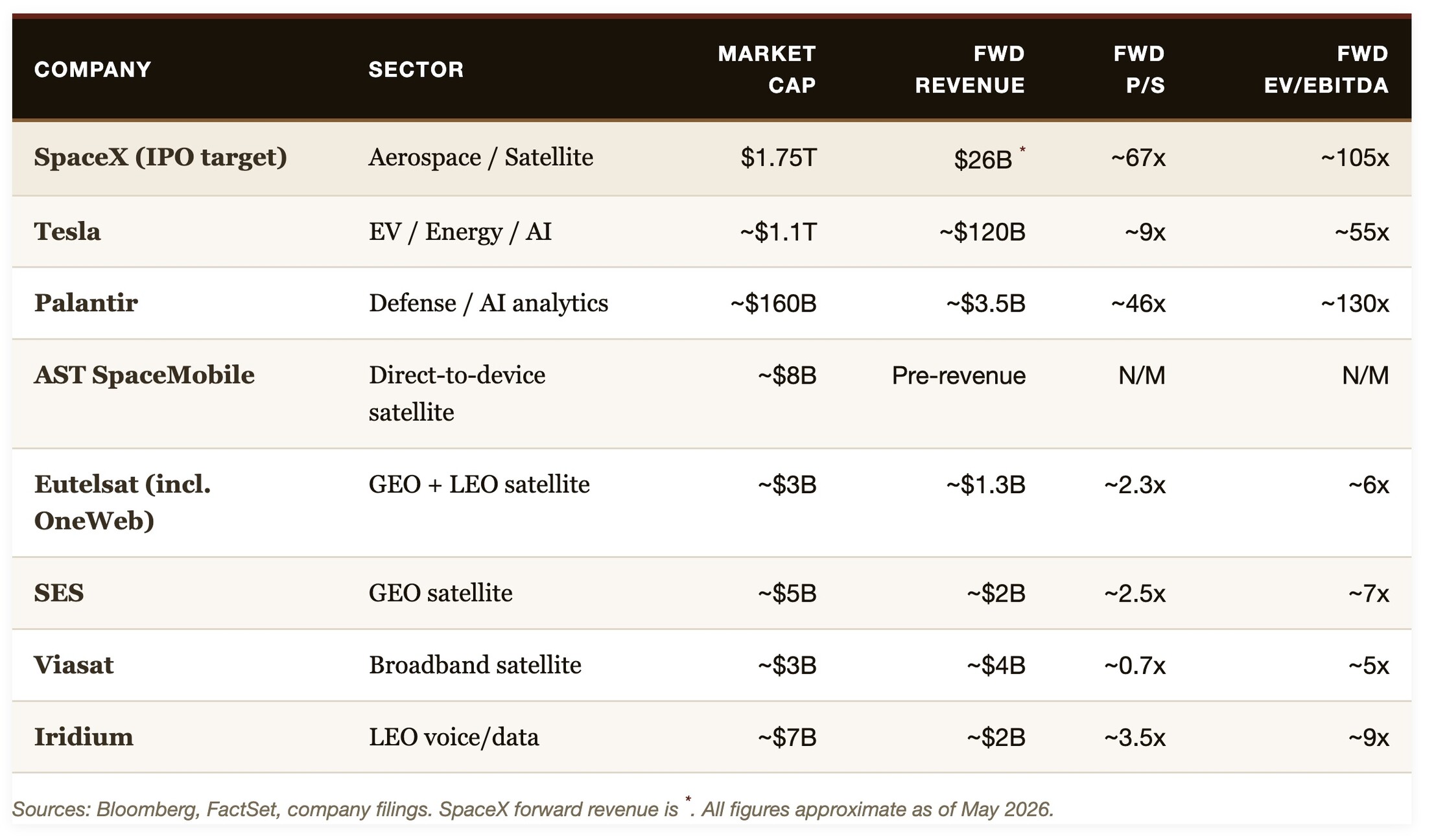
According to Icarus Asia Research's sum-of-the-parts analysis, a defensible range of 44x to 48x revenue already grants SpaceX a premium that no aerospace, telecom, or satellite company has ever sustained in public markets. Even at that generous range, implied equity value lands between $1.15 trillion and $1.25 trillion, roughly $500 billion to $600 billion below what investors are being asked to pay.
Four Things That Must Go Right Simultaneously
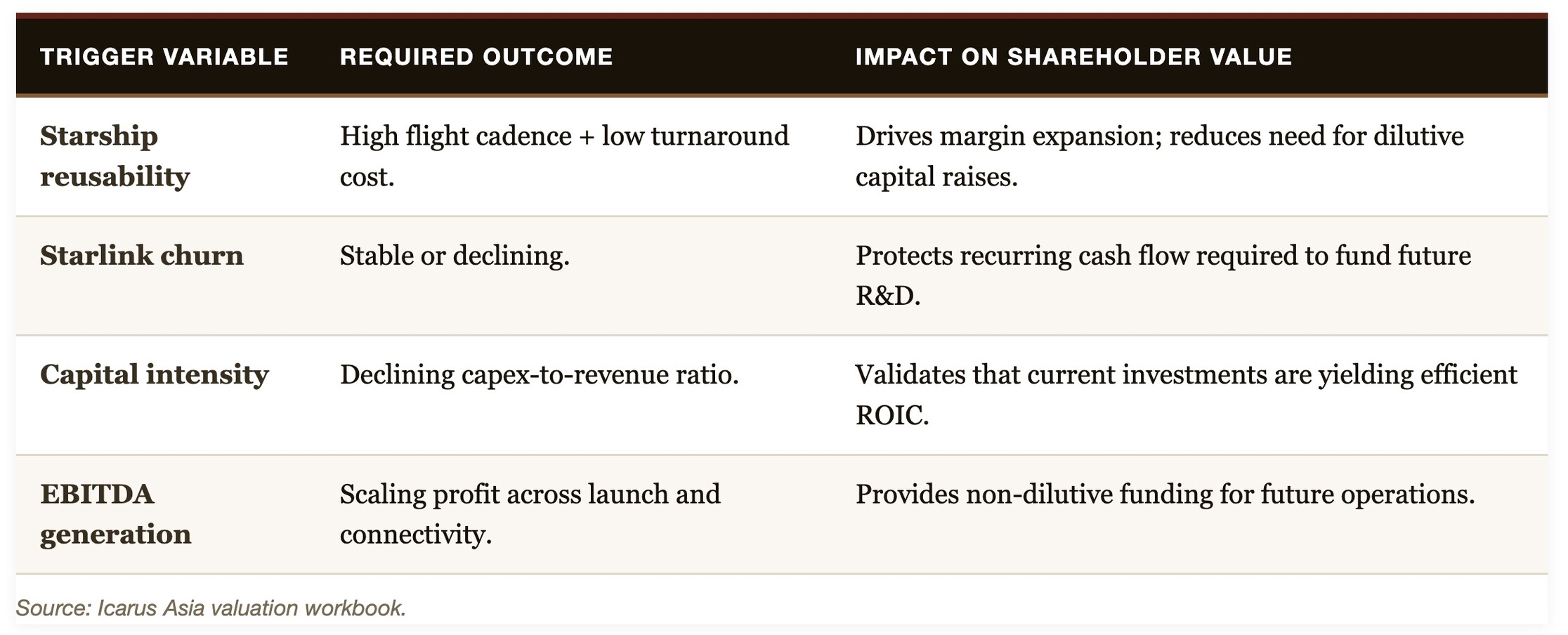
For the $1.75 trillion valuation to hold after listing, four conditions need to stay on track at the same time. Starlink churn must remain stable or decline. Capital intensity must fall as a share of revenue. EBITDA must scale across both launch and connectivity. And dilution must stay contained enough that per-share economics actually improve.
Break any two of those, and the path toward $1.35 trillion or below accelerates considerably.
The first six months after listing may look fine. Scarcity value, index mechanics, and limited float can prop up a stock for a while. By the 6-to-12-month mark, quarterly earnings reports will start separating the story from the numbers. Starship milestones, dilution disclosures, and AI loss trajectories will drive the conversation. That's when the gap between narrative and reality tends to close.
By the 6-to-12-month mark, quarterly earnings reports will start separating the story from the numbers
What Would Make the Story Investable
In Icarus Asia's view, five conditions would shift the calculus. First, a string of successful Starship flights that establish routine cadence rather than one-off achievements. Second, evidence that Starlink ARPU has stabilized even as the subscriber base keeps expanding. Third, actual commercial launch and measurable customer uptake in India. Fourth, a visible path to lower AI losses and more disciplined capital spending. Fifth, a secondary-market price closer to a range where public investors are compensated for governance risk and execution uncertainty.
None of those conditions are met today.
SpaceX deserves admiration for its achievements. At $1.75 trillion, it also deserves skepticism
SpaceX deserves admiration for its achievements. At $1.75 trillion, it also deserves skepticism. The S-1 shows a business with one elite asset in Starlink, a strategically valuable but lower-return launch franchise, and a newly consolidated AI operation that has made the equity story materially riskier. The engineering achievements are genuine. The valuation requires investors to treat unfinished work as settled fact.
The most credible way to express conviction in SpaceX is to wait for a better entry.
The most credible way to express conviction in SpaceX is to wait for a better entry. At $350 per share, the market is pricing in a future that hasn't arrived.
Discipline, not fear of missing out, is the right instinct here.
The author is the Head of Research and Analysis at Icarus Asia, a Hong Kong-based risk and advisory business.
Access our research report and house view here - The SpaceX IPO: Paying for the Promise Before the Proof
Disclaimer:
This article draws on analysis by Icarus Asia Research, a public service initiative. SpaceX S-1 prospectus filed May 20, 2026. Icarus Asia's valuation methodology uses sum-of-the-parts analysis with segment-level scenarios, cross-referenced against comparable-company multiples.
This article does not constitute investment advice.