
News · Markets · Global
The AI Boom Looks a Lot Like the Dot-Com Bubble
The Bank for International Settlements has done what few institutions will -- named the AI investment surge as a potential systemic threat, compared it to the canal mania of the 1830s, and explained, precisely, why a bust this time wouldn't stay contained beyond Silicon Valley.
The global AI spending surge is beginning to look uncomfortably like the dot-com boom of the late 1990s -- and the Bank for International Settlements now says it could be worse.
The Basel-based institution released its Annual Economic Report on Sunday, warning that the current wave of AI investment combines the speculative excess of past technology booms with financing structures so tangled that a correction could propagate through the financial system in ways that have no historical precedent.
The BIS, which acts as a central bank for central banks and is regarded as the most authoritative voice on systemic financial risk, said policymakers are navigating four overlapping pressure points -- a resurgence of inflation, an AI investment cycle that may be overextending itself, cracks in financial markets running deeper than they appear, and government debt near record highs in many countries.
The warning comes as a global energy shock -- triggered by the historic closure of the Strait of Hormuz earlier this year -- has revived the inflation fears that central banks spent three years fighting down.
The current tension between exuberant risk appetite and elevated macroeconomic risks could unwind abruptly.
Prices of plastics and fertilizers, key manufacturing and agricultural inputs, have risen 30% and 50%, respectively, since the Hormuz disruption began. Even if the Strait reopens fully, the BIS warned that inflationary effects may take several quarters to clear, with the steepest consequences landing on food prices in the world's poorest countries.
"Policymakers must act now," said Pablo Hernández de Cos, General Manager for BIS. "Delay will only make the necessary adjustments more costly and increase the chance of difficult trade-offs in the future," he added in his foreword to the report.
Faster, Bigger, More Opaque
Before the Hormuz shock hit, the global economy had held up better than most expected.
Tariff hikes that rattled markets in 2025 did less damage than feared -- firms absorbed costs, trade rerouted, and effective tariff rates came in below the headline numbers. What really kept growth alive was AI. A wave of capital expenditure on data centres, chips and cloud infrastructure, concentrated in the United States but spreading through global supply chains, lifted investment and kept stock valuations -- and financial conditions -- easy.
The BIS researchers are now asking whether that optimism can hold.
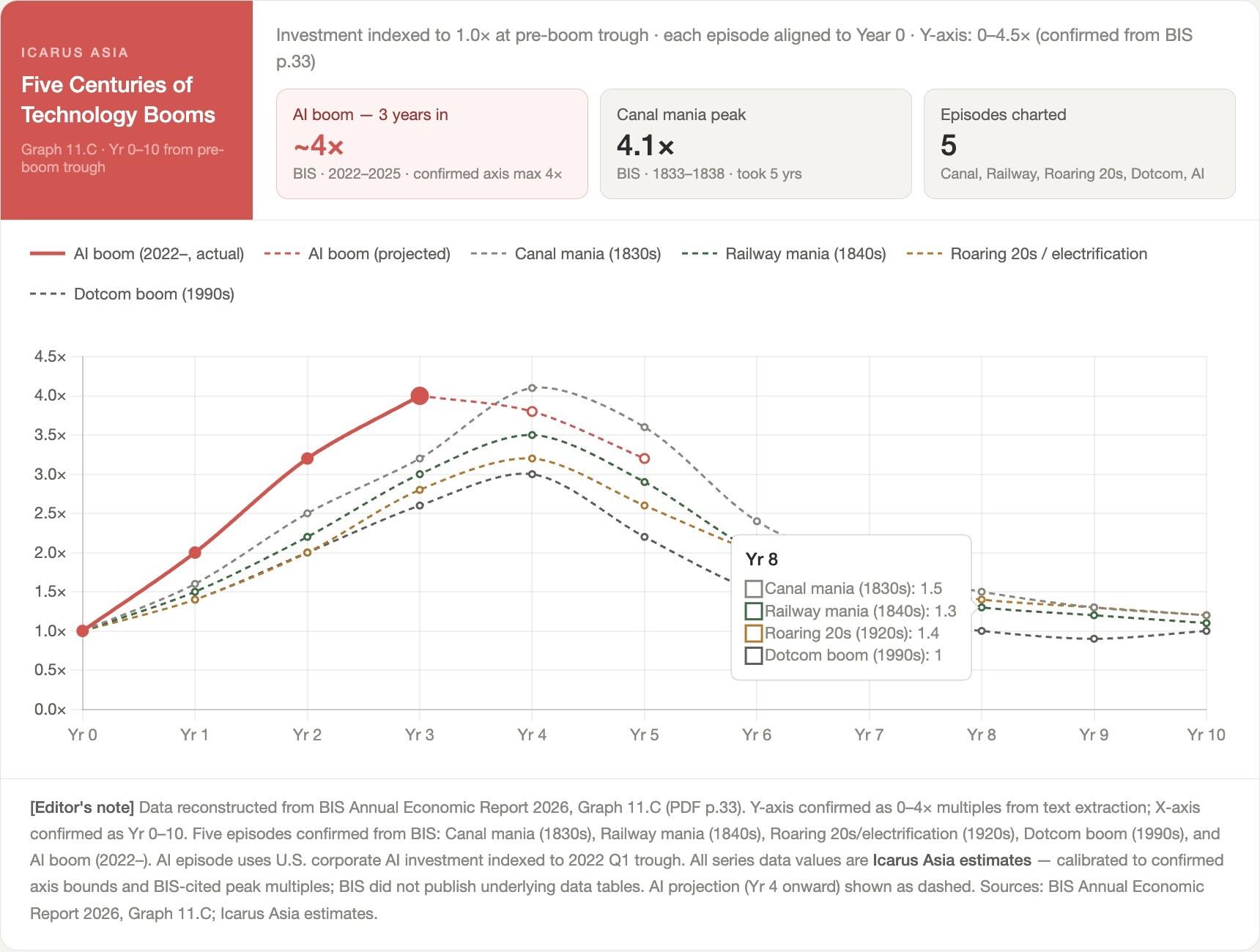
Their historical survey spans nearly two centuries of technology investment booms: the canal expansion of the 1830s, the British railway mania of the 1840s and the dot-com frenzy of the late 1990s. The current AI cycle compares unfavourably to all of them on the metrics that matter most.
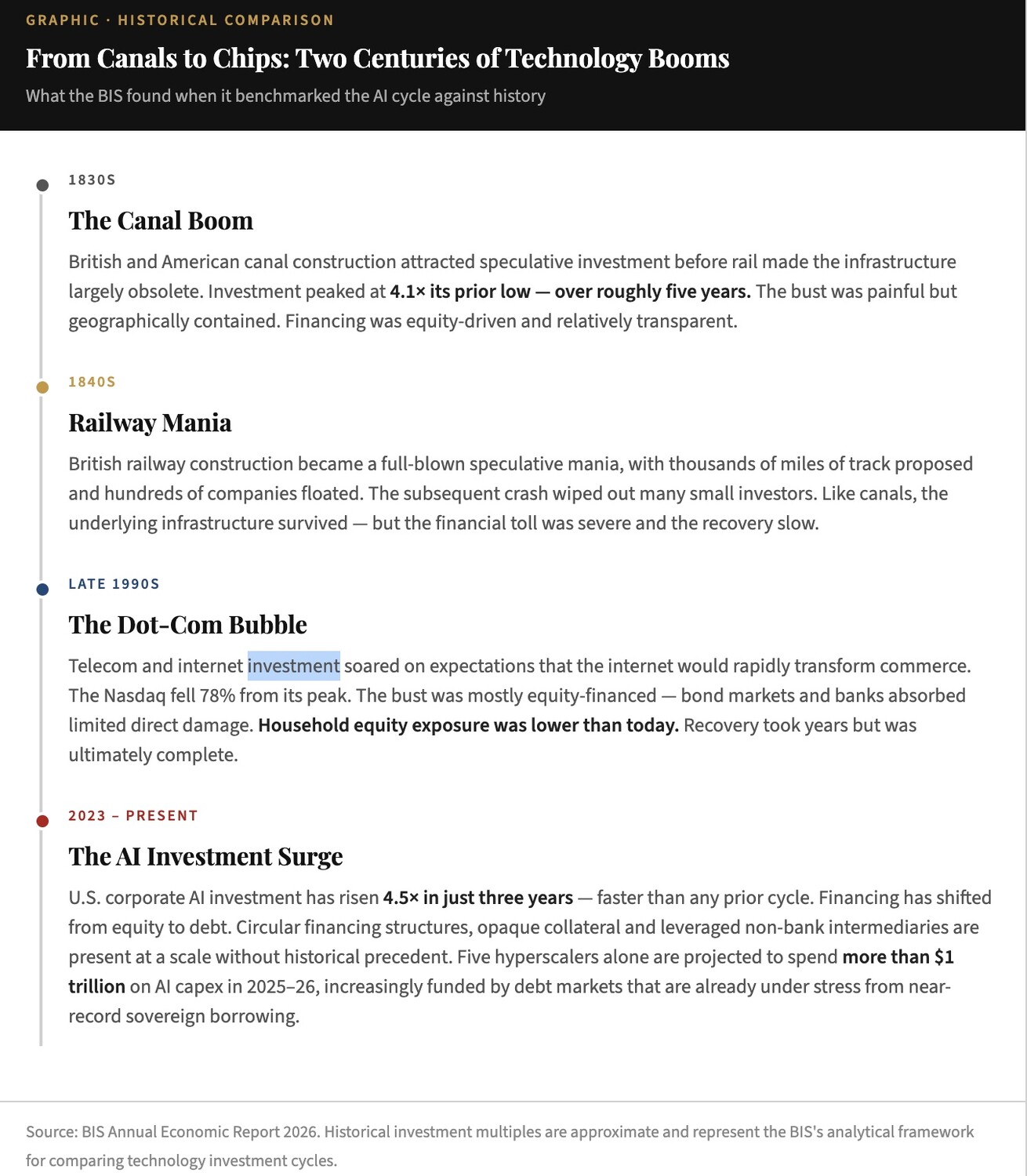
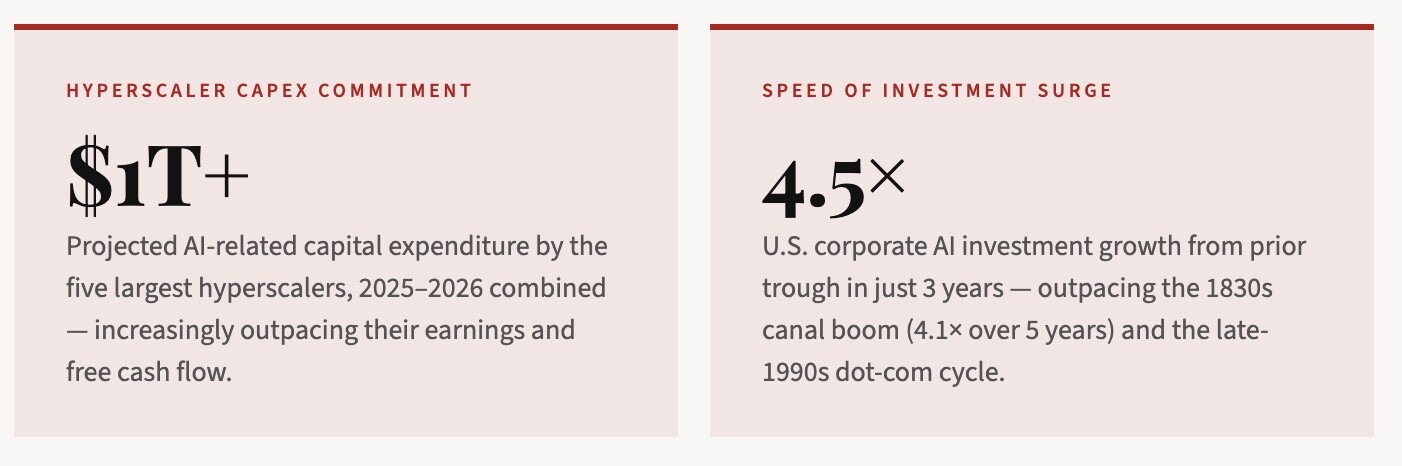
U.S. corporate AI investments have surged to 4.5 times their previous low point in just three years. The 1830s canal boom -- itself a cautionary tale of infrastructure overbuilding -- took five years to reach a 4.1-times multiple. The dot-com bubble, the most recent and most cited parallel, was slower and less concentrated. The pace alone distinguishes this cycle. But it's the financing that worries the BIS most.
Money Going in Circles
The dot-com boom was financed largely by public equity markets.
Investors bought shares in technology companies; some companies survived and grew; most didn't; the equity wiped out is painful but contained. The AI build-out works differently, and the BIS spent considerable attention mapping exactly how.
BIS researchers identified a practice they call "circular financing."
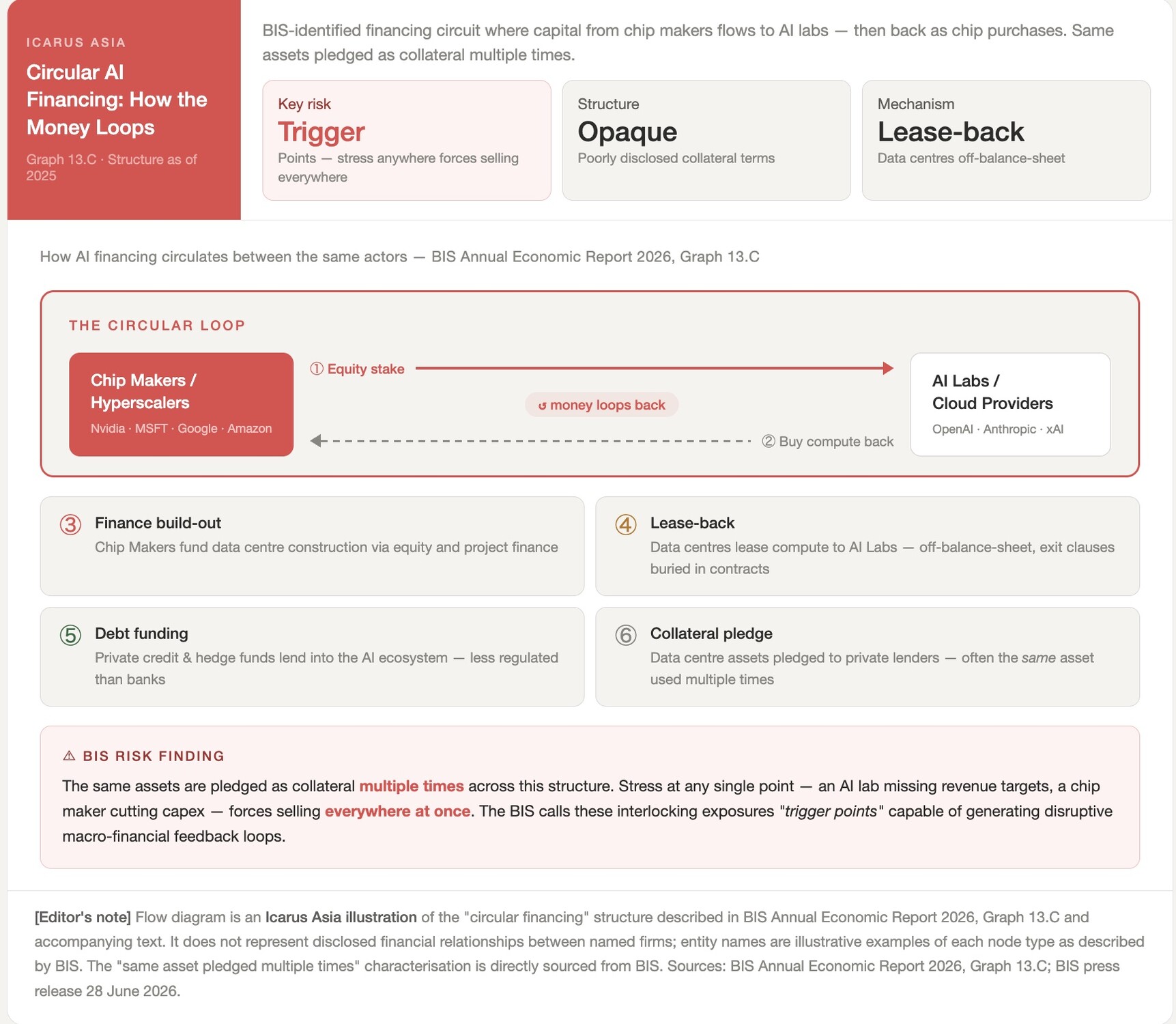
Semiconductor manufacturers and major technology firms -- the hyperscalers -- take equity stakes in AI labs or cloud providers. Those AI labs and cloud providers then use the capital raised to purchase chips or computing power from the same companies that just invested in them. Money loops. The same underlying assets are pledged as collateral in multiple transactions, often with poorly disclosed terms. The BIS warns that these create "trigger points" -- moments when a shock to one part of the chain forces selling across all of it.
The same underlying assets are pledged as collateral in multiple transactions, often with poorly disclosed terms.
Adding another layer of opacity, data-centre construction is increasingly outsourced to third parties under long-term "lease-back" contracts with embedded exit clauses. The result is that debt ownership and risk are dispersed across a web of relationships that no single regulator can see whole.
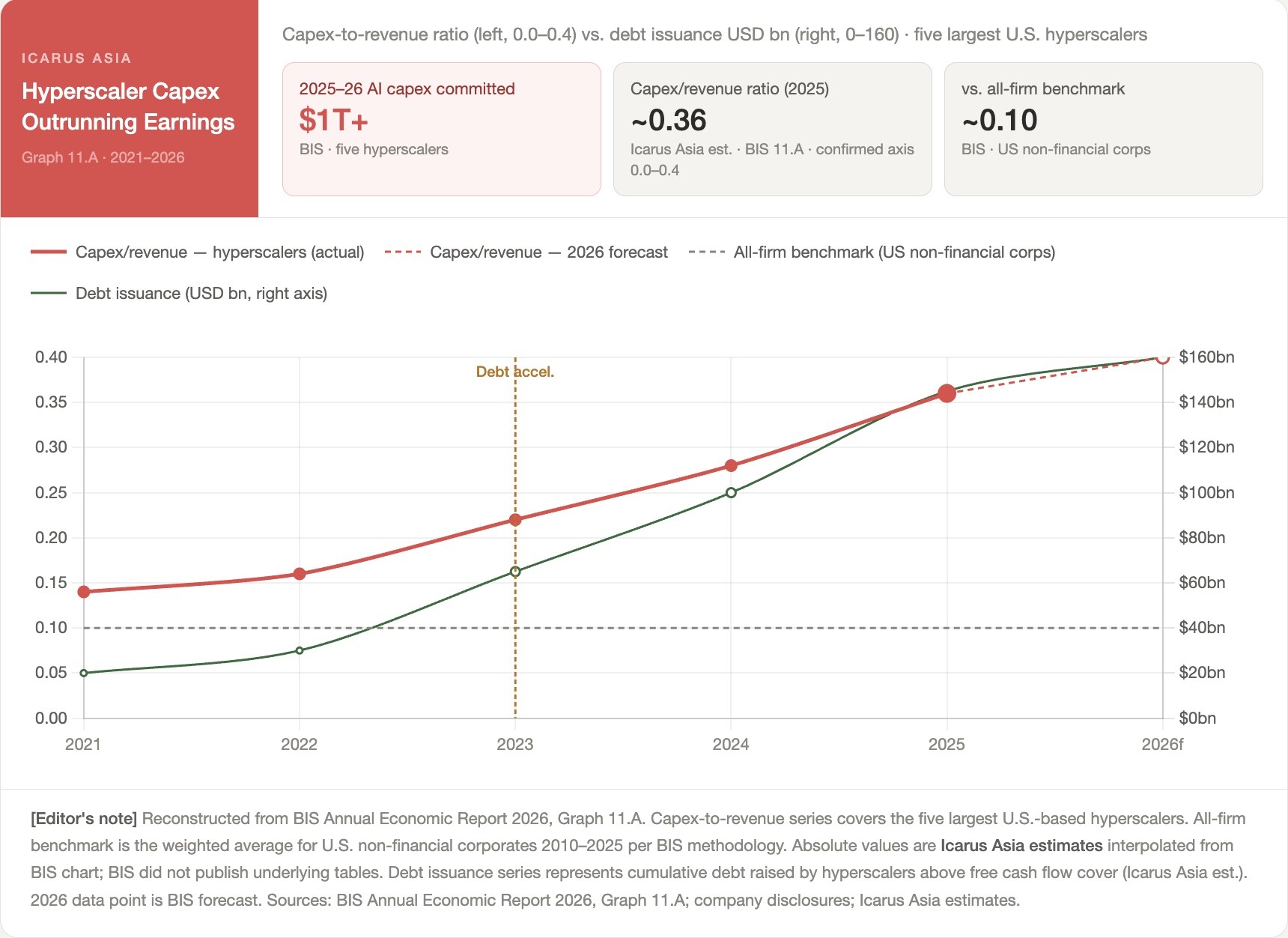
The five largest hyperscalers are projected to spend more than $1 trillion on AI-related capital expenditure between 2025 and 2026. That commitment, the BIS notes, is increasingly outrunning their earnings and free cash flow -- meaning it is being funded, directly or indirectly, by debt markets.
That is a fundamental shift from how AI investment was financed even three years ago, when retained earnings dominated. The BIS traced this evolution and was direct about its implications: financial vulnerabilities that did not exist at the start of the AI cycle are now present and growing.
Intense competition for market leadership may fuel overinvestment further, as seen in previous innovation waves, increasing the risk of a sharp reversal if AI payoffs disappoint.
When the Bust Doesn't Stay Contained
After the dot-com crash, the damage was bad but bounded.
Equity losses were severe; telecommunications companies collapsed; investors lost real money. But the financial plumbing -- banks, bond markets, household balance sheets -- mostly held. The BIS researchers argue that an AI correction would transmit through channels that didn't exist in 2000, or that existed in weaker form.
Households now hold significantly more of their wealth in equities relative to their income than in any previous technology boom.
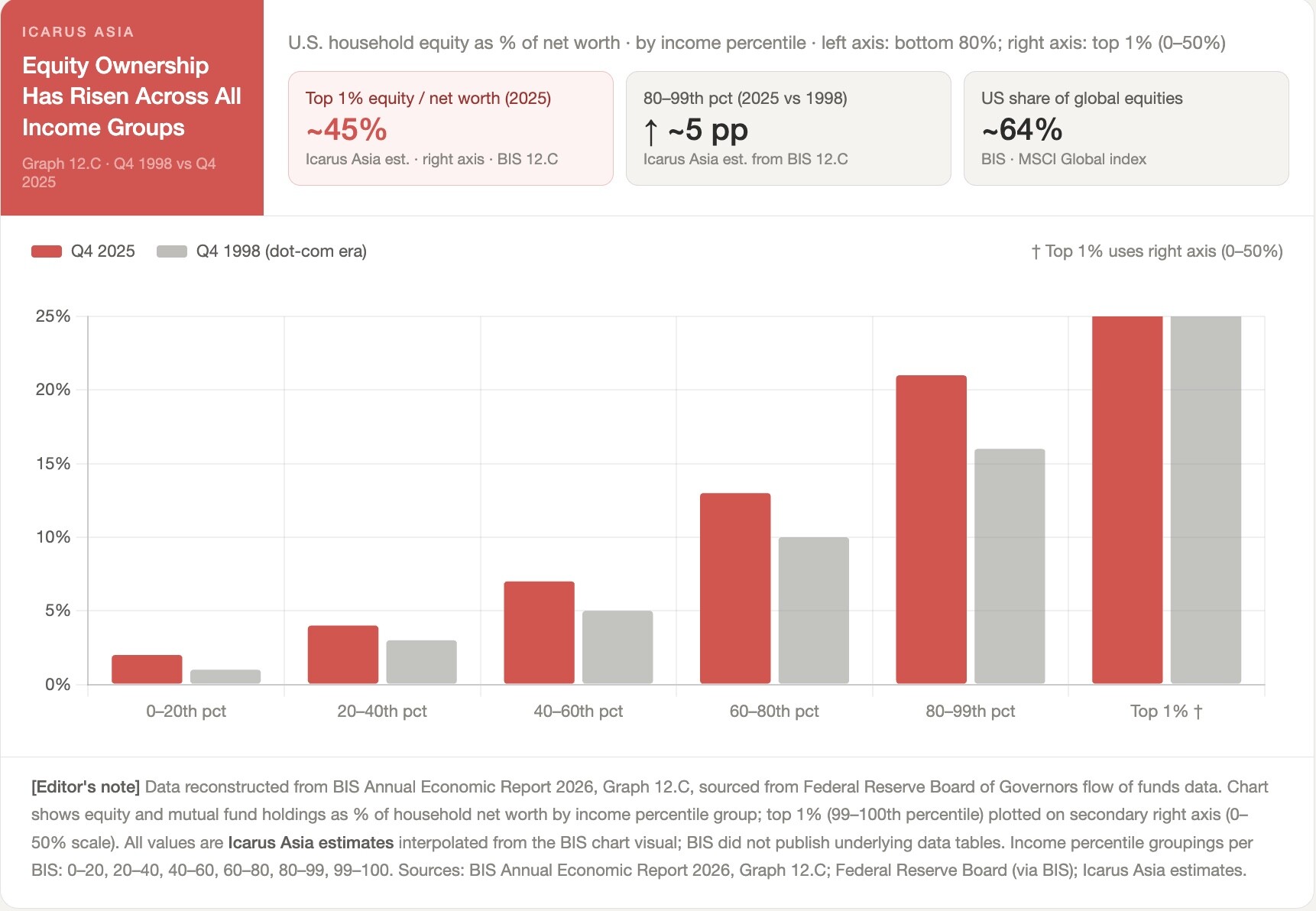
A sharp decline in AI-linked stocks would hit consumer spending harder than the dot-com bust did, through what economists call the wealth effect. Combined with high levels of debt across households, corporations and governments, the spending pullback could be sharper and more sustained.
Households now hold significantly more of their wealth in equities relative to their income than in any previous technology boom.
The financing of AI infrastructure is also tied, in ways that weren't true in 1999, to the same leveraged non-bank financial institutions -- hedge funds, private credit vehicles -- that the BIS separately identifies as fragility points in sovereign bond markets. If those institutions face margin calls or losses on AI-related positions, they may be forced to sell government bonds too. The two crises, one in AI equity and one in sovereign debt, could reinforce each other.
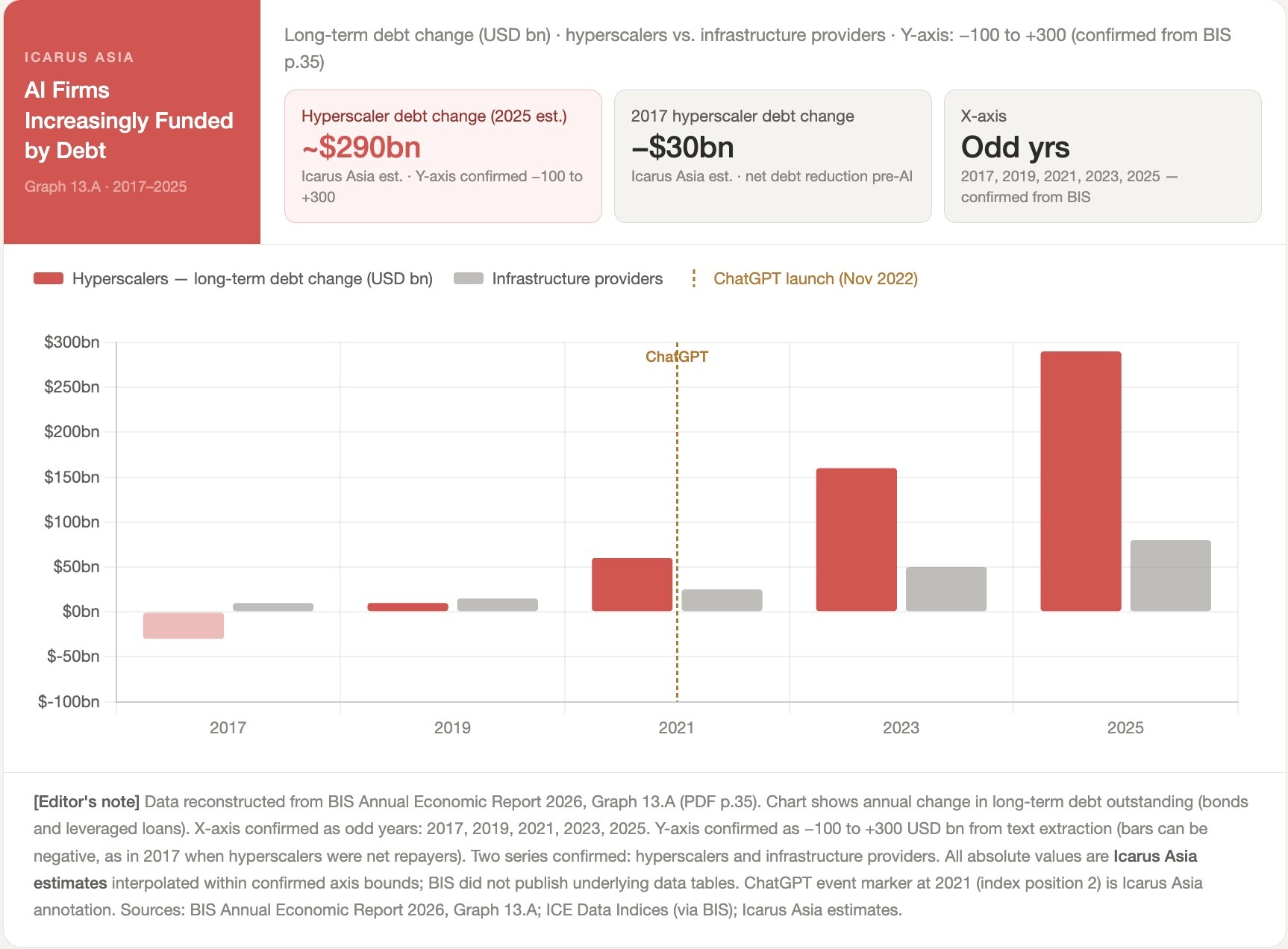
The BIS also pointed to a demand-side inflation dimension that previous tech booms didn't generate at this scale. AI's voracious appetite for electricity and semiconductors is contributing to what some analysts are calling "chipflation" -- upward pressure on input costs that complicates central banks' task of managing price stability even before any correction occurs.
A New Kind of Debt Crisis in Sovereign Markets
Running beneath the AI story is a structural problem in sovereign debt markets that the BIS describes as a "new fiscal-financial stability nexus."
The traditional worry was the bank-sovereign doom loop: banks loaded up on government bonds, governments guaranteed the banks, and if one wobbled the other followed. That risk hasn't gone away. But alongside it a newer and less understood dynamic has emerged.
Over the past decade, highly leveraged hedge funds have become major intermediaries in core government bond markets, particularly in advanced economies. They borrow short-term, often through repo markets, to finance leveraged positions in sovereign debt. In calm conditions, they provide liquidity and keep spreads tight. Under stress, they become forced sellers. The cascade that follows can seize up bond markets far faster than any traditional bank-run dynamic.
Over the past decade, highly leveraged hedge funds have become major intermediaries in core government bond markets, particularly in advanced economies.
"Government bond market liquidity may seem ample for extended periods but can vanish abruptly," said Frank Smets, Acting Head of the BIS Monetary and Economic Department. "Fiscal space can shrink well before public debt reaches limits suggested by long-run fundamentals."
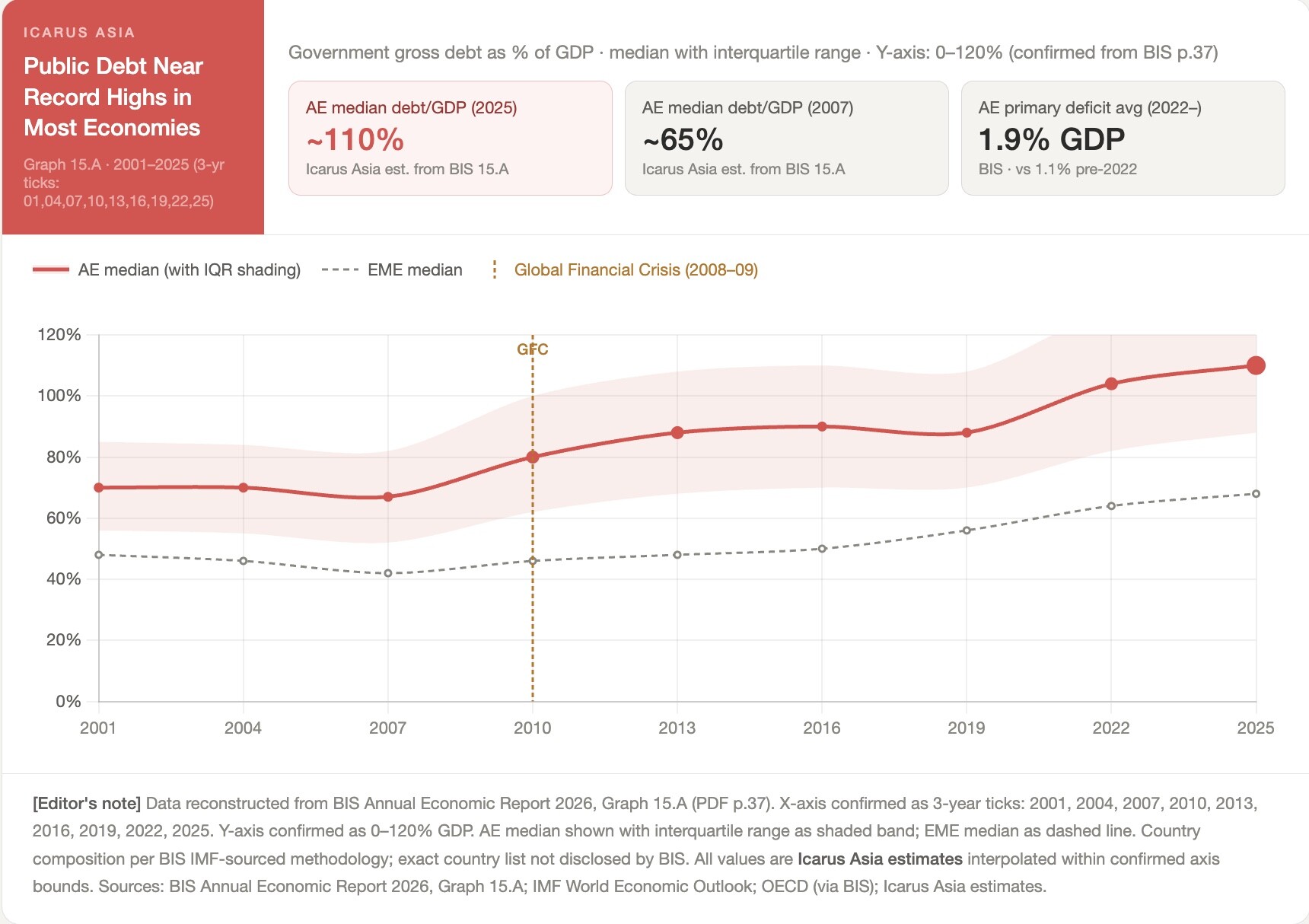
Governments already carrying near-record debt loads face rising demands from energy shocks, geopolitical spending and demographic pressures. Interest payments as a share of GDP have risen across many countries.
Central banks, the BIS warns, face a trap: when sovereign bond markets seize up, they face pressure to intervene by buying bonds. But repeated interventions risk encouraging the same leveraged funds that caused the problem to take on more risk next time — and in an inflationary environment, large-scale bond purchases conflict directly with keeping prices stable.
What the BIS Wants Done About It
The BIS's prescriptions are, by necessity, easier to state than to execute -- and the institution acknowledges it has been saying versions of them for years.
On inflation, central banks should hold rates firm enough to anchor expectations, especially given how quickly price pressures re-accelerated after the Hormuz shock. Any fiscal measures to cushion the energy shock should be temporary and targeted, not broad -- a lesson from the post-pandemic period, when generous government support contributed to the inflation surge central banks spent years fighting down.
On fiscal policy, governments need credible medium-term consolidation plans. The BIS is explicit that the composition matters as much as the pace: cuts and tax measures should expand the tax base and attract private investment, not simply shrink the state. Structural reforms that allow countries to capture AI productivity gains broadly -- rather than concentrating them among large firms in rich countries -- should accompany fiscal tightening, not follow it.
On financial stability, the BIS wants regulatory coverage extended to non-banks.
The hedge funds and private credit providers that now play central roles in government debt markets and AI financing operate with less transparency than the banks they have partly displaced. The BIS uses the phrase "congruent regulation" -- prudential standards that follow risk wherever it sits in the financial system, rather than leaving unregulated pockets through which danger migrates.
On AI itself, the BIS is not sounding an alarm that the technology is without merit.
Its own researchers found measurable productivity gains and smaller-than-feared job losses. The concern is narrower and more specific: the financing model built around AI is fragile, and the market structure -- concentrated in a handful of large technology companies across every layer of the AI stack -- is opaque enough that regulators cannot adequately stress-test it.
"Policymakers must prioritise price stability, strengthen financial stability, ensuring sound monetary and fiscal foundations and undertaking reforms to ensure sustainable growth," the report said.
The dot-com bust took 18 months from peak to trough. Not every innovation cycle ends in a crash, and AI may yet deliver the productivity gains that its backers promise. But the BIS is telling the world's central bankers, in the clearest terms it has used in years, that they should not wait to find out.
The resilience that carried the global economy through 2025 was real. Earning it again will take more than optimism.
The author is the Head of Research and Analysis at Icarus Asia, a Hong Kong-based risk and advisory firm.
Disclaimer
This article is a journalistic synthesis produced by Icarus Asia for informational and educational purposes only. It does not constitute investment advice, financial guidance, or a solicitation to buy or sell any security or financial instrument.
Readers should not rely on it as the basis for any investment decision.
The article draws exclusively on publicly available publications of the Bank for International Settlements (BIS). All direct quotations are reproduced verbatim from BIS official publications. The BIS permits limited reproduction of its material with full source attribution; this article is produced under that basis and does not claim any proprietary rights over BIS content.
Charts and data visualisations are produced by Icarus Asia and are clearly labelled where values have been estimated or interpolated from BIS chart visuals. The BIS did not publish the underlying data tables for the graphs cited; all figures derived from visual inspection of BIS charts are Icarus Asia estimates and should be treated as approximate. Axis bounds and scale information confirmed from BIS source text are noted accordingly in each chart's editor's note.
References to named companies -- including Nvidia, Microsoft, Google, Amazon, OpenAI, Anthropic, and xAI -- are illustrative examples of the entity types described by the BIS and do not imply any specific finding, allegation, or characterisation about those firms individually.
Sources
Bank for International Settlements. BIS Annual Economic Report 2026. Basel: BIS, 28 June 2026.
Bank for International Settlements. "Global economic pressure points call for policy discipline." Press release. Basel: BIS, 28 June 2026.
Bank for International Settlements. BIS Annual Report 2025/26. Basel: BIS, 2026.
Board of Governors of the Federal Reserve System. Distributional Financial Accounts (flow of funds data). Washington DC: Federal Reserve, 2026.
International Monetary Fund. World Economic Outlook. Washington DC: IMF, 2026.
Organisation for Economic Co-operation and Development. Fiscal data. Paris: OECD, 2026.
ICE Data Indices. Bond and leveraged loan issuance data.
Burgert, Mathieu, et al. Supply shock methodology and breadth/intensity framework, 2025.
Rees, Daniel. Supply shock intensity analysis, 2026.
Consensus Economics. Inflation and growth consensus forecasts.
Cranmer, H.J. "Canal investment, 1815–1860." Cited in BIS Annual Economic Report 2026, Graph 11.C. Full citation available in BIS reference list.
Note: Burgert et al (2025), Rees (2026), and Cranmer (1960) are cited as they appear in the BIS Annual Economic Report 2026. Icarus Asia has not independently accessed these working papers; readers requiring full citations should consult the BIS report's reference list directly.