
News · Policy · China
China Is Winning the Trade War. But It Comes With Consequences.
Beijing made a quiet decision to stop fighting its own currency. The bill is coming due for the exporters who weren't paying attention.
Every morning, in a glass-walled office above a factory floor that never fully quiets, Chen Liang* refreshes the same screen before his coffee goes cold.
He is the chief financial officer of a mid-sized electronics exporter in Shenzhen, and the screen shows him one number -- the People's Bank of China's daily fixing rate for the yuan against the dollar. It used to take him two seconds. A quick glance, a shrug, on to the real work. "We think of the yuan the same way you think of the weather," he said in comments translated from Mandarin. "Sometimes it rains. You get wet. You move on."
He doesn't shrug anymore.
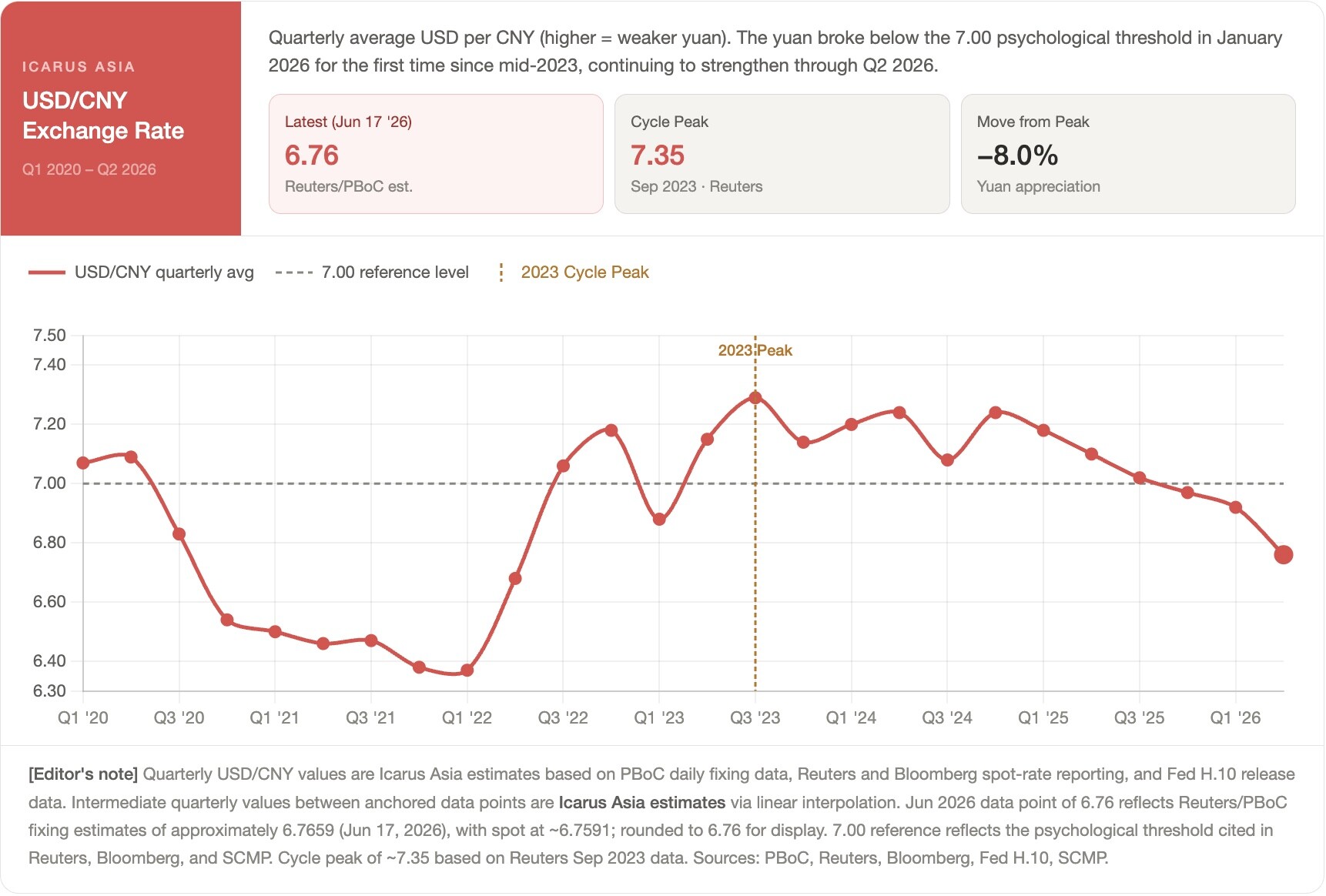
In January, the yuan pierced 7 per dollar for the first time since 2023 -- and kept going. The PBoC set the rate there itself, lifting its daily midpoint through the threshold without drama or explanation. That was the moment Chen knew something structural had changed. He called his bank that afternoon to discuss hedging.
He was not alone.
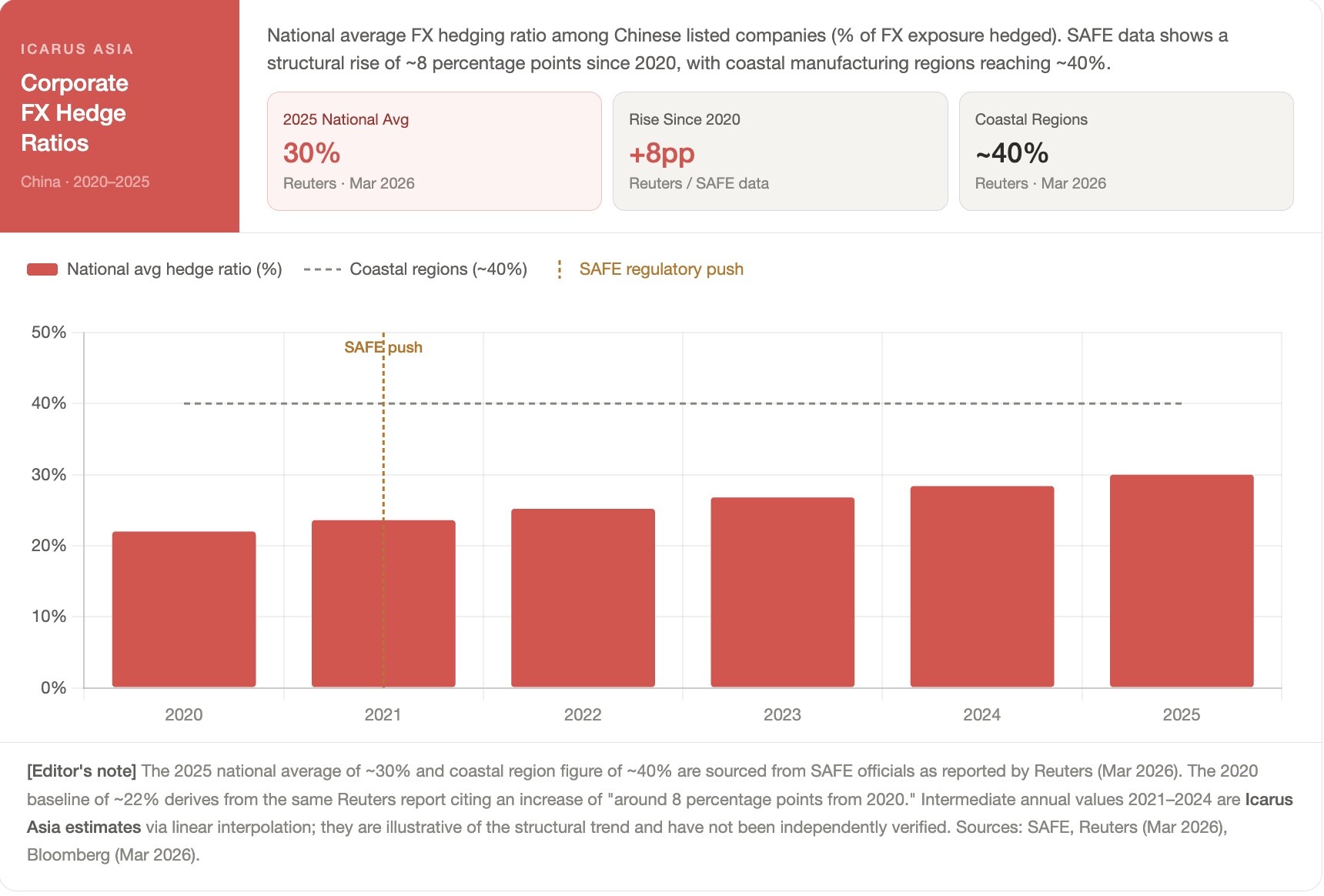
A record 1,409 listed Chinese companies disclosed foreign-exchange hedging measures in 2025, up 13.5 percent from the year before, according to Reuters. In 2026, roughly 300 companies had already unveiled forex hedging plans by March, the news agency added. Behind that number lies the same scramble Chen went through. The slow, uncomfortable recognition that a currency you spent years ignoring now demands your attention before breakfast.
Three things are driving the yuan's rise, and none of them are retreating.
The first is the surplus. Despite a gauntlet of American tariffs, China's trade surplus surged to a record $1.2 trillion last year, roughly 20 percent higher than the year before. Conventional wisdom in Washington held that the pressure would finally stifle the "Made in China" machine. Instead, exporters pivoted. They swapped the American market for the rising economies of Southeast Asia and the established ports of Europe, doubled down on the high-margin goods the rest of the world is clamoring for: electric vehicles, batteries, solar panels. The surplus surged.
Conventional wisdom in Washington held that the pressure would finally stifle the "Made in China" machine. Instead, exporters pivoted.
That matters for the currency in a simple, mechanical way. Exporters earn dollars. They need to pay workers and suppliers in yuan. When they convert, they bid up the renminbi. Unless Beijing absorbs those dollars through its own reserve purchases, or companies park them offshore, a surplus that size pushes the currency higher. Relentlessly.
Second, the dollar has retreated. As the Federal Reserve moves toward less restrictive policy, the broad tailwind that pushed USD/CNY above 7.3 has died. Multiple global investment banks now forecast the pair below 7.0 on a sustained basis over the next 12 to 18 months, with some placing it in the mid-to-high 6s. That removes a major hurdle the yuan faced in prior years. It no longer has to fight a rising dollar just to hold its ground.
The third driver is Beijing itself. This is the one that surprised people.
The PBoC keeps its hand firmly on the tiller. It sets a daily fixing rate and enforces a 2 percent trading band onshore, and it has never pretended otherwise. But the direction of that hand has changed. In past cycles, when the yuan strengthened toward uncomfortable levels, the bank pushed back hard. The 2015 fixing reform still haunts traders who lived through it. It was a botched attempt to link the rate more closely to market signals that triggered capital flight and sent volatility spiking into double-digit annualized ranges.
It took years to clean up. More damagingly, the devaluation eroded trust in the yuan both at home and abroad -- undermining its potential as a global reserve currency.
This time, the bank is lifting the midpoint. Steadily and deliberately. It set the fixing below 7.0 in January for the first time since 2023. It has kept lifting since.
The CFETS basket — Beijing's own trade-weighted index that measures the yuan against a broad set of partner currencies, not just the dollar -- has stayed roughly flat through all of it. That is the tell. It means Beijing is comfortable with yuan strength against the dollar specifically, as long as China's overall export competitiveness against its full range of trading partners holds.
It means Beijing is comfortable with yuan strength against the dollar specifically, as long as China's overall export competitiveness against its full range of trading partners holds.
Why?
A stronger yuan cuts import costs. It steadies inflation. It makes Chinese assets more attractive to foreign capital. And, for Beijing's longer-term play, it lends credibility to the renminbi as a global settlement currency. China has spent years building out yuan use through the Belt and Road Initiative and bilateral swap lines with dozens of central banks. A depreciating currency quietly undermines all of it. Controlled appreciation is the point.
Back in Shenzhen, Chen Liang is not thinking about geopolitics. He is thinking about the company's margins.
This comes as a double-whammy of sorts for exporters like Chen who were already feeling the pinch from tariffs in the U.S. and higher transportation costs owing to the higher logistics costs from the conflict in Iran.
This comes as a double-whammy of sorts for exporters like Chen who were already feeling the pinch from tariffs in the U.S. and higher transportation costs owing to the higher logistics costs from the conflict in Iran.
His company sells electronics components priced in dollars. His factory costs run in yuan. Every time the yuan strengthens by a percentage point, the gap narrows. "My customers don't give me more dollars just because the exchange rate moved," he said. "So I have to find the money somewhere else."
He found it in forwards. He now hedges a third of his annual dollar receivables at the start of each quarter, locking in conversion rates before they can move against him. His bank has noticed. Its FX desk handled more forward contracts in the first quarter of 2026 than in all of 2023.
China's State Administration of Foreign Exchange has pushed companies toward exactly this. National average hedging ratios have climbed to roughly 30 percent, up about 8 percentage points since 2020, with some coastal manufacturing regions reaching 40 percent. For a country where many firms spent a decade treating currency risk as a rounding error, that is a genuine shift in behavior.
Beijing is also juggling a paradox.
A stronger yuan eases import bills, but it throttles the exporters who built the economy. It is a tightrope walk. The PBoC has kept its tools close: in February, SAFE scrapped a reserve requirement that raised the cost of buying dollars, giving companies a cheaper route to accumulate foreign currency if needed. In June, Chinese banks began raising dollar deposit rates -- a subtle brake on the pace of conversion. The tiller stays manned.
A stronger yuan eases import bills, but it throttles the exporters who built the economy. It is a tightrope walk.
The risks are real. A geopolitical shock over Taiwan, a new round of tariff escalation, a Fed pivot back toward tightening -- any of these could send USD/CNY surging back above 7.2 in weeks. The 2015 episode proved how fast things can unravel when currency policy and market sentiment part ways.
For now, the surplus holds. The dollar retreats. And Beijing has concluded that a stronger currency costs less than a weaker one.
Chen Liang hits refresh. The fixing is lower again -- the yuan a little stronger, his margins a little thinner. He lets out a breath that isn't quite a sigh, picks up the phone, and calls his bank.
*Name changed to protect the identity of the executive who is based in China.
The author is the Head of Research and Analysis at Icarus Asia, a Hong Kong-based risk and advisory business. He is a former journalist who covered China, and foreign-exchange markets in Asia.
Disclaimer: This article and the accompanying research is not intended to serve as investment advice. Please do your own research and consult with a registered financial advisor.
Access our research "Beijing Stopped Fighting the Yuan. Now It's Winning."
Sources
Reuters. "China's Trade Ends 2025 With Record Trillion-Dollar Surplus Despite Trump Tariffs." January 14, 2026.
Reuters Breakingviews. "China's Trade Surplus Misleads Its Western Critics." February 11, 2026.
CNBC. "China Trade Data: Surplus, Exports, Imports, December — Tariff Tensions." January 14, 2026.
Reuters. "Global Investment Houses Eye Chinese Yuan Rise Past Key 7 Mark in 2026." November 11, 2025.
Reuters. "China's Yuan Hits 32-Month High as PBoC Carefully Lifts Midpoint." January 26, 2026.
Bloomberg. "China Sets Yuan Fixing Stronger Than 7 for First Time Since 2023." January 23, 2026.
Reuters. "China Lifts Yuan Guidance to 34-Month High, Firmer Than Market Projections." March 5, 2026.
Reuters. "Chinese Companies Race to Hedge Against Swinging Yuan With Regulatory Encouragement." March 11, 2026.
Bloomberg. "China Firms Ramp Up Derivatives Hedging to Record as Yuan Surges." March 17, 2026.
Reuters. "What Can China Do to Slow Down Its Rising Currency?" February 27, 2026.
Reuters. "China Scraps FX Risk Reserve Ratio to Lower Cost of Dollar Buying." February 27, 2026.
Reuters. "Goldman Sachs Delays Fed Cut Outlook to December 2026." May 11, 2026.
Reuters. "Nomura Forecasts No Fed Rate Cuts in 2026 as Inflation Rises." May 22, 2026.
Reuters. "China Banks Raise Dollar Deposit Rates Amid Yuan Strength." June 5, 2026.
CNBC. "Central Banks Offload US Treasuries; China Holdings at 18-Year Low." May 19, 2026.
Reuters. "China's Regulators Struggle to Sway Companies on Currency Risk." June 22, 2021.
Reuters. "Exclusive: China's FX Regulator Surveyed Banks, Companies on Yuan Risk." August 30, 2021.
Federal Reserve Bank of St. Louis (FRED). USD/CNY Daily Exchange Rate Series (DEXCHUS).
International Monetary Fund. "China's Exchange Rate Management." IMF Connect, June 2019.
International Monetary Fund. "RMB Exchange Rate Regime Analysis." IMF E-Library, 2019.
International Monetary Fund. "RMB Exchange Rate History." IMF E-Library (book chapter).
Federal Reserve Bank of New York. Staff Report No. 828: China's Managed Float Analysis.
Norregaard, John, et al. "RMB Volatility Regime Study." PMC / National Institutes of Health, 2023.
Edith Cowan University Research Online. "CNH/CNY Volatility and Basis Risk."
ScienceDirect. "RMB Volatility Regime Switching." China Economic Review, 2018.
Georgetown Journal of International Affairs. "De-Dollarization, the Belt and Road Initiative, and the Future of the Chinese Yuan."
Fine, Eric, and Natalia Gurushina. "The Curiously Unpopular Case for RMB/CNY Appreciation." VanEck Emerging Markets Bonds Blog, August 12, 2025.