
News · Policy · Japan, China, India
How China got Trump Talking
China doesn't just mine rare earths. It makes nearly all the world's rare-earth magnets, and in 2025 it used that chokehold to force its way into trade talks with Washington. U.S. President Donald Trump can't afford to ignore the leverage days weeks away from the end of the one-year deal.
In April, the assembly line that builds the Suzuki Swift went quiet. The subcompact car has nothing to do with geopolitics. It is a commuter hatchback sold mainly in Japan and India. But small electric motors in the car depend on permanent magnets made from rare-earth metals, and when Beijing tightened export licensing on those magnets that month, Suzuki couldn't get enough of them. The company halted Swift production and didn't restart it until June.
Suzuki wasn't alone.
Automakers, aerospace suppliers and semiconductor makers in multiple countries spent the following weeks scrambling for a substance most of their executives could not have named a year earlier. The shortage traced back to a single country's hold on a handful of unglamorous industrial elements, and it was no accident. Over five months in 2025, China used that hold to force its way into the center of its trade standoff with Washington. The result was a one-year truce both governments called historic. Eleven months on, it looks a lot more like a pause.
China's power over rare earths was never simply a matter of geology.
The country produced about 60 percent of the world's mined magnet rare earths in 2024, a substantial but not overwhelming share. Its real advantage sat further down the supply chain.
It refined roughly 91 percent of those materials and made about 94 percent of the sintered permanent magnets that turn rare-earth oxides into usable industrial components, according to the International Energy Agency (IEA). A mining company in Australia or Canada that digs ore from the ground still has to send much of it to China, or to a Chinese-trained supply chain, to become a magnet a carmaker can install.
That chasm between digging up rock and shipping a finished part explains why the current standoff looks different from the last one.
The first shock came in 2010, when Beijing cut its global rare-earth export quota by more than a third and its production quota for concentrates by roughly a quarter, a tightening that landed amid a separate diplomatic rupture with Japan over the Senkaku/Diaoyu Islands. Chinese officials denied singling out Japan for a shipment freeze, and a later academic review of trade data found little evidence they had.
Prices rose anyway.
Neodymium oxide, the material at the heart of the magnets used in electric motors and wind turbines, climbed from roughly $25 a kilogram in early 2010 to a peak near $340 a kilogram by mid-2011, according to a history of Chinese rare-earth policy published by the Colorado School of Mines researchers Yuzhou Shen, Ruthann Moomy and Roderick Eggert.
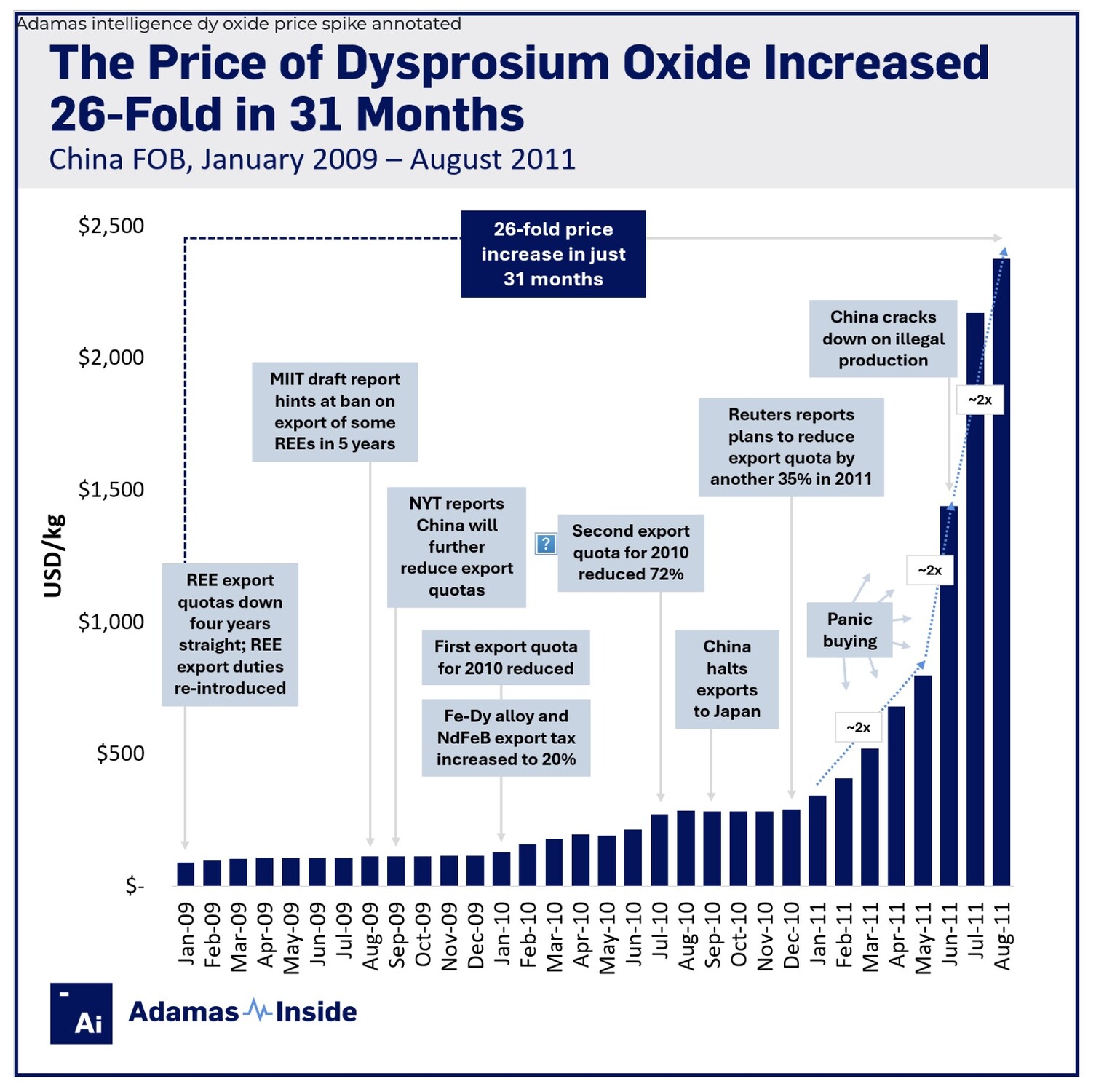
Dysprosium oxide, a rarer heavy rare earth, moved even further, from about $91 a kilogram in early 2009 to more than $2,300 a kilogram by August 2011, a nearly 26-fold rise in under three years, according to industry price data compiled at the time.
The United States, the European Union and Japan took China to the World Trade Organization over the export quotas, and in 2014 a panel found that Beijing had violated trade rules and could not justify the restrictions as conservation measures. China removed the export duties and quotas by 2015.
What the ruling couldn't affect was everything China had built underneath the quotas.
String of Pearls
The refineries, the separation plants, the alloy makers and, above all, the magnet factories that had grown up around cheap, abundant ore and a government willing to subsidize scale. Losing a legal fight over export duties didn't cost Beijing its processing monopoly.
If anything, the decade after the WTO case saw that monopoly deepen.
Chinese producers consolidated and moved up the value chain while rivals abroad, lacking the same government backing, shed capacity or shut down outright. By 2025, that monopoly was ready to be used again, and with more precision than in 2010.
In April, China imposed licensing controls on seven heavy rare-earth elements and related magnet products. It wasn't a blanket embargo though. Exporters simply needed government approval for each shipment. Volumes fell sharply that month and the next. It was enough to idle the Swift line in Japan and force manufacturers elsewhere to ration inventory or slow production, even though outright denials of licenses stayed rare.
The uncertainty itself was the pressure point. A customer who can't predict whether a shipment will clear in two weeks or two months has to treat every order as if it might not arrive at all.
A customer who can't predict whether a shipment will clear in two weeks or two months has to treat every order as if it might not arrive at all.
Then, in October, as trade tensions with Washington flared again and a meeting between President Trump and China's leader, Xi Jinping, approached, Beijing widened the net.
New controls announced on Oct. 9 covered five additional elements, along with related equipment and technology, and reached further than any prior measure. They asserted jurisdiction over foreign-made components manufactured anywhere in the world, if those components contained Chinese-origin rare earths or were produced using Chinese technology.
Flipping the Playbook
Researchers at the Center for Strategic and International Studies, among others, described the mechanism as a version of the "foreign direct product rule" the United States itself uses to control the global reach of American chip technology.
Beijing had borrowed a tool from Washington's own playbook and turned it back on Western supply chains.
Beijing had borrowed a tool from Washington's own playbook and turned it back on Western supply chains.
Nine days after the announcement, Trump and Xi sat down in South Korea, and rare earths dominated the agenda. On Oct. 30, the two leaders announced a framework.
China would suspend the expanded October controls globally for one year and commit to issuing general licenses, a lighter-touch approval process meant to speed up routine shipments, for rare earths, gallium, germanium, antimony and graphite bound for American end users and their suppliers. In exchange, Washington agreed to cut a fentanyl-related tariff by 10 percentage points, extend a pause on higher reciprocal tariffs through November 2026, and suspend for a year its own expansive rule extending Entity List restrictions to affiliates of blacklisted Chinese companies.
"All of the rare earth has been settled," Trump told reporters afterward.
The White House's own written account went further, describing the general-license commitment as amounting to "the de facto removal" of the export controls China had imposed since 2023.
Both claims outran the text of the agreement.
A Bird in Hand
What Beijing had actually promised was a one-year suspension of one set of controls and a streamlined licensing process. Not the dismantling of the licensing system itself, which remains in place and which China could reimpose or tighten once the year is up.
What Beijing had actually promised was a one-year suspension of one set of controls and a streamlined licensing process. Not the dismantling of the licensing system itself.
Researchers who track the sector closely think both sides got something real out of the deal, but neither got what they wanted most.
"China certainly retains leverage now, but that leverage will only go down," said Gracelin Baskaran, PhD, who heads the critical minerals security program at the Center for Strategic and International Studies (CSIS), in an assessment of the year since the April controls.
Washington has moved to fill the gap that scared it in the first place, committing roughly $7.3 billion across five federal agencies. A $400 million equity stake in MP Materials paired with a price floor for the company's output, financing for a Vulcan Elements magnet plant, and loan commitments reaching from a Brazilian rare-earth mine to an Australian and Saudi processing venture. Malaysia has become the first producer outside China to separate heavy rare earths at commercial scale. Lynas Rare Earths, an Australian company, began commercial dysprosium oxide production in May 2025, a milestone none of China's rivals had reached first.
But Baskaran and other analysts are careful not to overstate how far that diversification has come.
American rare-earth production in 2025 covered only about a third of the country's own consumption. The rest still had to be imported, and roughly seven in ten of those imports still came from China. Replicating what China built, mines, separation plants, alloy makers and magnet factories all operating together, feeding one another, takes years if not a single trade summit.

"A mine without a processing facility is a stranded asset," Baskaran said. "A processing facility without a manufacturer to buy that is a stranded asset." Every link has to be built at roughly the same time, which is why she describes the American effort as "flying the plane as we build it."
A mine without a processing facility is a stranded asset - Dr. Gracelin Baskaran, CSIS
China demonstrated, twice in one year, that it could disrupt a global industry without cutting off exports entirely. It simply made the terms of access unpredictable.
The United States bought itself a year of calmer supply and a head start on alternatives it should arguably have built a decade earlier, after the last price shock made the risk just as obvious. Neither outcome resolves the deeper asymmetry the research keeps pointing back to.
China's edge was never really about the rocks in the ground.
It was about everything China built on top of them, one processing plant and one magnet factory at a time, while the rest of the world watched the price of dysprosium and assumed the problem would pass.
The author is an Executive Director and Head of Research and Analysis at Icarus Asia, an independent financial research and market analysis firm that specializes in macroeconomic insights, structural fixed-income analysis, and liquidity trends across Asian and global capital markets.
DISCLAIMER: Not investment advice. Please do your own research and consult with a registered financial advisor.
Sources
Baskaran, Gracelin, and Meredith Schwartz. "Rare Earth Export Restrictions One Year Later." Center for Strategic and International Studies, 2026.
China Briefing. "Trump-Xi Meeting: US and China Agree to Tariff, Rare Earth Concessions." China Briefing, October 2025.
Deccan Herald. "Suzuki Motor Halted Swift Car Production Due to China's Rare Earth Curbs, Sources Say." Deccan Herald, 2025.
Evenett, Simon, and Johannes Fritz. "Revisiting the China–Japan Rare Earths Dispute of 2010." CEPR VoxEU, 19 July 2023.
International Energy Agency. Rare Earth Elements. IEA, 2026.
Mining.com "China's Rare Earth Clampdown Backfired: CSIS Analyst." Mining.com, 2026.
Mining.com. "Charts: Rare Earth Export Restrictions, Price Spikes and the Risks of Demand Destruction." Mining.com, 2026.
Shen, Yuzhou, Ruthann Moomy, and Roderick G. Eggert. "China's Public Policies Toward Rare Earths, 1975–2018." Mineral Economics, vol. 33, 2020.
U.S. Trade Representative. "United States Wins Victory in Rare Earths Dispute with China." Office of the United States Trade Representative, March 2014.
White House. "Fact Sheet: President Donald J. Trump Strikes Deal on Economic and Trade Relations with China." The White House, November 2025.
World Trade Organization. "DS431: China — Measures Related to the Exportation of Rare Earths, Tungsten and Molybdenum." WTO Dispute Settlement, 2014.