
News · Banks · China
How Rich Are China's Banks Abroad?
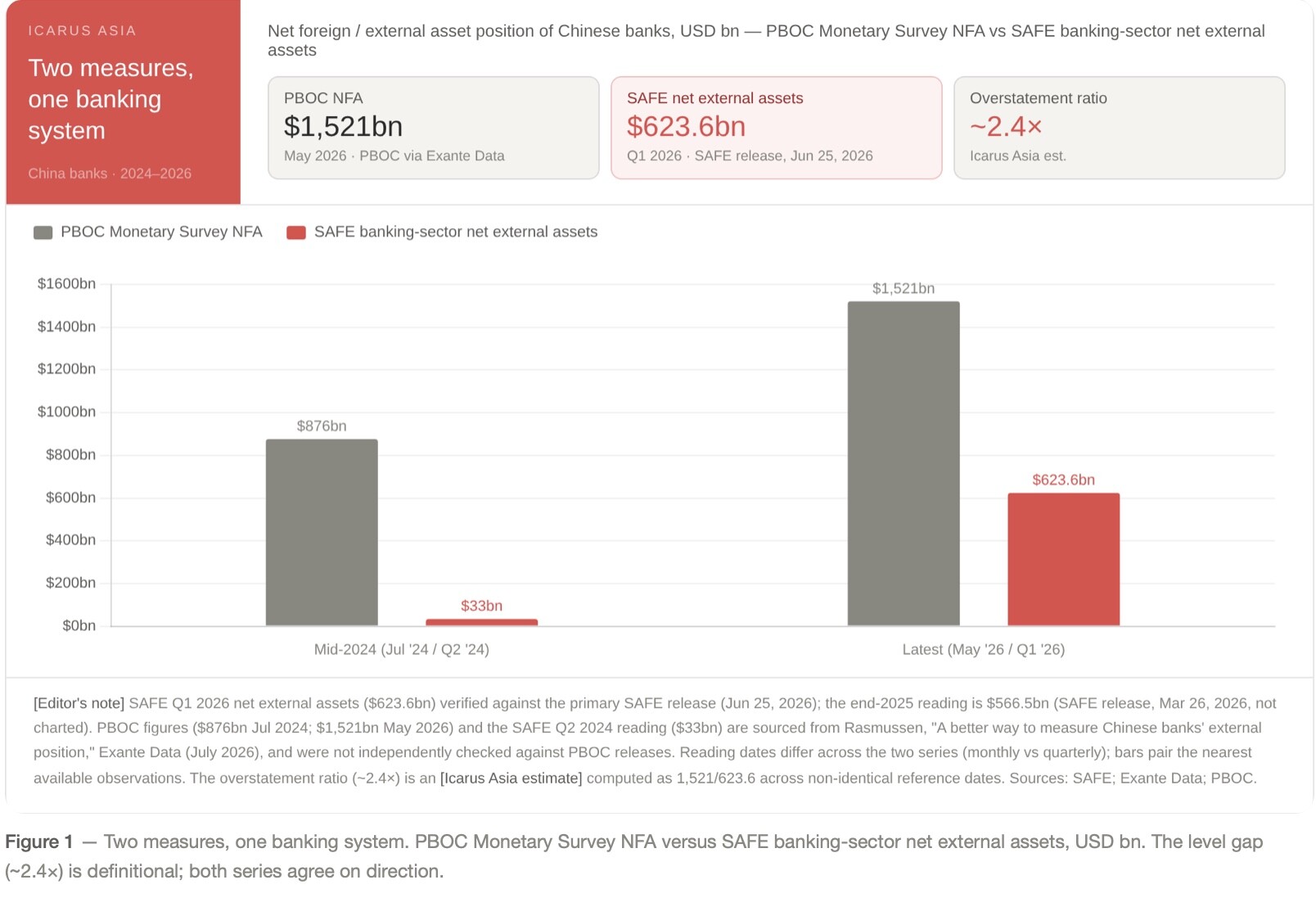
China's banks hold either $1.5 trillion or $624 billion in net foreign assets, depending on which branch of the Chinese government is doing the counting. The difference is not a rounding error.
Two arms of the Chinese government publish two very different answers, and the gap between them has become a $900 billion question for anyone trying to gauge the system's resilience.
China's banks hold either $1.5 trillion or $624 billion in net foreign assets, depending on which branch of the Chinese government is doing the counting. The difference is not a rounding error.
The larger figure comes from the People's Bank of China, the central bank, whose monthly monetary survey is the number most analysts reach for first. The smaller one comes from the State Administration of Foreign Exchange, known as SAFE, which reported net external assets of $623.6 billion for the banking sector at the end of March. A new analysis argues the smaller number is the right one, and that the habit of quoting the larger one has left investors and policymakers with an inflated sense of how well cushioned Chinese banks are against shocks from abroad.
The gap matters because China's banking system, the world's largest, sits at the center of debates about dollar funding, financial sanctions and the fallout from a trade war. A cushion of $1.5 trillion suggests a system that could shrug off almost any external squeeze. A cushion of $624 billion, set against $1.49 trillion of foreign debts that must be refinanced on schedule and in the right currency, suggests something sturdier than fragile but far from untouchable.
The gap matters because China's banking system, the world's largest, sits at the center of debates about dollar funding, financial sanctions and the fallout from a trade war.
The case for the smaller number comes from Martin Rasmussen, an analyst at Exante Data, a research firm that advises institutional investors, in a note published this month in the firm's newsletter, Money: Inside and Out. Rasmussen traced the discrepancy to a quirk of definitions. The central bank's survey counts banks' foreign assets expansively but defines their foreign liabilities so narrowly that the line item behaves, in practice, like a tally of one thing: offshore deposits denominated in China's own currency, the renminbi.
Deposits that foreign banks place with Chinese lenders appear to be left out. So do deposits that foreigners hold inside China, which international accounting standards treat as external debt. Add those obligations back, as SAFE's quarterly data does, and the banks' foreign liabilities roughly triple, to $1.49 trillion. The net cushion shrinks by more than half.
Too Big to Ignore
The distinction was easy to ignore when both measures were small. It stopped being ignorable in late 2024, when Chinese banks began accumulating foreign assets at a pace with few precedents. By SAFE's count, the sector's net external assets rose from $33 billion in mid-2024 to $566.5 billion at the end of last year, according to the agency's data, and to $623.6 billion by March. The central bank's survey showed the same climb, but starting from, and arriving at, a much higher level: roughly $1.52 trillion as of May, up from $876 billion in July 2024, according to Exante Data's figures.
Even the International Monetary Fund has leaned on the central bank's series in its assessments of China's external position, which means the overstatement is embedded in some of the most widely read official analysis of the country's finances.
What the banks owe the rest of the world is less exotic than the headline numbers suggest.
SAFE's breakdown shows 46 percent of the liabilities were deposits and loans at the end of 2025, and 19 percent were bonds. Slightly more than half were denominated in renminbi rather than dollars, which limits the classic emerging-market problem of borrowing in a currency you cannot print. Dollar obligations came to $264.7 billion, about 19 percent of the total. Nearly two-thirds of the money is owed to foreign companies, asset managers and other non-banks rather than to overseas banks.
The asset side is where the geopolitics enters.
Why it Matters
China's swollen trade surplus generates foreign currency that someone must hold, and its state-owned banks have absorbed much of it, largely in dollar assets. That recycling, along with renminbi trade credit extended to finance exports, explains most of the accumulation, Rasmussen found.
It is a policy machine rather than a profit strategy.
It also means the banks' dollar holdings would sit squarely in the blast radius of any American financial sanctions, a vulnerability that grows even as more of China's trade is invoiced in its own currency.
It also means the banks' dollar holdings would sit squarely in the blast radius of any American financial sanctions, a vulnerability that grows even as more of China's trade is invoiced in its own currency.
A companion report from Icarus Asia Research, which verified the SAFE figures against the agency's primary releases, argues that analysts should treat the net position as context rather than comfort. "The net figure is context; the gross liabilities are the risk object," the report says. Its stress scenarios, which the firm labels as hypothetical, center on the same pressure points: a trade shock that stalls the surplus, a dollar-funding squeeze, or domestic loan losses that make foreign depositors nervous.
China's economy-wide debt picture remains comfortable by the usual yardsticks.
Total foreign debt stood at $2.33 trillion at the end of 2025, SAFE reported in March, with short-term borrowings equal to 39.2 percent of the country's foreign exchange reserves, well below the 100 percent threshold that international guidelines treat as a warning line. The agency concluded that the country's "external debt risk is controllable."
Rasmussen frames his reconciliation of the competing data sets as carefully developed hypotheses rather than settled fact; the treatment of interbank positions and residents' offshore deposits remains murky even to specialists.
The data itself moves, too.
A figure for the banking sector's end-2025 position circulating in secondary summaries was about $127 billion below what SAFE's current release shows, a reminder that in Chinese financial statistics, the vintage of a number can matter almost as much as the number itself.
The practical advice for anyone watching the system: use SAFE's quarterly data for the level of debt, use the central bank's monthly survey only for direction, and be suspicious of any analysis that quotes a $1.5 trillion cushion without saying what got left out of it.
The author is the Head of Research and Analysis at Icarus Asia, a risk and advisory business based out of Hong Kong.
DISCLAIMER
This analysis draws heavily but not entirely from Martin Rasmussen's note for Exante Data's newsletter, Money: Inside and Out. Readers are encouraged to exercise caution and their own judement in drawing inferences.
This is strictly not investment advice. Please do your own research and consult with a registered financial advisor.
SOURCES
SAFE banking-sector data, end-2025 — Mar 26, 2026 release: end-2025 levels, net FX assets, liability breakdowns
SAFE banking-sector data, Q1 2026 — Jun 25, 2026 release: the $623.6bn net position and Q1 gross levels
SAFE external debt data, end-2025 — Mar 27, 2026 release: $2.33trn total, 39.2% short-term-to-reserves, the "controllable" quote
SAFE data hub for the series — Full quarterly history
Rasmussen, "A better way to measure Chinese banks' external position," Money: Inside and Out (Exante Data), Jul 2, 2026
Icarus Asia Research, "Half as Safe as It Looks," July 2026