
News · Macro · Japan, US
A Quiet Meeting in Tokyo Could Rattle Markets
When the Bank of Japan's policy board sits down next Monday, it will be deciding whether to raise its benchmark rate by a quarter point, to 1.00%. That sounds modest. Its impact isn't.
The Bank of Japan meets June 16. With $5 trillion in foreign assets and an 80% chance of a rate hike, a decision by the central bank makes it the most consequential markets-moving tail risk of 2026.
When the Bank of Japan's policy board sits down next Monday, it will be deciding whether to raise its benchmark rate by a quarter point, to 1.00%. That sounds modest. Its impact isn't.
Japan sits on approximately $5 trillion in foreign assets — the largest stock of overseas holdings by any single country on earth. Around $1.2 trillion of that is parked in U.S. Treasury bonds. Those positions were built over two decades when Japanese rates were zero, or below it, and the gap between what investors could earn in Tokyo versus anywhere else made borrowing yen to buy foreign assets a near-automatic trade.
That gap has been closing. Monday's meeting could close it further, and fast.
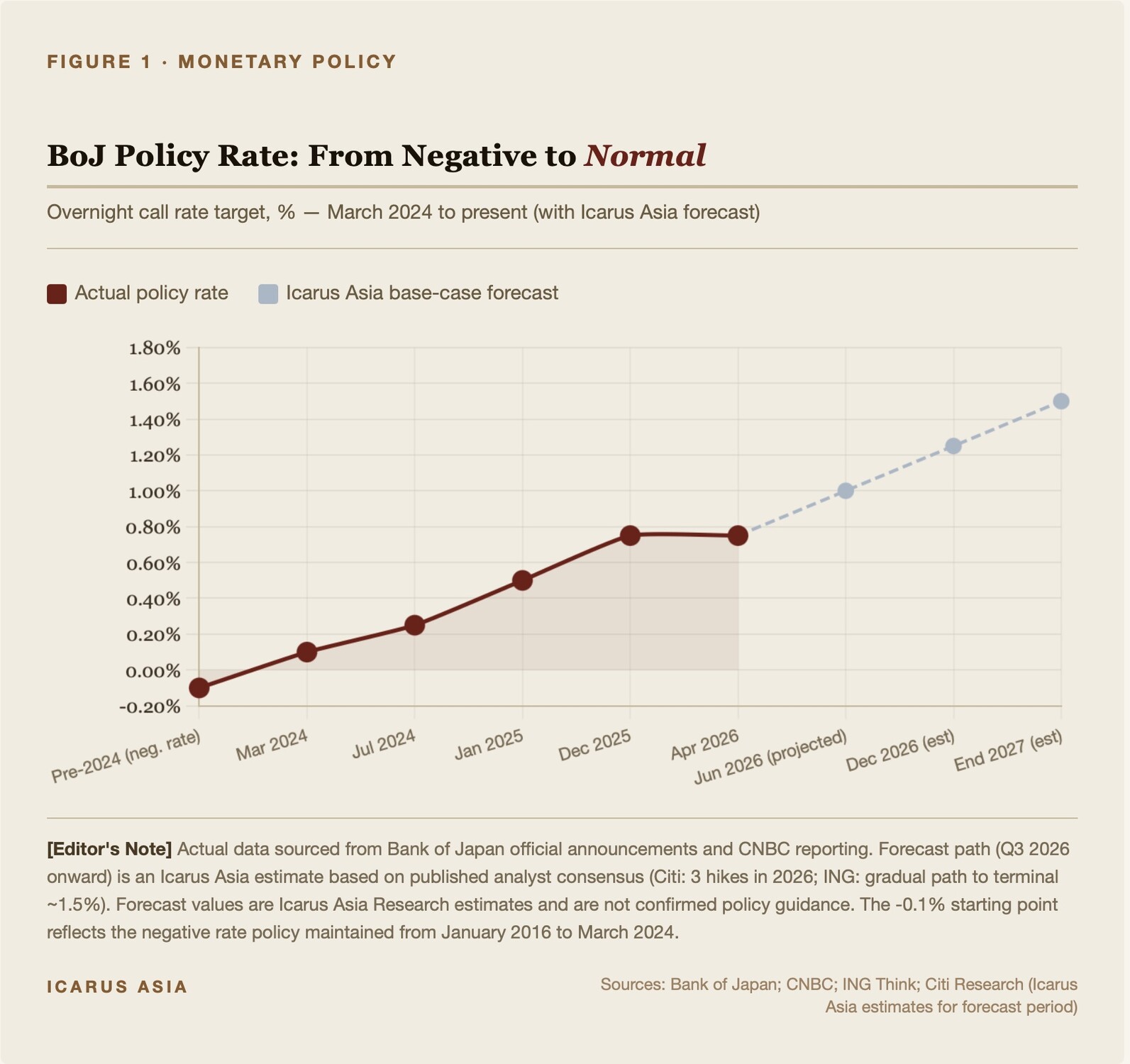
Markets are pricing roughly an 80% probability of a hike. Thirty-year Japanese government bond yields have already hit a record high above 3.90%, their highest level since the instrument was introduced in 1999. Half of Japan's major life insurers have publicly announced plans to shift back into domestic bonds this fiscal year. The repatriation is already underway. What's uncertain is the pace.
The Bank of Japan does not attract the same media attention as the Federal Reserve. It should. History shows, twice in recent memory, that when the yen carry trade unwinds — when investors who borrowed cheap yen to fund positions across the world have to give those positions back — the damage lands everywhere at once.
History shows, twice in recent memory, that when the yen carry trade unwinds — when investors who borrowed cheap yen to fund positions across the world have to give those positions back — the damage lands everywhere at once
What Comes Next
In the autumn of 1998, the Long-Term Capital Management hedge fund collapsed under the weight of its own leverage. LTCM hadn't built its positions in Japan, but many of its counterparties had borrowed yen to fund trades across emerging markets, U.S. equities, and European credit. When LTCM faced margin calls, those yen-funded positions unwound simultaneously. The yen surged roughly 20% against the dollar within weeks. The S&P 500 fell nearly 20% from its peak before the Federal Reserve orchestrated a bailout. The yen itself had not been touched by a rate hike. The carry trade unwound anyway, because leverage forces the hand.
The second episode is fresher.
On July 31, 2024, the Bank of Japan raised its policy rate by 15 basis points — from 0.1% to 0.25%. Two days later, US payrolls came in sharply below expectations, narrowing the gap between what investors could earn in American bonds and what they were paying to borrow in Japan. On August 5, the Nikkei 225 fell 12.4% in a single session, its worst day since Black Monday in 1987. The VIX volatility index spiked above 65, a level last seen during Covid. Bitcoin dropped 20%. Mexican pesos and South African rand sold off in the same 72-hour window. The yen carry trade had nothing to do with any of those assets directly. But the investors who held them had funded many of those positions with yen borrowing, and when the math stopped working, everything went at once.
The yen carry trade had nothing to do with any of those assets directly. But the investors who held them had funded many of those positions with yen borrowing, and when the math stopped working, everything went at once.
Strategists estimated afterward that only 10 to 15 percent of total yen carry positions had actually unwound. The rest of the trade — estimated at around $4 trillion in yen-funded positions deployed globally — remained intact.
Monday's meeting brings the policy rate to a level where the economics of that trade stop working for a meaningfully larger share of outstanding positions.
The Mechanics of Contagion
The carry trade is the most direct channel.
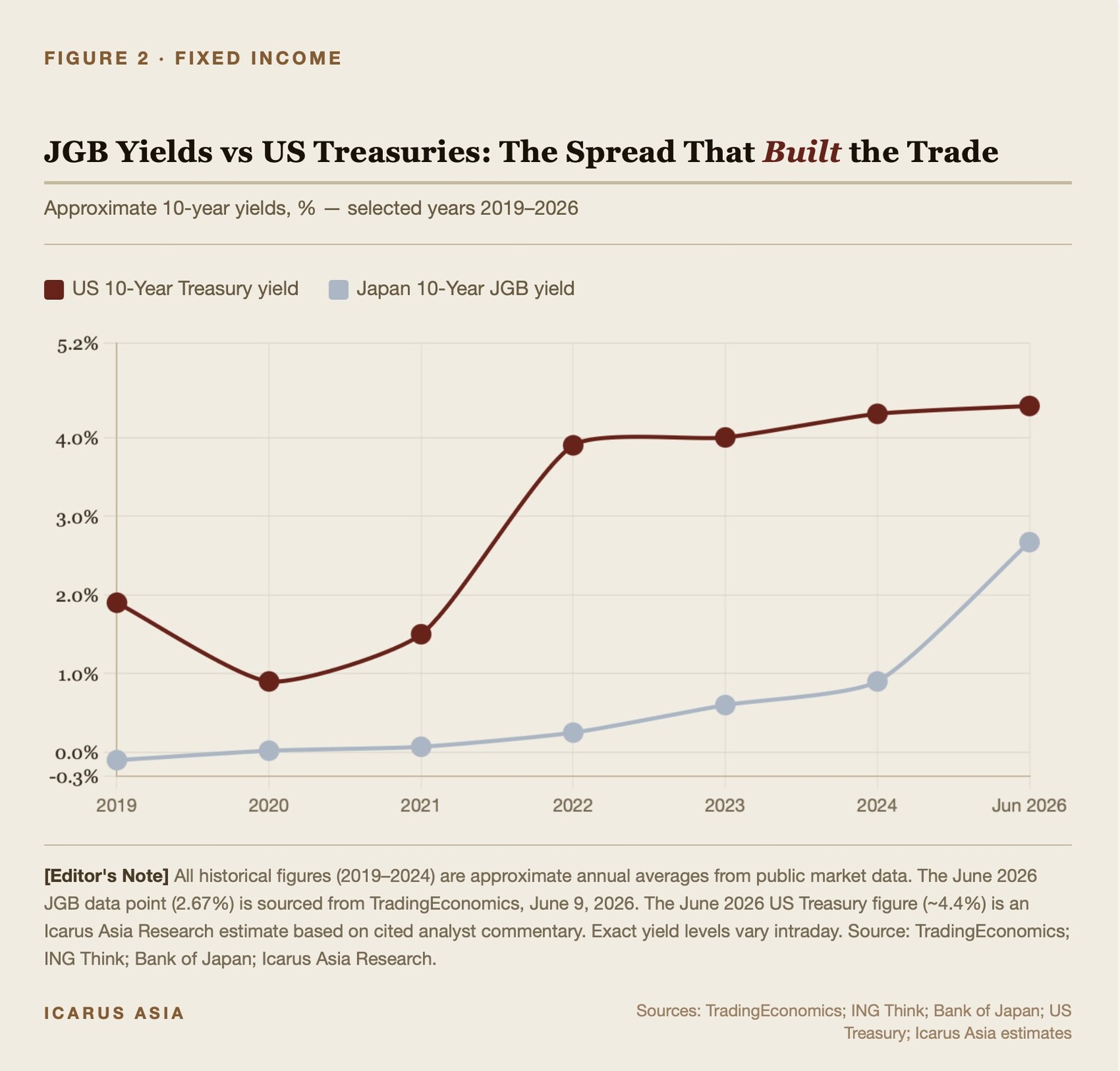
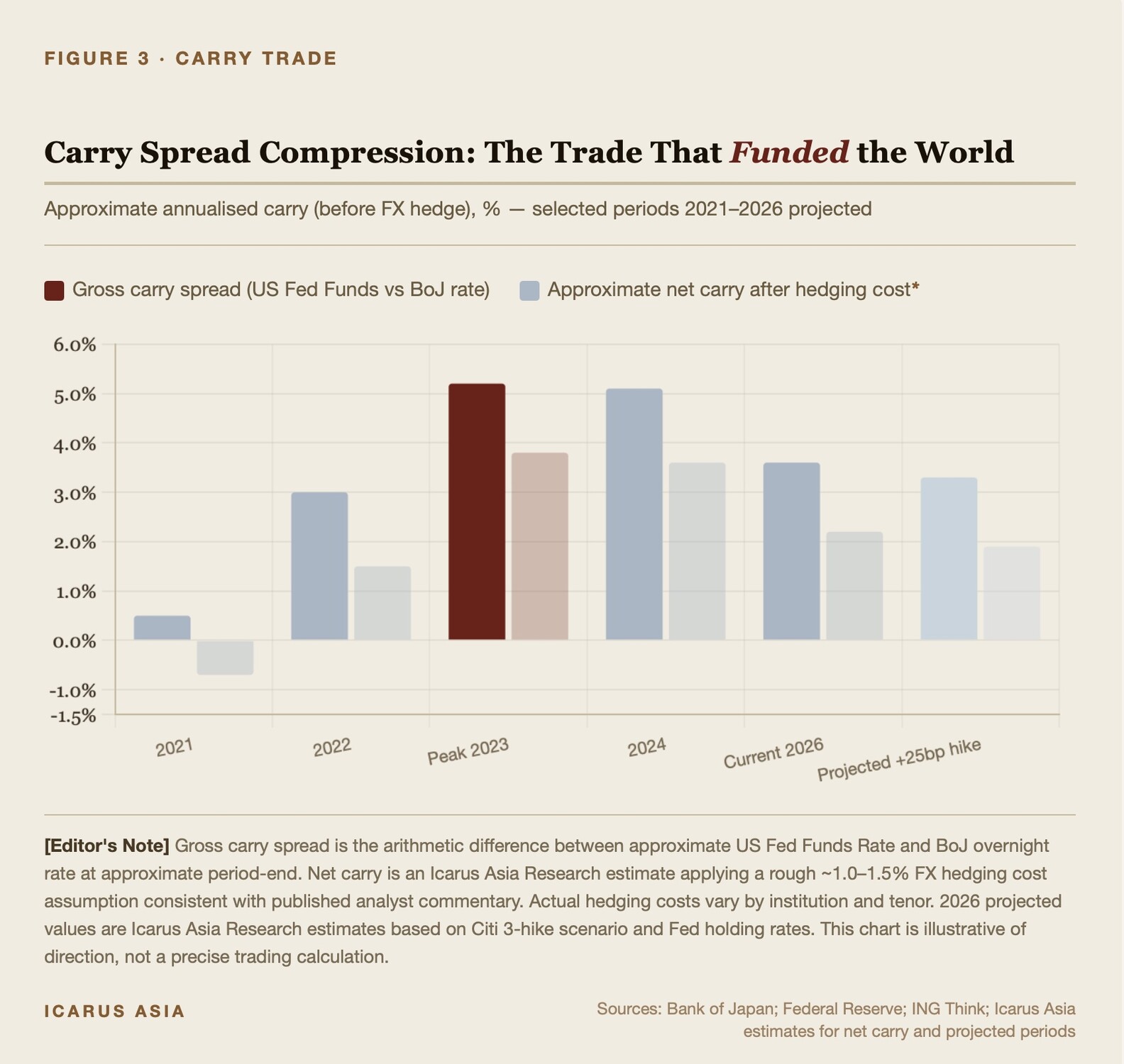
Borrowing in yen and deploying into US Treasuries, emerging-market credit, or US technology stocks works as long as the interest rate differential between Japan and the rest of the world is wide enough to cover hedging costs and provide a return. With the Bank of Japan at 0.75%, the current carry spread against a US 10-year Treasury is roughly 170 basis points — compressed from around 400 basis points in 2020, when the Federal Reserve cut rates to near zero and Japan was still at negative 0.1%.
Another 25 basis point hike tightens that further. Any resulting yen appreciation forces mark-to-market losses on the short-yen leg, which can trigger forced selling of the assets on the other side — whatever they happen to be.
The second channel is slower but larger in dollar terms.
Japanese life insurers and pension funds hold hundreds of billions in foreign bonds, mostly US Treasuries and European sovereigns, positions built precisely because domestic Japanese bonds paid nothing for years. With 30-year JGBs now yielding above 3.9%, and with a new solvency regime introduced in April 2025 that ties insurer balance sheets more tightly to domestic bond prices, the domestic alternative is genuinely competitive. Institutions with yen-denominated liabilities no longer have to reach overseas for yield. They're already reaching back.
A third channel runs through energy.
Japan imports roughly 90% of its primary energy needs, priced in dollars. When the yen weakens, those import bills rise on two dimensions: the dollar-denominated price of the commodity, and the exchange rate. During the 2021–2022 energy shock, Japan's LNG bill rose 65% in dollar terms but 98% in yen terms, because the weakening currency amplified an already painful price move. To pay those bills and intervene in currency markets, both public and private Japanese institutions sell dollar assets — mostly Treasuries — to buy back yen. A stronger yen from a rate hike reduces the pressure on this channel. But it doesn't disappear.
To pay those bills and intervene in currency markets, both public and private Japanese institutions sell dollar assets — mostly Treasuries — to buy back yen. A stronger yen from a rate hike reduces the pressure on this channel. But it doesn't disappear.
The fourth channel is the one that hit Bitcoin and the Mexican peso in August 2024: pure leverage contagion.
The most liquid assets go first. In a forced unwind, investors don't sell what they want to sell. They sell what they can sell. That means US large-cap technology stocks and liquid EM sovereign debt before anything else, because those markets can absorb the volume. An unwind of even 20 to 25 percent of the outstanding carry book would exceed August 2024's disruption in scale.
What Portfolio Managers Are Watching
The trades that follow from this setup are not complicated.
Long yen versus short dollar. Underweight long-dated US Treasuries, where Japanese life insurers are becoming net sellers rather than buyers. Reduced exposure to emerging-market carry positions — Mexican peso, South African rand, Brazilian real — that were partially funded with yen borrowing and will face correlated pressure in a broad unwind. Tail protection on US equities through volatility instruments, which remained cheap heading into the meeting given that August 2024 is still recent enough to remember.
The key threshold for institutional repatriation, according to published guidance from Japanese insurers, was a 10-year JGB yield of around 2.5%. As of last week, it was trading near 2.67%.
The threshold has already been crossed. The question from here is speed.
The Larger Shift
None of this means Monday's meeting will produce a repeat of August 2024.
Markets are more prepared. The hike is largely priced in. Bank of Japan Governor Kazuo Ueda has been unusually clear by historical central bank standards about the direction of travel.
But preparation and pricing-in are not the same as immunity.
August 2024 itself was not a surprise in the broad sense — carry trade unwind risk had been discussed for months before it materialized. What surprised markets was the speed, the simultaneity, and the reach. When 10 percent of a $4 trillion trade unwinds in 72 hours, it doesn't knock politely on the doors of the specific assets it funded. It takes out the whole building.
The Federal Reserve manages a $24 trillion economy and sets the world's reserve currency rate. The European Central Bank oversees nineteen countries and a currency union that is perpetually on some version of existential alert. The People's Bank of China is navigating a property sector that has lost a decade of gains and a youth unemployment rate that the government stopped publishing.
All of that matters.
None of it has $5 trillion in foreign assets that were built on the assumption of zero rates, now sitting in a world where Japan's own long bond yields more than 3.9% and the carry economics that created those positions are evaporating quarter point by quarter point.
The meeting would give a whole new meaning to Monday blues.
The author is the Head of Research and Analysis at Icarus Asia, a Hong Kong-based risk and advisory business.
Disclaimer
This article is for informational purposes only. It does not constitute investment advice. Readers should independently verify all data and consult their own advisers before making any investment decisions. Forward-looking statements involve risk and uncertainty; actual outcomes may differ materially from those described.
Sources
ING Think. "Does Japan's higher rate cap materially hurt Treasuries?" — on JGB-Treasury yield gap compression.
TradingEconomics; CNBC; OANDA. Japan 30-year JGB yield in record-high range of ~3.87–3.94%, late May–June 2026. 10-year JGB yield at ~2.67% as of June 9, 2026 (TradingEconomics).
Nikkei Asia. "Half of Japan's major life insurers to expand domestic bond holdings." Aviva Investors. "Bond Voyage — February 2026: Dancing to a new tune: How Japan's Lifers are adapting to a market in flux."
Emory Economics Review. "The Unraveling of Carry Trading: How Rising Interest Rates and Yen Fluctuations Impacted Global Markets," January 2025. Federal Reserve IFDP Paper No. 899 on yen carry dynamics.
BIS Bulletin No. 90. "The market turbulence and carry trade unwind of August 2024."
Investing.com. "USD/JPY Holds Near 160 as Japan Energy Costs Pressure the Yen." IEEFA. Japan's energy dependence and LNG procurement.
IEEFA. "Japan's diversified LNG procurement strategy cannot fully shield it from global price spikes." 2022.
Goldman Sachs. Via BitMEX / FXStreet reporting, June 2026. Note: Icarus Asia does not have direct access to the original Goldman research; citation is based on published media summaries and should be treated as unverified until a primary source is confirmed.
CNBC. "Bank of Japan keeps policy rate steady while raising inflation forecast on Iran war worries." April 28, 2026.
Fortune. "The top foreign holders of U.S. debt may soon dump Treasury bonds and bring their money back home." May 17, 2026.