
News · Policy · US
Food Insecurity Surges Among America's Poorest
The New York Fed survey finds nearly 1 in 5 low-income households can't afford enough to eat -- while consumer optimism among the food-insecure has collapsed to record lows, even as headline economic data stays broadly…
The New York Fed survey finds nearly 1 in 5 low-income households can't afford enough to eat -- while consumer optimism among the food-insecure has collapsed to record lows, even as headline economic data stays broadly resilient.
Nearly one in five American households earning under $50,000 a year reported in early 2026 that they couldn't find enough food to eat -- up from fewer than one in fifteen in June 2020 -- according to new data from the Federal Reserve Bank of New York, underscoring the widening fault line between those thriving in a bifurcated U.S. economy and those left behind.
The findings, drawn from the New York Fed's Survey of Consumer Expectations and published Wednesday, offer fresh evidence that the optimism embedded in aggregate economic data -- low unemployment, near-peak household net wealth, resilient consumer spending -- is masking a sharp deterioration in living standards for lower-income Americans. Food insecurity among the poorest households has nearly tripled since the pandemic's early months, while households at the top of what economists call the "K-shaped" recovery have grown substantially wealthier.
"The bottom of the K-shape represents a significant share of the middle- and lower-income population experiencing elevated levels of economic uncertainty and financial hardship," wrote Gizem Kosar, Ishva Mehta, and Wilbert van der Klaauw, all economic researchers at the Federal Reserve Bank of New York's Research and Statistics Group.
The share of households earning less than $50,000 annually who reported going without enough food -- or having children skip meals -- rose from 6.7% in June 2020 to 16.0% in October 2025 and then to 19.7% by February 2026. For non-white households, the rate climbed from 4.5% to 19.1% over the same period. Households with children saw the rate reach 14.1% in October 2025 before pulling back to 11.0% in February 2026 -- a decline from the peak, but still nearly double the 6.2% baseline recorded in June 2020. Across all surveyed households, the figure more than doubled from 4.0% to 10.0%.
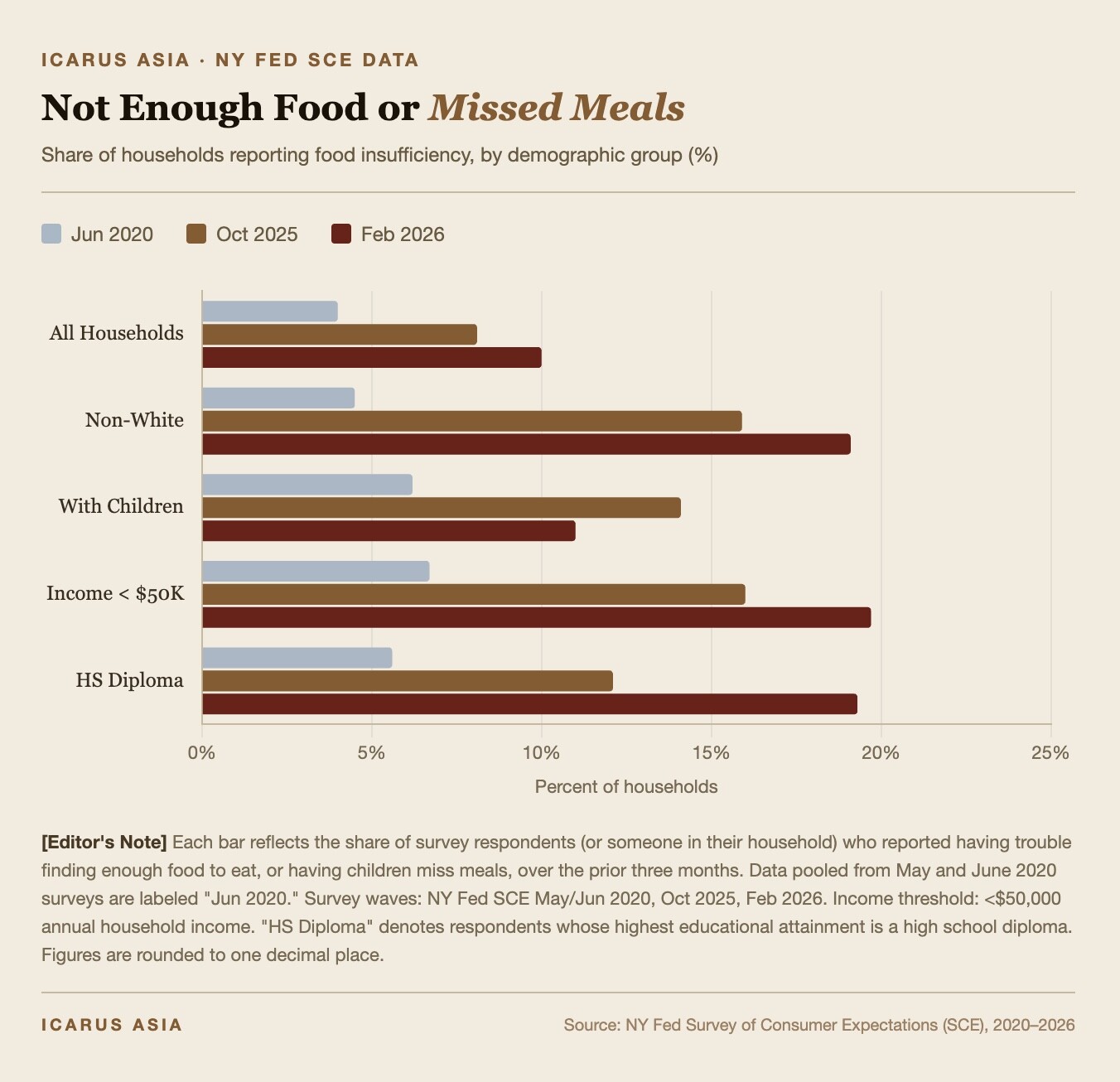
The trend accelerated notably between October 2025 and February 2026.
The sharpest four-month deterioration was concentrated among households with only a high school diploma, whose food insufficiency rate jumped from 12.1% to 19.3% -- a 7.2 percentage-point move in a single survey interval. Across demographic groups, SNAP enrollment continued to climb: low-income households' receipt rate rose from 21.8% in 2020 to 38.2% by February 2026, a figure that reflects both greater need and the partial rebound in benefit availability following earlier cuts.
The findings arrive at a politically charged moment.
President Donald Trump said he doesn't "think about Americans' financial situation" when negotiating with Iran over a deal to end the war - PBS
Persistent inflation in grocery prices, housing, and utilities -- categories that claim a disproportionately large share of low-income budgets -- has proved stubborn long after broader price pressures cooled. The expiration of expanded pandemic-era SNAP benefits removed a critical buffer for millions of households. USDA data for 2024, the most recent official measure, placed food insecurity at 13.7% of all households and 18.4% among households with children -- the highest rate since the post-financial crisis peak of 14.9% in 2011.
The survey, drawn from a rotating panel of roughly 1,200 nationally representative U.S. household heads, also tracked a broad deterioration in emergency savings. The share of all households that reported dipping into savings or emergency accounts to cover expenses rose from 21.8% in June 2020 to 36.8% by February 2026. For households with children, that figure reached 43.4%; for non-white households, 44.2% -- underscoring the near-complete drawdown of pandemic-era fiscal buffers among the most vulnerable.
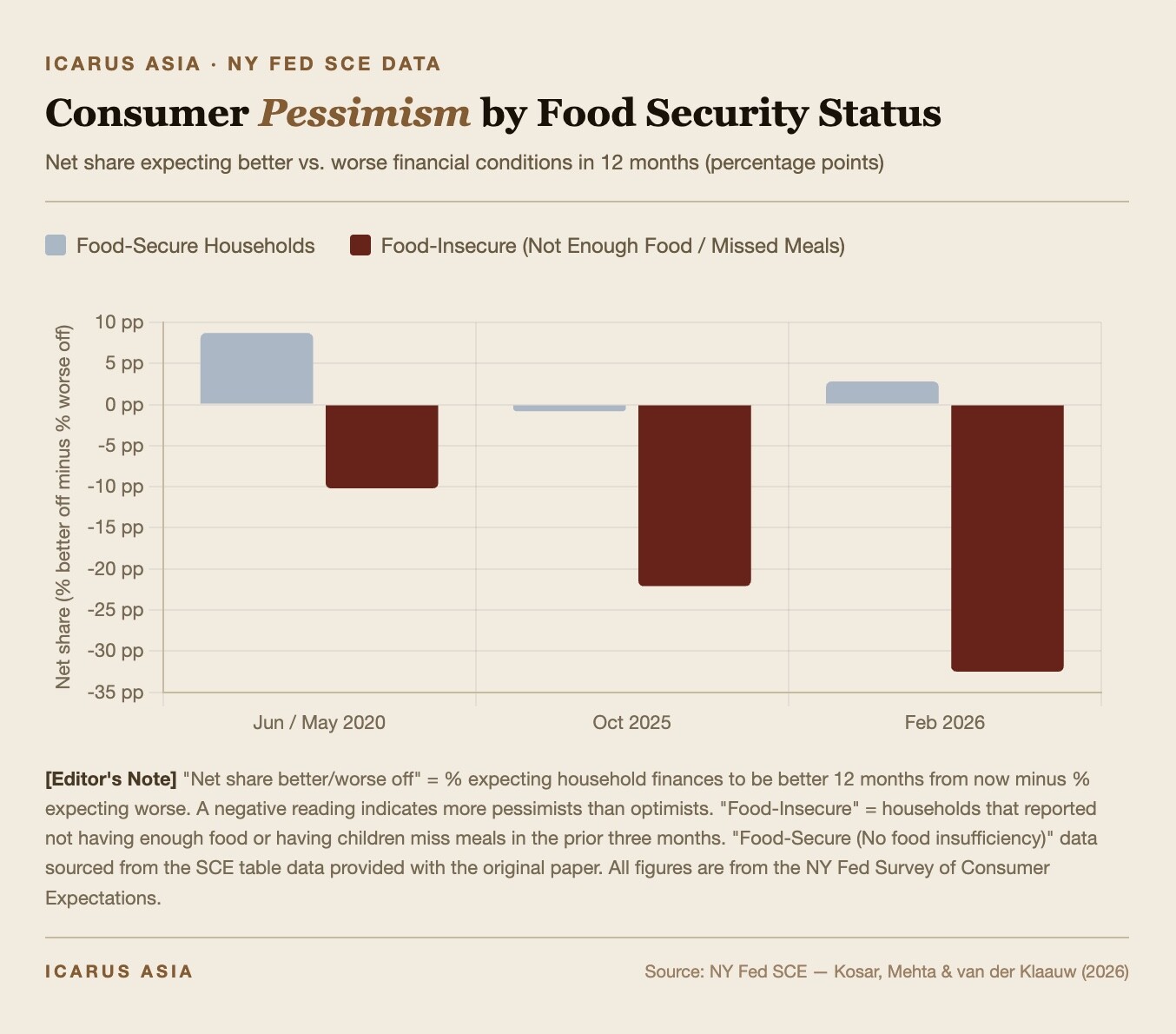
"The observed positive association between food insecurity and overall consumer pessimism, together with the increase in the incidence of food insecurity, especially among households at the bottom of the K-shape, point to a potential explanation for the unusually low recent levels of consumer sentiment at a time when the hard economic data paint a more positive picture." - Kosar, Mehta & van der Klaauw, NY Fed Liberty Street Economics
These strains are feeding a grimmer economic outlook.
Among households that reported food insufficiency, the net share expecting to be financially better off a year from now fell from -10.2% in June 2020 to -32.5% by February 2026. In plain terms: among food-insecure Americans, nearly a third more respondents now expect their finances to worsen than expect improvement - a stark inversion of baseline optimism. Food-secure households, by contrast, showed a partial sentiment recovery between October 2025 and February 2026, even though they too had grown considerably more pessimistic since 2020.
Labor market anxiety is compounding the gloom.
Among SNAP recipients, the reported probability of finding a new job within three months -- if their current job were lost today -- fell from 50.1% in June 2020 to just 33.7% by February 2026. For households not receiving SNAP, the equivalent figure was 45.6%. The gap, roughly 12 percentage points, suggests that those at the bottom of the K-shape increasingly fear that job loss would carry severe and lasting consequences.
In the US, SNAP stands for the Supplemental Nutrition Assistance Program. Formerly known as "food stamps," it is the country's largest federal anti-hunger program. It provides monthly funds to low-income individuals and families to help them afford nutritious groceries.
Debt expectations round out the picture.
Overall, debt delinquency probabilities held relatively stable across the full survey population, rising slightly from 11.2% in 2020 to 11.6% in February 2026. But among households experiencing food insufficiency, the probability of missing a minimum debt payment within three months stood at 32.3% in February 2026 -- roughly 3.5 times the level reported by food-secure counterparts. The gap is a reminder that financial distress tends to cluster: those who can't afford food are also the most likely to fall behind on debt.
The gap is a reminder that financial distress tends to cluster: those who can't afford food are also the most likely to fall behind on debt.
The New York Fed researchers are careful to note that the link between food insecurity and consumer pessimism is associative rather than strictly causal.
Yet the correlation is robust, and the researchers argue it offers a partial answer to one of the more puzzling questions in recent macroeconomics: why consumer sentiment has languished at near-recessionary levels even as headline indicators -- employment, equity valuations, aggregate household net worth -- have remained broadly healthy.
The answer, the data suggests, lies in where you sit within the income distribution.
At the top of the K -- where, as the NY Fed researchers note, rising stock prices, near-peak home equity, and the 2020–21 refinance boom have kept net wealth elevated -- the macro picture looks broadly fine.
At the bottom, families are skipping meals.
The author is the Head of Research and Analysis at Icarus Asia, a Hong Kong-based risk and advisory business.
Sources
Gizem Kosar, Ishva Mehta, and Wilbert van der Klaauw, "Food Insecurity and Consumer Pessimism," Federal Reserve Bank of New York Liberty Street Economics, May 27, 2026.
Chart data: LSE_2026_food-insecurity_vanderklaauw_data.
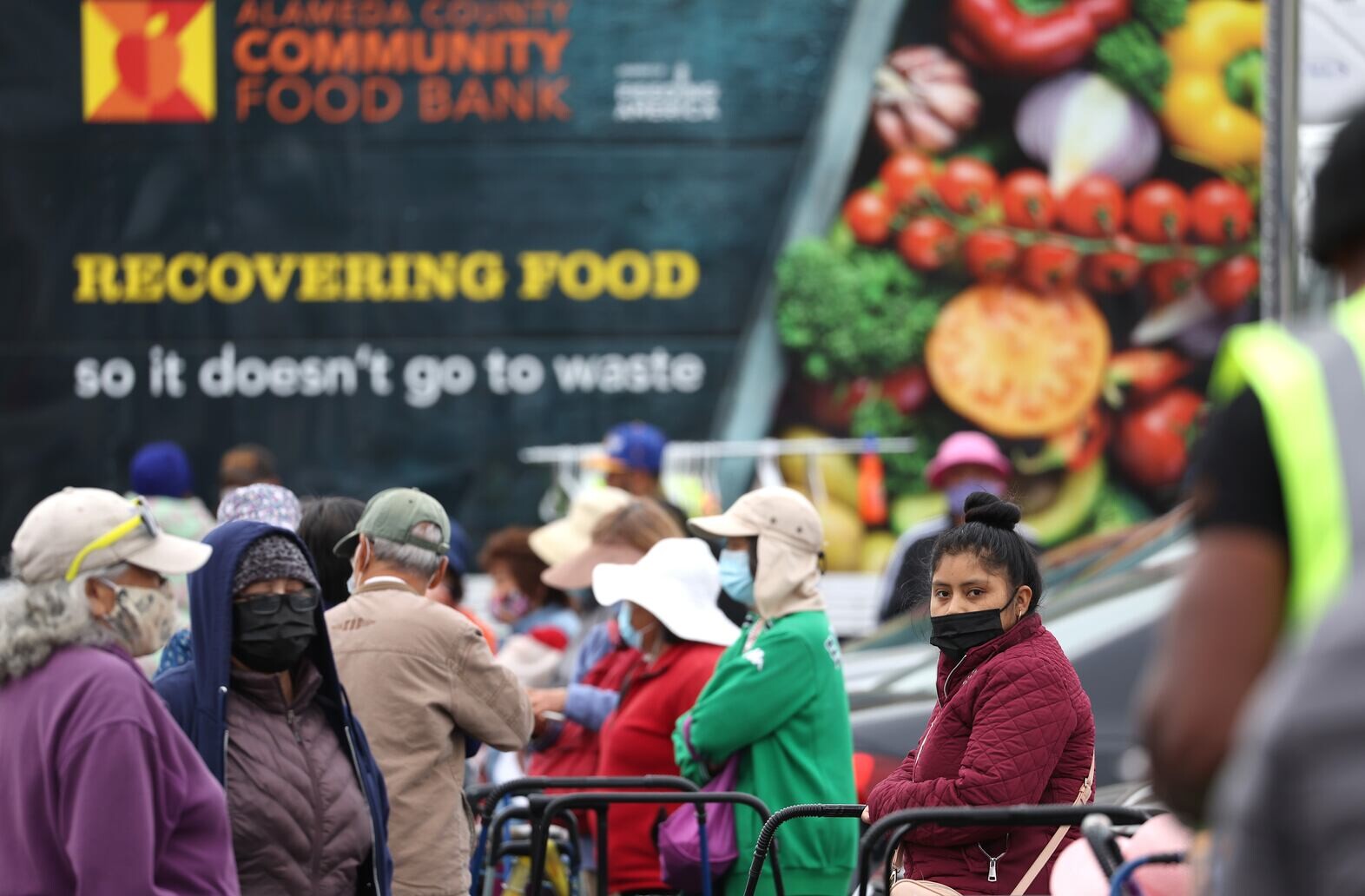
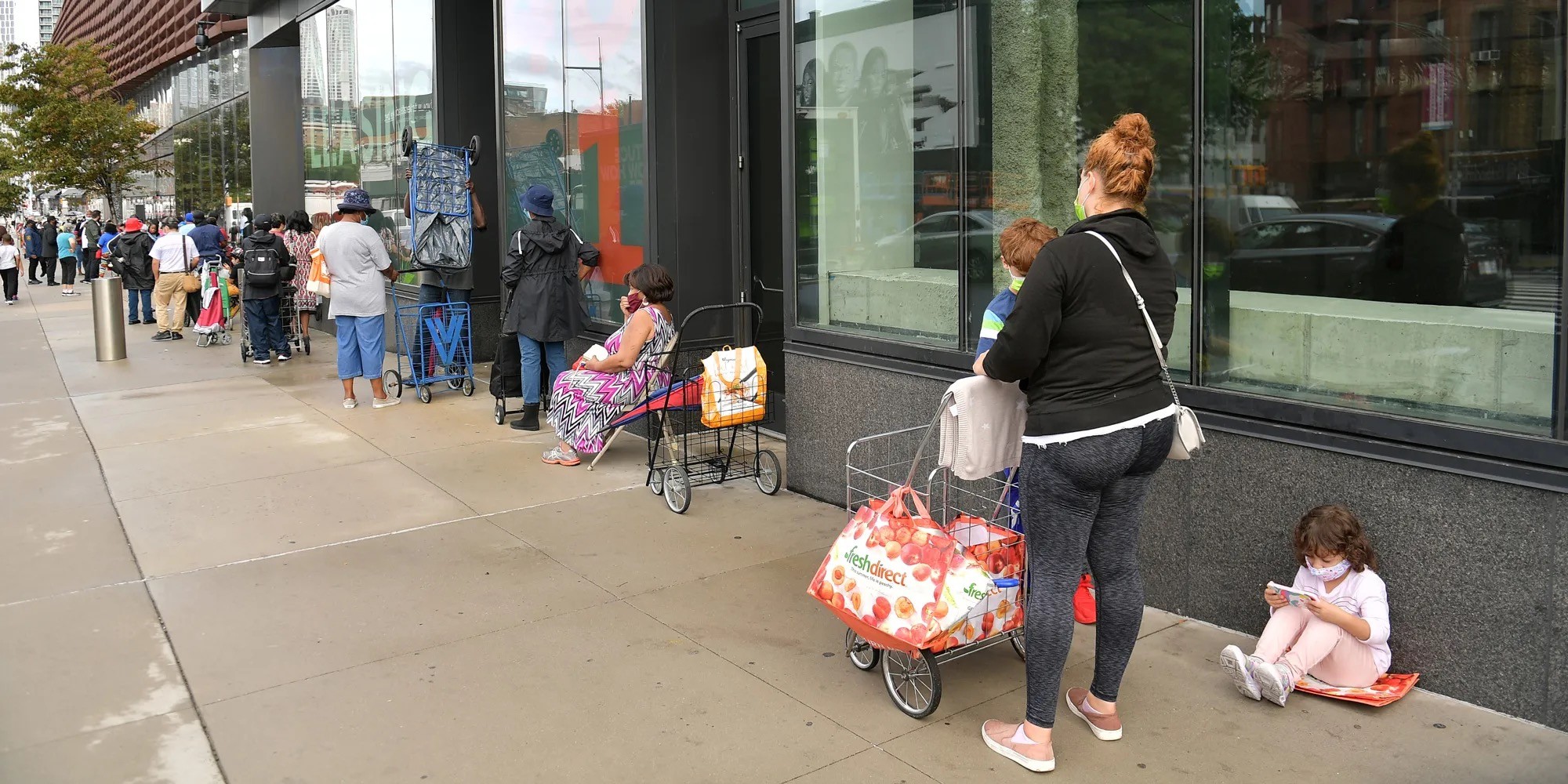
Caution: The pictures used in this story are from the time of around the COVID-19 pandemic when job losses and shop/factory closures led to a widespread food crisis in the U.S. They do not represent the current situation.
Disclaimer: The views expressed in the original post upon which this article is based are those of the authors and do not necessarily reflect the position of the Federal Reserve Bank of New York or the Federal Reserve System.