
News · Macro · Japan
Japan is Bringing Its Savings Home
Higher Japanese bond yields let the country's pension funds and insurers earn what they need with less overseas duration. This comes as Japan's Treasury holdings fall every month since April.
The Bank of Japan's policy board voted 7 to 2 on Friday to raise its overnight interest rate to around 1.25 percent, a 31-year high by Reuters' count, and the two members on the losing side put their objections on the record.
Toichiro Asada, a policy board member, saw a weak case for it.
With core consumer price inflation below 2 percent recently, the bank's summary of his view says, "it could not necessarily be said that the economic situation was strong." Ayano Sato, another member of the board, judged that economic and price developments had not substantially accelerated and that it was "not appropriate for the Bank to raise the policy interest rate at this time."
Both Asada and Sato are relatively new members of the board, appointed in March and part of the so-called pro-Abenomics “reflationists” camp who advocate for a weaker yen to help the Japanese industry, rising prices at home notwithstanding.
The two members who voted yes, Hajime Takata and Naoki Tamura, objected from the other direction, though only to the wording of the outlook report. Each thought inflation was already broadly consistent with the 2 percent target.
A Hung Jury?
Unlike the unanimous decision by the Federal Reserve to raise rates, the Bank of Japan’s dissension made markets read the highly anticipated decision as news.
The dollar rose as much as 1.3 percent, to 158.05 yen, then slipped back on reports that Japanese authorities had conducted rate checks, and it stood about 0.5 percent higher late in the global session. The 10-year Japanese government bond yield fell about 4.9 basis points, to 2.947 percent. The Nikkei 225 gained about 1.5 percent. A CNBC headline said Japan's markets had "flipped the usual script."
For most investors outside Japan, that is where the story ends, and for now it is a fair place to stop.
Not Quite Out of the Woods
While we, at Icarus Asia, believe the September move is close to a non-event for global risk assets, investors would be better off noting what this means for who buys bonds.
When Japanese government bonds pay more, the pension funds and insurers that hold much of the country's savings can hit their return targets with less overseas duration. Fewer of them bid for Treasuries, Australian government bonds and European sovereigns at the margin.
When Japanese government bonds pay more, the pension funds and insurers that hold much of the country's savings can hit their return targets with less overseas duration.
The US Treasury's data show the early version of this.
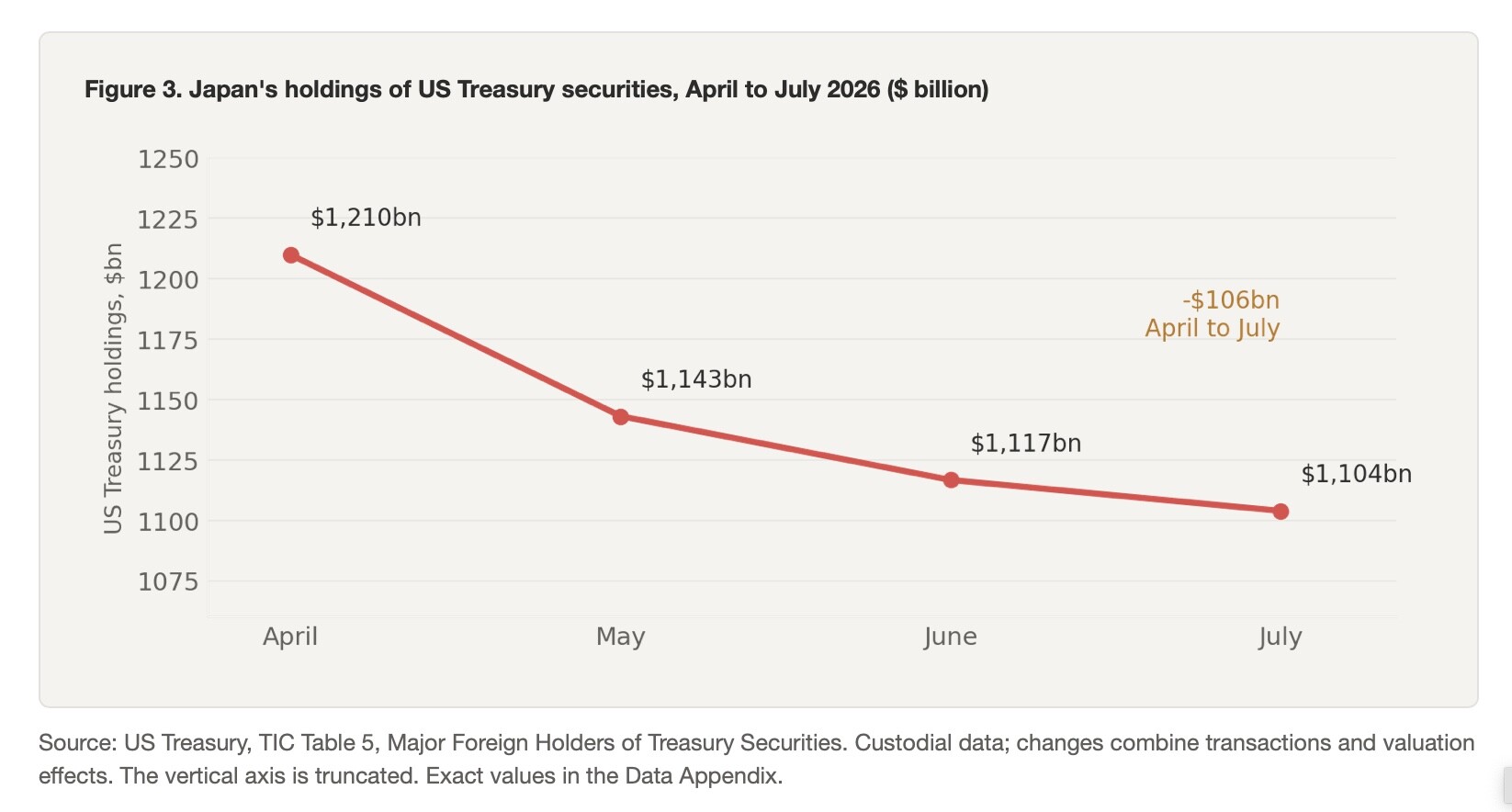
Japan held $1,103.9 billion of Treasuries in July, down from $1,209.9 billion in April. It fell in each month between: $1,143.1 billion in May, $1,116.7 billion in June. That is a drop of $106 billion in three months, and Japan still ranked as the largest foreign holder in the Treasury's table.
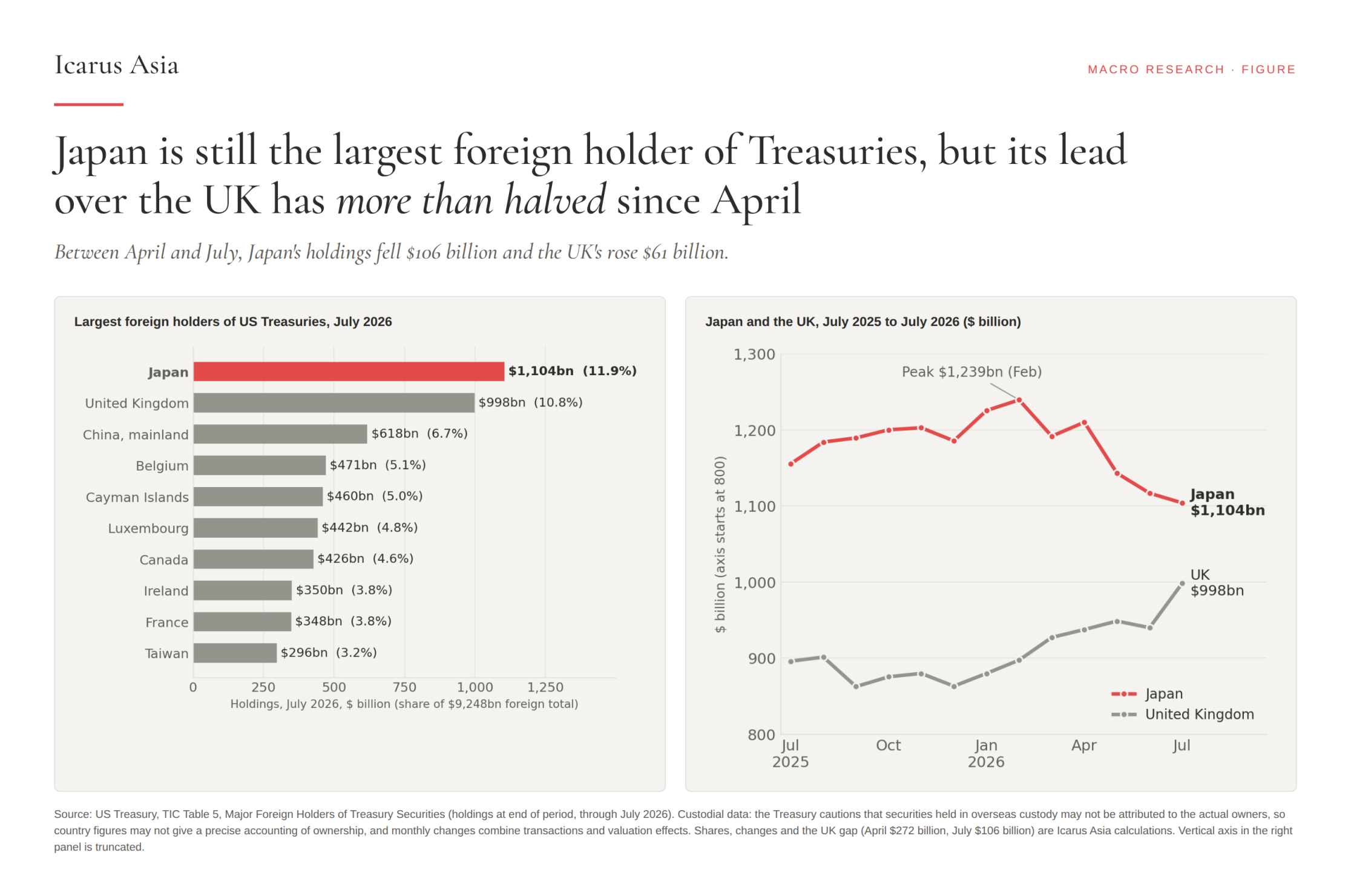
The data comes with a warning that the Treasury prints itself. They are built from US custodians and broker-dealers, and securities held in overseas custody "may not be attributed to the actual owners." They cannot separate sales from price changes.
Analysts who spoke to Reuters read the meeting in different ways.
Masahiko Loo of State Street Investment Management described Japan as part of a synchronized tightening cycle in which higher domestic yields keep more capital at home. In his account, Japan is gradually ceasing to be the marginal buyer of foreign assets, and its existing holdings stay put. David Chao of Invesco pointed to the same coincidence from another angle. The Bank of Japan, the Federal Reserve and the European Central Bank all tightened in the same month, so Japan was no longer an outlier.
On the hawk-or-dove question, the desks split.
Prashant Newnaha of TD Securities found the promise of more rate rises hawkish but saw no evidence of a move in October. HSBC's Frederic Neumann thought back-to-back hikes unlikely, though the bank had to keep December open. At Nomura, Naka Matsuzawa put the yen's fall down to the dissents. Yugo Tsuboi of Daiwa Securities Group Inc. called the decision dovish in that no 50-basis-point option had appeared, and the dissents made a rapid acceleration harder to picture.
The retreat from foreign bonds, if it comes, will be slow.
A J.P. Morgan Asset Management survey of 82 Japanese corporate pension funds found the highest net share since 2008 planning to add domestic bonds. Mandates change at scheduled reviews, though, so the shift arrives as smaller purchases and not forced sales.
Life insurers own 15.8 percent of the JGB market, by J.P. Morgan Private Bank's figure, and have been buying less at the longest maturities because price swings there threaten their balance sheets. The International Monetary Fund regards abrupt reallocation as unlikely. Japanese institutions hold substantial capital and liquidity buffers, and the Bank of Japan itself owned 51 percent of outstanding government bonds as of June 2025.
Life insurers own 15.8 percent of the JGB market, by J.P. Morgan Private Bank's figure, and have been buying less at the longest maturities because price swings there threaten their balance sheets.
Who is buying Japan's own debt is harder to pin down, because the data disagree.
Foreigners bought a record ¥13 trillion, net, of long-dated Japanese bonds in 2025, the IMF said, or 53 percent of all new purchases. For August 2026, the Ministry of Finance series shows nonresidents as net sellers of about ¥0.7 trillion of long-term debt and about ¥5.0 trillion of short-term debt. Reuters' broader count shows foreigners as net buyers of about ¥3 trillion of Japanese fixed income that month. The two readings disagree in sign. We at Icarus Asia advise on leaning on neither.
The picture is further complicated when one accounts for offshore accounts operated by Japanese insurers, and conglomerates who use structures in Cayman Islands and other jurisdictions such as Singapore and Hong Kong for tax efficiency, treasury operations, and ease of use in international settlements.
These count as foreigners although not strictly valid is the narrowest sense of the term.
The Widow Maker
The immediate worry for investors is how this signal translates through the yen.
Cross-border yen borrowing hit a record ¥360 trillion, about $2.35 trillion, by March, according to a Jefferies analysis of Bank for International Settlements data. Nobody can say how much of that is exposed to a sudden yen rally. It includes financing with no connection to directional bets, and the only carry-specific estimate anyone has published is the BIS's roughly ¥40 trillion, from 2024, which the BIS itself thought was too low.
That 2024 episode is the one traders remember.
A hawkish reading of the Bank of Japan's increase came in alongside weak US jobs data, and the TOPIX index fell 12 percent in a day. The S&P 500 lost 3 percent on August 5, and the VIX briefly topped 60. Markets recovered fast, which suggests the episode amplified a shock and did not signal a broken economy. The BIS pinned the amplification on leverage, thin liquidity and rising margins, and it found leveraged positions being rebuilt soon afterward.
The yen had already jolted the carry crowd this month. Reuters reported on Sept. 8 that the currency had gained 4.5 percent in a week. The hike, read as dovish, pushed it the other way and took the acute risk down. What did not change is the cost.
By our estimate, each quarter-point rise in the overnight rate adds about ¥100 billion a year in interest on ¥40 trillion of yen funding, and about ¥900 billion on the full ¥360 trillion if all of it is repriced, which it does not.
Those figures say nothing about the losses from a yen rally, which come faster than interest bills.
Where Do We Go Now
Icarus Asia's baseline is what it calls an orderly normalization. Somewhat higher global yields, wider gaps between winners and losers across equities and emerging markets, and no systemic unwind.
The worst case scenario needs several holes in the cheese to line up at once.
A faster Bank of Japan, a sharp yen rally, weak global growth and crowded positions. September went against the first two. The Bank of Japan's own guidance leaves no doubt about direction. "The Bank will continue to raise the policy interest rate and adjust the degree of monetary accommodation," it said, "in response to developments in economic activity and prices as well as financial conditions."
Not all is gloom and doom though.
A risk-off episode would lower US and European yields, widen the advantage of foreign bonds over Japanese ones again, and slow repatriation just when markets most need buyers. Japan's holdings have fallen every month since April. Even as the Treasury had not published country-level data for August as of Monday.
The Bank of Japan, for its part, does not describe any of this as leading to restrictive lending conditions.
"Accommodative financial conditions are expected to be maintained after the change in the policy interest rate," the central bank said amid the highest rate in 31 years. "Real interest rates have remained at low levels, mainly in the short- to medium-term zone," it added.
The author is an Executive Director and Head of Research and Analysis at Icarus Asia, an independent financial research and market analysis firm that specializes in macroeconomic insights, structural fixed-income analysis, and liquidity trends across Asian and global capital markets.
DISCLAIMER: Not investment advice. Please do your own research and consult with a registered financial advisor.
Sources
Bank for International Settlements. "The Market Turbulence and Carry Trade Unwind of August 2024." BIS Bulletin No. 90.
Bank of Japan. "Change in the Guideline for Money Market Operations." September 18, 2026.
Bank of Japan. Statement on the September 18, 2026 monetary policy decision (title not returned by the fetch; description supplied). September 18, 2026.
CNBC. "Why Japan's Markets Flipped the Usual Script; BOJ Raises Rates to Over 30-Year High." CNBC, September 18, 2026.
Icarus Asia Research. "Japan's Savings Start to Stay Home." September 21, 2026.
International Monetary Fund. "Global Financial Stability Report, April 2026, Chapter 1." April 2026.
J.P. Morgan Private Bank Asia. "Japan: A Delicate Balance."
Ministry of Finance, Japan. "International Securities Transactions" (monthly data), August 2026.
Reuters. "Dollar Advances vs Yen as BOJ Dissent Clouds Rate-Hike Outlook." Reuters, September 18, 2026.
Reuters. "Global Shares Edge Higher as Central Banks Double Down." Reuters, September 18, 2026.
Reuters. "How Japan's Bond Rout Is Turning the Tide of Global Capital." Reuters, September 2, 2026.
Reuters. "Investors React to BOJ Raising Interest Rates to 31-Year High." Reuters, September 18, 2026.
Reuters. "The Yen's Sudden Surge Upsets the Carry Trade Faithful." Reuters, September 8, 2026.
Reuters Breakingviews. "Japan's PM Has a New Ally: Foreign Yield Hogs." Reuters, September 10, 2026.
US Department of the Treasury. "Major Foreign Holders of Treasury Securities" (TIC Table 5).