
News · Macro · Japan, China
The Cheapest Money in Asia No Longer Comes From Tokyo
Japan's path to normalization has given way to a new source of cheap funding to not just the region, but to the wider world as China's two-pronged strategy to stoke its economy and negate the effects of U.S. tariffs keeps rates low.
For most of the last three decades, a banker in Singapore or a shipping company in Jakarta looking for the cheapest possible loan in Asia knew where to look. Japan's interest rates had been near zero, or below it, for so long that "borrow yen" stopped being a strategy and became a reflex. The trade financed factories in Vietnam, container ships out of Busan, and, for years, entire hedge fund portfolios built on the assumption that the yen would stay cheap forever.
That assumption is fraying.
Japan raised interest rates in June to 1 percent, the highest level since 1995, and the Bank of Japan is expected to hold there when it meets again on July 30 and 31. Meanwhile in Beijing, the People's Bank of China has been doing the opposite. Cutting, easing, and in late June rolling out a new overnight lending facility priced at 1.25 percent, below what most analysts had expected and described by Standard Chartered as a de facto rate cut.
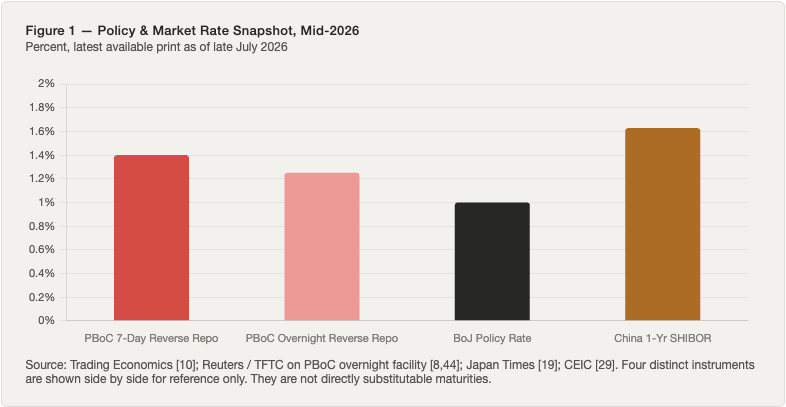
The two lines on the chart have not crossed.
China's benchmark seven-day reverse repo rate, at 1.40 percent, is still above Japan's 1 percent policy rate. But look one layer down, at the money-market rates banks actually use to price loans to each other, and the picture flips: China's one-year interbank rate, known as Shibor, was running at 1.628 percent in January, a level that increasingly looks competitive against Japanese funding once other costs are factored in. And look at the parts of the market where money actually moves across borders, and a case can be made that China has already taken Japan's old job.
That is the finding of a research note published this week by Icarus Asia, a risk and advisory consultant based out of Hong Kong. And it is a bigger deal than a rate table suggests.
Japan's status as the source of the world's cheapest large-scale funding was never really about the number on the policy rate.
It was about what that rate made possible: three decades of investors and companies borrowing yen to fund things priced in dollars, euros, or just about anything else, because Tokyo would let them borrow cheaply enough to make the trade worth doing. If China is inheriting even part of that role, the implications reach well beyond the two central banks involved.
Three places the shift is showing up
The first is trade finance, the unglamorous plumbing of global commerce that lets an importer in Manila pay a supplier in Shenzhen without either side taking on currency risk it doesn't want.
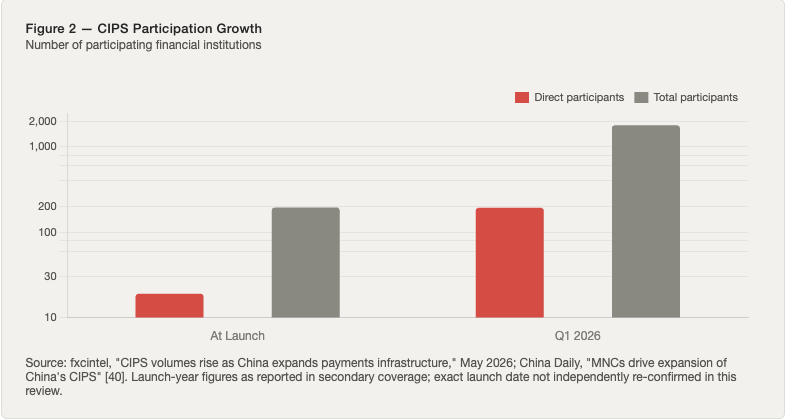
China's Cross-Border Interbank Payment System, the settlement network Beijing built to move money in its own currency instead of relying on the dollar-clearing system that runs largely through New York and London, had grown to 1,791 participating financial institutions by the first quarter of this year, spanning 124 countries. That is up from 19 direct participants when the system launched. Average daily transaction volume hit a record in March: roughly 920 billion yuan, or about $133.5 billion, up 20 percent from a year earlier. The renminbi, meanwhile, ranked sixth among the world's payment currencies in December, with a 2.73 percent share by value, according to SWIFT's most recent tracker of the currency's global use.
The second is the bond market.
Foreign governments, multilateral lenders and banks that want to borrow directly in Chinese yuan do it through so-called panda bonds, sold in China's domestic market, or dim sum bonds, sold offshore in Hong Kong. Panda bond issuance hit a record 88.24 billion yuan in the first quarter of this year, according to China Daily, with the number of deals up 87.5 percent from a year earlier and total volume more than doubling. Full-year issuance in 2025 came to 163.31 billion yuan, up 15.6 percent, Standard Chartered reported. Neither figure would have been plausible a decade ago, when China's bond market was largely closed to outsiders.
"First, the funding cost is relatively cheaper than for US dollars," Samuel Tse, senior economist at Singapore-based bank DBS, told the Global Times in an article published last week. "Second, there is a growing need for yuan funding amid the accelerated use of yuan," he said. "Third, onshore liquidity remains ample, thereby enabling onshore institutions to absorb such bond supply."
Onshore liquidity remains ample, thereby enabling onshore institutions to absorb such bond supply - Samuel Tse, Senior Economist, DBS
The third is harder to see because it happens between central banks rather than in public markets: swap lines and official liquidity facilities that let foreign banks tap Chinese money directly.
Bank of China recently disclosed a trade-financing deal in Singapore funded through the Monetary Authority of Singapore's renminbi facility, itself backed by a bilateral swap arrangement between the two countries' central banks. It was a single transaction. But it is also a template for how Beijing has been quietly wiring renminbi liquidity into financial systems that have nothing to do with mainland China.
Put those three together and the picture is not a currency crossover so much as a currency becoming usable. The renminbi doesn't have to replace the dollar, or even match what the yen did in its prime, to matter. It only has to become cheap and accessible enough that a growing number of borrowers choose it. By that test, China is winning ground it didn't hold five years ago.
The renminbi doesn't have to replace the dollar, or even match what the yen did in its prime, to matter. It only has to become cheap and accessible enough that a growing number of borrowers choose it.
The Catch: The Nuance in the Sticker Price
Every rate cited above is a domestic number. None of them is what a foreign company actually pays once it borrows in yuan and swaps the money back into dollars, euros, or whatever currency it actually spends.
That hedging cost is captured by something traders call the CNH-implied yield, derived from the forward price of the dollar against the offshore yuan.
It is not simply a function of Chinese interest rates. It moves with how tight or loose dollar funding is outside China, and it moves sharply whenever markets expect the yuan to weaken, because a weaker future yuan makes the hedge more expensive today. A company that locks in a "cheap" onshore rate and then pays to hedge the currency risk can end up with a bill that looks nothing like the number in the PBoC's press release.
A company that locks in a "cheap" onshore rate and then pays to hedge the currency risk can end up with a bill that looks nothing like the number in the PBoC's press release.
That distinction sounds technical. But it matters enormously for who actually benefits from cheaper Chinese money.
A shipping company that gets paid in yuan for hauling Chinese exports has no reason to hedge; for that company, the crossover is real and immediate. A private equity fund in London borrowing yuan to buy an asset priced in euros is a different story entirely, and probably still better off in yen or dollars once the hedge is priced in.
Icarus Asia's report treats this as the single biggest gap in how the crossover story typically gets told, and flags it as the first thing any borrower should check before acting on the thesis.
It isn't a story about China being safer, either
One assumption worth debunking would be that China's rates are not lower because investors see it as safer than Japan.
S&P Global rates China at A+, one notch below the top investment-grade tiers, and Moody's Ratings rates it A1, having raised its outlook to stable in April. Japan's S&P rating is also A+. The two countries sit at roughly the same place on the credit spectrum.
Whatever is driving the rate gap, it is not that lenders trust Beijing more than Tokyo. What is driving it, more plausibly, is that China's central bank is fighting a domestic problem that has nothing to do with currency competitiveness.
Whatever is driving the rate gap, it is not that lenders trust Beijing more than Tokyo. What is driving it, more plausibly, is that China's central bank is fighting a domestic problem that has nothing to do with currency competitiveness.
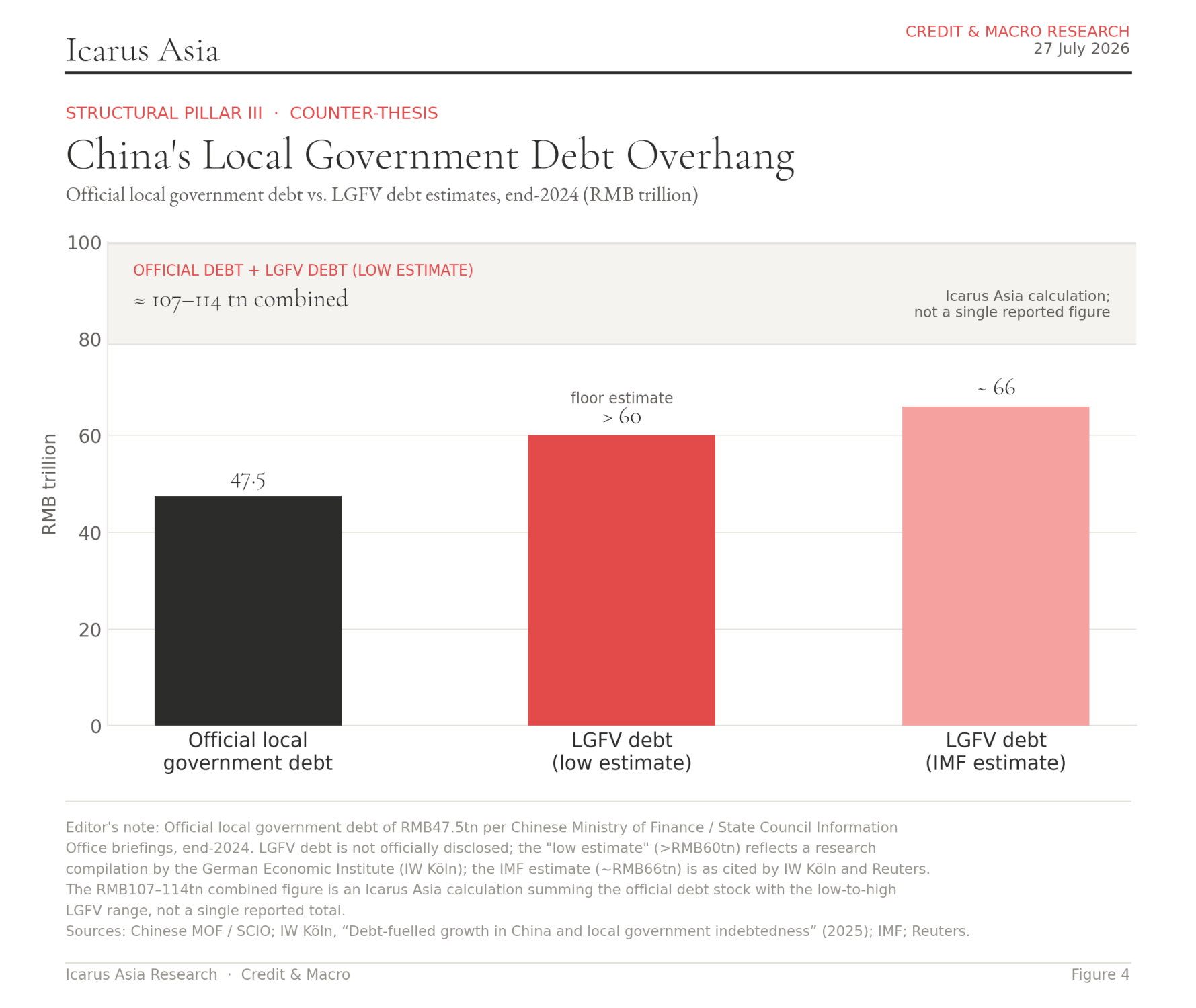
Local government debt in China stood at close to 48 trillion yuan at the end of 2024, and financing vehicles tied to local governments, off-balance-sheet entities that fund everything from toll roads to industrial parks, owed more than 60 trillion yuan on top of that, much of it dependent on implicit state backing rather than their own cash flow.
Fitch warned in January that the continuing crash in property investment is raising credit risk for homebuilders, banks and local governments simultaneously. The World Bank, in a December assessment, said a broader recovery in the property sector could still be a year or two away.
Seen that way, the PBoC's aggressive easing looks less like a central bank calmly building a cheaper funding regime and more like one still fighting a fire.
That doesn't mean that the contention that Beijing is substituting Tokyo as a provider of cheap capital doesn't have legs. Instead it suggests the reasons behind the phenomena cuts both ways. The same conditions that make Chinese money cheap right now are also the conditions that would need to resolve, one way or another, for anyone to know whether the advantage sticks around.
The number that hasn't moved
There is one statistic in the Icarus Asia report that argues for caution more than any rate comparison: how much of the world's money central banks actually choose to hold in yuan?
The International Monetary Fund's most recent count of global currency reserves put the renminbi's share at 1.95 percent in the final quarter of last year. The yen's share, by contrast, was 5.84 percent that quarter, before slipping to 5.44 percent in the first quarter of this year. Both figures are dwarfed by the dollar's roughly 57 percent and the euro's roughly 20 percent.
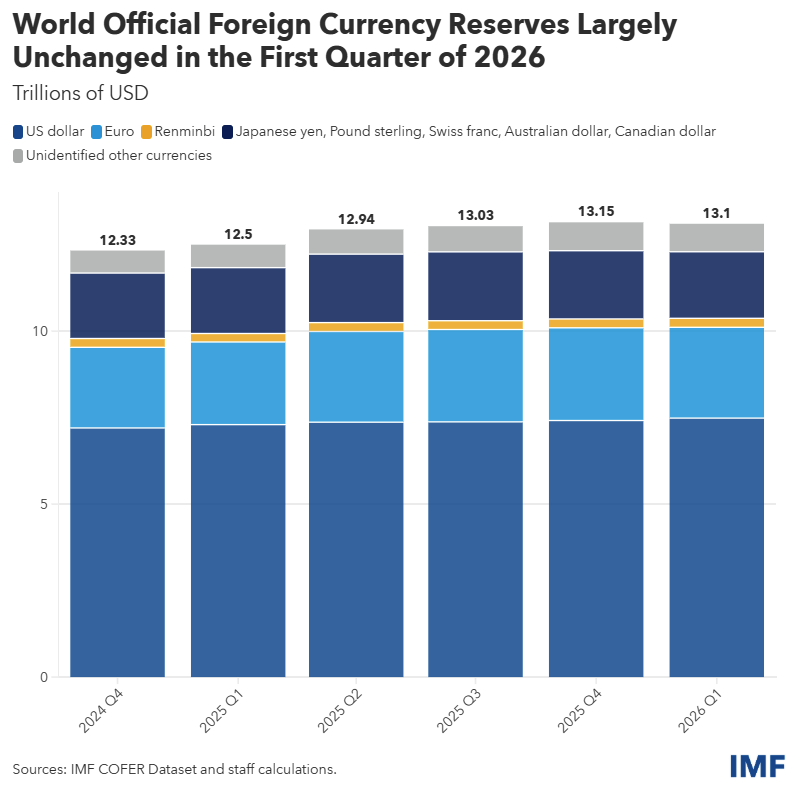
That gap has not narrowed. If anything, the yen's declining share this year moved the two currencies in different directions, not closer together.
Central banks, in other words, are not treating the yuan as a replacement store of value even as more banks and companies treat it as a workable way to borrow and settle trade. Icarus Asia's report draws a distinction between what economists call flow, the day-to-day business of financing trade and issuing bonds, and stock, the long-term decision to park a country's savings in a given currency.
Central banks, in other words, are not treating the yuan as a replacement store of value even as more banks and companies treat it as a workable way to borrow and settle trade.
China is winning on the first. It has barely moved on the second, and there is no evidence yet that it is about to.
What Happens Next
Markets will get several tests of the thesis in short order.
The Bank of Japan's two-day monetary policy meeting on July 30–31 is one; another rate increase, or even hawkish language about the next one, would widen the gap between Tokyo and Beijing's official rates in the opposite direction from where this story points.
The PBoC's new overnight facility, barely a month old, is another: whether it gets used heavily, or fades into a rarely touched backstop, will say something about how serious Beijing is about keeping money cheap.
And underneath both of those, the property market keeps ticking.
If China's local governments and their financing vehicles start working through their debt without a disorderly reckoning, the PBoC gets room to normalize policy, and today's rate gap narrows on its own terms rather than through a crisis. If they don't, the central bank may have to cut further still, for reasons that have nothing to do with winning market share from the yen and everything to do with keeping the domestic financial system upright.
If China's local governments and their financing vehicles start working through their debt without a disorderly reckoning, the PBoC gets room to normalize policy, and today's rate gap narrows on its own terms rather than through a crisis.
Either way, the shift already visible in trade finance and bond markets doesn't require Beijing to win that argument.
Companies with real yuan revenue are already borrowing yuan. Regional banks are already extending yuan trade credit. The infrastructure, a payments network with 1,791 members in 124 countries, a bond market issuing record volumes, swap lines quietly financing real transactions in Singapore, does not disappear if China's rate advantage narrows again. It just becomes slightly more expensive to use.
For three decades, that infrastructure belonged to the yen. Now some of it belongs to the yuan too.
The author is the Head of Research and Analysis at Icarus Asia, a Hong Kong-based risk and advisory consultant.
Disclaimer: This article is based on original research and analysis published by Icarus Asia Research. Full source notes, data caveats, and the complete research note are available on the company's website. Icarus Asia Research has no investment banking relationship with any issuer or institution named in this piece and holds no positions in the securities or instruments discussed.
Please do your own research and consult with a registered investment advisor before taking any decisions.