
News · Policy · China, US
Washington and Beijing Can't Agree on Much. Gold Might Be the Exception.
The International Monetary Fund cut its global growth forecast this week, and the reasoning was almost more revealing than the number itself. The fund said Wednesday it was modestly downgrading its outlook for the world…
A weaker world economy is leaning on war spending and AI capital budgets to stay upright. Icarus Asia's new research note argues the two countries best positioned to offer something steadier are the ones that talk to each other least.
The International Monetary Fund cut its global growth forecast this week, and the reasoning was almost more revealing than the number itself. The fund said Wednesday it was modestly downgrading its outlook for the world economy this year, citing the energy shock from the Iran war, with the drag partly offset by a boom in artificial intelligence investment. Global output is now projected to grow 3 percent in 2026, down from 3.5 percent last year and from the 3.1 percent the fund had forecast in April, before rebounding to 3.4 percent in 2027.
The world economy is currently being held up by two things -- money spent because of a war, and money spent on chips. Defense budgets have climbed across Europe and parts of Asia for three straight years now, and a meaningful share of the manufacturing base that once ran on consumer demand runs on procurement contracts instead.
This raises an obvious question nobody in Washington or Beijing seems eager to answer. If rearmament and AI capex are propping up the world economy almost by default, what would it actually take to add a third pillar that isn't built on either war or a chip shortage?
Our latest report from Icarus Asia Research, an independent research firm, makes an argument that sounds almost too simple at first.
The two governments best positioned to do something about global financial stability are the United States and China, not because they get along, but because they happen to hold the two largest stashes of an asset neither one has to negotiate away to use.
The two governments best positioned to do something about global financial stability are the United States and China, not because they get along, but because they happen to hold the two largest stashes of an asset neither one has to negotiate away to use.
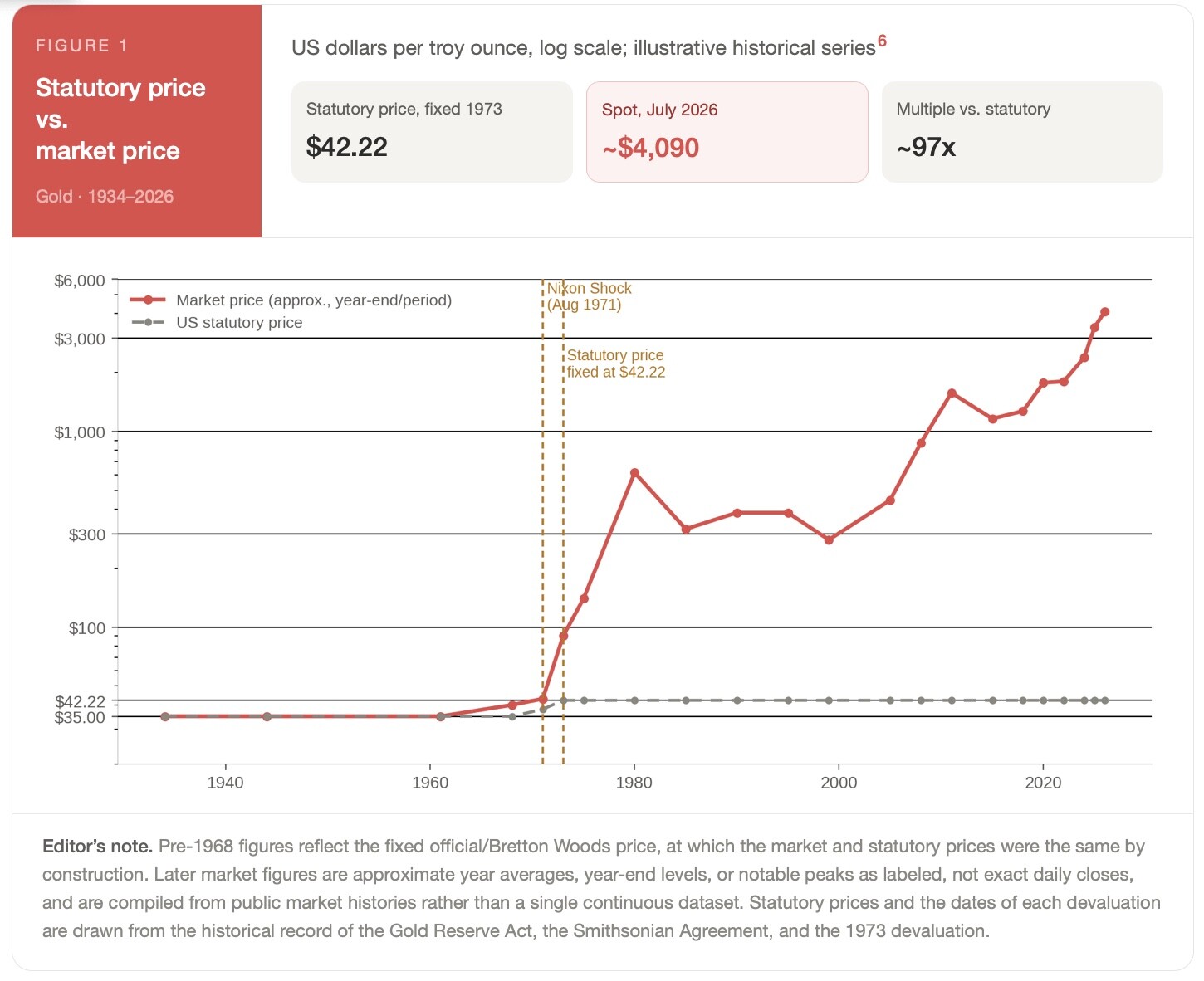
The United States has roughly 8,133 metric tons of official gold, still priced on the Treasury's books at $42.22 an ounce, a figure Congress set in 1973 and never touched again. Gold trades today near $4,090 an ounce, nearly 100 times that statutory number.
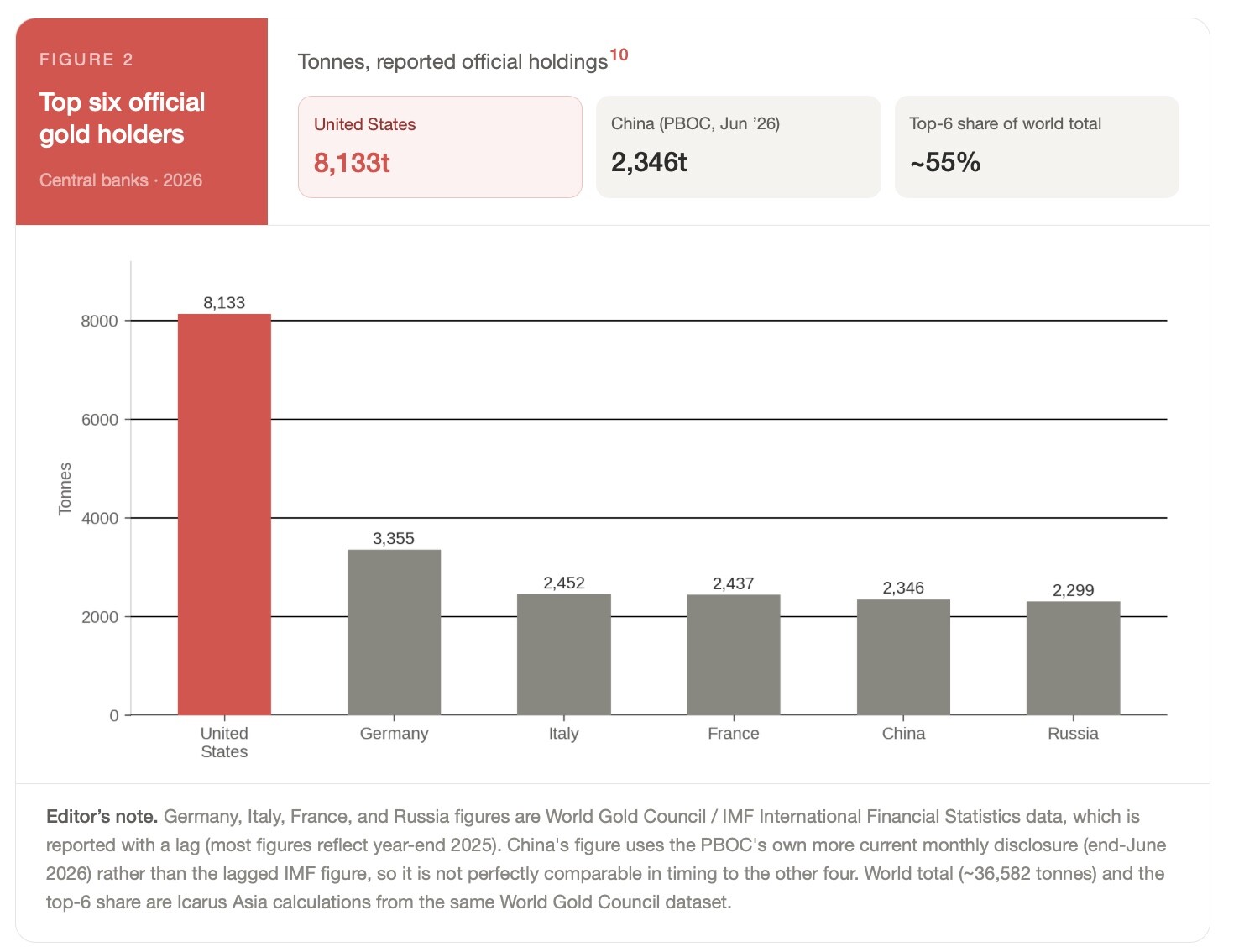
Meanwhile, China's central bank has built its own position from scratch, buying gold for 20 straight months and reporting roughly 2,346 tons as of the end of June. Add in Germany, Italy, France and Russia, and six countries that mostly do not trust one another hold more than half the gold that central banks own worldwide.
Gold as a Bulwark
China's buying fits inside a broader shift that started with the 2008 financial crisis, when central banks worldwide went from two decades of steady gold selling to steady buying, almost overnight. European governments had spent the 1990s and early 2000s unloading reserves under a formal sales agreement.
Britain's sale of roughly half its gold between 1999 and 2002, near a two-decade price low, is still cited in London as a byword for bad timing. That agreement quietly died in 2019 because nobody wanted to keep selling. Basel III's bank-capital rules have pushed the same direction since, more gradually: new U.S. rules that took effect in 2025 count physical gold as a top-tier liquid asset for banks, on par with cash and government bonds, a status the European Union and Britain are phasing in on their own, slower timelines.
Then, in 2022, Western governments froze an estimated $300 billion of Russia's foreign-exchange reserves after the invasion of Ukraine, and every reserve manager in Beijing, New Delhi and the Gulf drew the same lesson: a dollar or euro claim can be switched off by someone else's decision, and a bar of gold sitting in your own vault cannot. Central banks bought more than 1,000 tons of gold in each of 2022 and 2023, roughly double the prior decade's pace. China's own streak is one particularly disciplined example of a trend nearly everyone outside Washington has joined.
Then, in 2022, Western governments froze an estimated $300 billion of Russia's foreign-exchange reserves after the invasion of Ukraine, and every reserve manager in Beijing, New Delhi and the Gulf drew the same lesson: a dollar or euro claim can be switched off by someone else's decision, and a bar of gold sitting in your own vault cannot.
Here is the case for treating that overlap as an opportunity instead of a coincidence.
Grand bargains between Washington and Beijing are dead, and have been for years, and it is worth being specific about why. China pegged its currency to the dollar through 2005, and Washington spent a decade afterward accusing Beijing of holding the peg artificially weak.
Better Together
The U.S. Treasury flirted with, then backed away from, formally labeling China a currency manipulator for most of two decades, before doing exactly that in August 2019 at the height of the trade war, only to reverse the designation five months later. China spent that same period building its own financial plumbing, from a 2016 seat in the I.M.F.'s reserve-currency basket to its own cross-border payment system, largely so it would never again have to depend entirely on Washington's.
None of that history makes a currency deal or a trade deal any easier now. Almost all of it, though, is about the exchange-rate system and the dollar's role in it. Gold sits outside that fight entirely, which is exactly why it is still open.
A technical adjustment to how the United States accounts for gold it already owns does not require either government to concede anything the other side would call a win.
Under a 1934 law, the Treasury secretary can issue "gold certificates" to the Federal Reserve equal to the dollar value of the government's gold stock. Raise the statutory price, and Treasury can issue more certificates; the Fed credits Treasury's cash account by the same amount, a pure accounting entry that Icarus Asia's report estimates could generate a paper gain of $650 billion to just over $1 trillion, depending on where the new price lands. No gold changes hands. No law needs to pass. The Federal Reserve's own weekly balance sheet already carries a gold certificate account of about $11 billion, which happens to match the report's separate math almost to the dollar.
It would not, on its own, be free money.
Crediting Treasury's account at the Fed does not by itself put a single new dollar into circulation; that account is walled off from the reserves banks actually lend against. The inflation risk only shows up once Treasury starts spending the balance down, the same way markets already watch debt-ceiling cash swings move bank reserves up or down.
The report's answer is that the Fed already has the tools to manage exactly this, the interest rate it pays on reserves, the rate on its overnight reverse repo facility, the pace of its own portfolio runoff, and none of them would need to be invented for the occasion. Treasury could also simply not spend the money, banking it as headroom against the debt limit instead, which would capture the balance-sheet optics with none of the inflation risk and, not coincidentally, none of the political fight over what to do with a trillion-dollar windfall.
The mechanism is not hypothetical in the sense of needing new institutions, either.
A Ready-made Solution
The Treasury's Bureau of the Fiscal Service already administers the gold certificate program. The Federal Reserve Bank of New York already acts as Treasury's fiscal agent for exactly this kind of book entry. The Fed's own Division of Monetary Affairs already sets the interest-rate tools that would manage any resulting cash.
On the other side, the People's Bank of China already runs the reserve-planning apparatus that would have to decide how to read and respond to a U.S. move. Every actor this would require already exists and already does some version of this job. That is a different kind of proposal than asking two governments to build something new and trust each other with it.
There is also a precedent for this kind of narrow, technical coordination working, if imperfectly.
In 1985, the United States, Japan, West Germany, France and Britain deliberately drove the dollar down at the Plaza Hotel in New York, and it worked almost too well: the yen rose so far, so fast, that the same five governments had to meet again at the Louvre in 1987 just to stop the dollar's slide. Japan's response to that yen shock, cheap money and heavy stimulus, helped inflate the asset bubble that gave the country its lost decade.
The lesson usually drawn from Plaza is that currency coordination is dangerous.
The lesson worth drawing instead is narrower: coordinated, technical monetary action between rival economic powers is not new, it has been done before among governments that liked each other little better than Washington and Beijing do now, and its failures came from what Japan did afterward at home, not from the act of coordinating itself. A gold revaluation carries none of Plaza's mechanism, since nothing about the exchange rate moves and no other government is asked to act in tandem. But the underlying claim, that two powers with limited trust can still execute a narrow technical step together, has already been tested once.
A gold revaluation carries none of Plaza's mechanism, since nothing about the exchange rate moves and no other government is asked to act in tandem.
None of that, by itself, fixes anything between the two countries. Its narrowness is the point.
The report is explicit that it is not proposing a reset of the exchange-rate system or a run at the dollar's role as the world's reserve currency. What it proposes instead is narrower and, for that reason, more plausible: joint technical work on containing currency volatility, expanded swap lines and liquidity backstops, and shared protocols for how the two countries talk to each other if markets seize up. Two governments that cannot agree on tariffs can still agree, in principle, on how to avoid making a financial crisis worse by accident. That's a low bar. Nobody has cleared it yet.
Two governments that cannot agree on tariffs can still agree, in principle, on how to avoid making a financial crisis worse by accident.
Skeptics will say this is beside the point, and they have a real argument.
Not Without its Risks
Gold is a rounding error next to the trillions in Treasurys and dollar reserves that actually anchor the global financial system, and a bookkeeping change to a 1973 price tag will not move a single interest rate or shipping container. A revaluation could also backfire.
The last two times Washington touched that statutory number, in 1934 and 1973, both were explicit devaluations of the dollar under a fixed exchange-rate system that no longer exists, and the report itself warns that bond investors and foreign governments could read a new one as a "stealth devaluation" regardless of the mechanics, simply because of what happened the last two times.
It also knocks down a popular but wrong version of the risk: commercial banks cannot buy gold from the Treasury at the old statutory price and flip it at the market rate, because Treasury does not sell gold to banks or the public at any price.
The real version of that risk is narrower, a rush by private investors out of paper gold and into physical bars, the kind of strain that briefly cracked open the gap between futures and spot prices in London and on the Comex exchange in March and April 2020.
Those are fair warnings, and they are exactly why the report frames this as a technical opening rather than a diplomatic breakthrough. Small, reversible steps that neither government has to sell domestically as a concession are precisely the kind of steps that survive contact with actual politics. Big gestures do not, which is most of the reason nothing has moved between Washington and Beijing on money in years.
Small, reversible steps that neither government has to sell domestically as a concession are precisely the kind of steps that survive contact with actual politics.
What's propping up the IMF's 3 percent forecast is more uncomfortable than the number itself. A world economy that depends on defense spending and AI investment to avoid stalling out does not have many other levers left, and the two countries capable of pulling a different one are also the two countries with the least practice pulling anything together.
Gold will not fix that on its own. But it may be the only lever both sides can reach without having to admit they are reaching for it.
The author is the Head of Research and Analysis at Icarus Asia, a Hong Kong-based risk and advisory business.
Sources
IMF modestly downgrading its outlook for the world economy this year, AP News.
U.S. Treasury-Owned Gold — Status Report of U.S. Government Gold Reserve, U.S. Treasury Fiscal Data; Status Report of U.S. Government Gold Reserve, Bureau of the Fiscal Service.
China's Central Bank Boosts Gold Reserves for 20th Straight Month, BigGo Finance; PBOC extends gold-buying streak to 20 months, China Daily.
Current price of gold: July 7, 2026, Fortune.
Central Banks Gold Reserves by Country, World Gold Council.
1999–2002 sale of British gold reserves, Wikipedia; Worst deal in UK history? 20 years since Brown sold Britain's gold, BullionByPost.
Gold Goes Full Reserve Asset As Basel III Elevates It To Tier 1 Status, Forbes; "As of July 1, 2025, gold will officially be classified as a Tier 1, high-quality liquid asset", SYZ Group.
What is the status of Russia's frozen sovereign assets?, Brookings; Confiscation of Russian central bank funds, Wikipedia.
U.S. drops designation of China as currency manipulator, PBS NewsHour; Nothing to See Here: China No Longer 'A Currency Manipulator', CSIS.
Plaza Accord, Wikipedia; Louvre Accord, Wikipedia; "The Plaza Accord, 30 Years Later", Jeffrey Frankel, NBER Working Paper.
Icarus Asia Research, "The Narrow Case for US–China Gold Diplomacy" (July 2026).
Disclaimer
This is not investment advice. Please do your own research and consult with a registered financial adviser.