
News · Macro · Japan, US
Washington Maybe Blaming Tokyo for a Fire It Started Itself
Scott Bessent flew to Tokyo to allegedly fix the yen. But the market crisis he used to make the case for Japanese culpability came not from Ginza but from a presidential threat about a Danish island. The evidence points in an inconvenient direction.
Editor's note: This analysis responds to an earlier article, "The U.S. has a blunt message for its biggest ally: you're on your own" (May 13, 2026), which a reader challenged on factual grounds subsequently upheld by an editorial review. A correction and update to that article has been published separately.
This piece represents editorial analysis. Analytical disagreements are marked throughout.
When Donald Trump stood before the World Economic Forum in Davos in January and said his stock market had "taken the first dip yesterday because of Iceland," he was confusing Greenland and Iceland, as he sometimes does. He was also, accidentally, telling the truth.
The previous Saturday, Trump had threatened sweeping new tariffs on eight European countries that had opposed his ambitions to annex Danish Greenland. When markets reopened Monday in Europe and Tuesday in New York, stocks fell sharply. His Treasury Secretary, Scott Bessent, then stepped in front of cameras at Davos and offered a different explanation. The volatility, he argued, had come from Japan. Japan had seen what Bessent called a "six standard deviation" move in its government bond market. That, he suggested, was where the disruption originated.
Weeks later, Bessent flew to Tokyo pressing Japan's government to reportedly raise interest rates and stop burning foreign reserves to prop up the yen. The trip was presented as a necessary intervention in an unstable currency relationship. This analysis argues it was also something else: a geopolitically convenient redirect from a market disruption that originated not in Tokyo's bond pits but in a presidential threat about a territory most Americans could not find on a map.
This is not a case for dismissing Bessent's underlying concerns. The mechanism he describes is real.
When Japan sells dollars from its $1.38 trillion in foreign reserves to prop up the yen, it draws on holdings kept overwhelmingly in U.S. Treasurys. As of February 2026, Japan held roughly $1.24 trillion in Treasuries, more than any other foreign government, and those sales do impose upward pressure on yields at the margin, even if the Federal Reserve has tools to absorb it in scale.
The BOJ normalization has been long overdue.
The problem is that the evidence supporting the specific causal story Bessent has been telling does not hold together entirely, and the rate increase he demands is unlikely to deliver the yen recovery Washington expects.
Sophistry or cherry picking?
Let’s start with the January episode, because it matters more than it has been treated.
Bessent's "six standard deviation" claim at Davos referred specifically to the 40-year Japanese government bond, the thinnest and most illiquid segment of the $7 trillion JGB market. Bloomberg reported that a mere $280 million in trading triggered the spike. The core 10-year JGB, the benchmark that governs global investment decisions, moved just two standard deviations on the same days -- a level reached on roughly 5% of trading days. That doesn’t fit the definition of a crisis, rather represents a routine session.
The timeline does the rest of the work.
Trump's tariff threat came on a Saturday. The Takaichi government's fiscal stimulus announcement, which drove the JGB move, came the following Monday. The market disruption preceded the Japanese trigger Bessent cited. Markets then calmed not when JGB volatility subsided but when Trump reversed his tariff threats and claimed a "fabulous" deal on Greenland.
"Fabulous," as veteran journalist Richard Katz observed in his February 2026 analysis, stems from "fable." Trump's Davos admission, that his market had dropped "because of Iceland," was accidental candor. Bessent's attributing the same drop to Japan was something more deliberate.
Katz, the author of the Japan Economy Watch newsletter on Substack, in his February 2026 analysis argued that Bessent had "seized on" the JGB move to deflect from the consequences of the Greenland dispute. That characterization involves an inference about motive. What the public record establishes, without inference, is that the sequencing and the scale were misrepresented.
Markets calmed when Trump reversed his Greenland tariff threats — not when JGB volatility subsided.
The argument is not new.
In August 2025, Bessent told Bloomberg Television that Japan's inflation had caused "definite leakage" into long-term U.S. Treasury yields and that the BOJ was, in his view, "behind the curve." Japan's chief trade negotiator, Ryosei Akazawa, issued a public clarification the following day: Bessent was expressing an expectation that Japan would raise rates on its own, not making a formal demand that it do so.
The distinction was diplomatically significant.
Heads we win, tails you lose
What was framed in May 2026 as a response to current market conditions had in fact been Bessent's stated position for at least nine months. The Tokyo visit was the latest staging ground for an argument already embedded in U.S.-Japan diplomatic exchanges throughout the preceding year.
The challenge for any independent observer in interpreting Bessent's messaging has been that the Japanese officials aren't explicity stating whether the Treasury Secretary is seeking rate increases.
It is understandable why they might be reticent in doing so.
The Takaichi government's sustenance rests on thin ice. Since late 2024, Japan has experienced significant government turnover, marked by a change in premiership and a weakened ruling coalition.
Messaging from her ministers, such as Katayama has been obfuscatory at best. Because of the few times that she has deviated from that language, critics have caught onto her.
"The finance ministry will still have to draw up ways of funding the tax cut without having to issue new debt," Japanese politics analyst Tobias Harris wrote in his Observing Japan newsletter on Substack. Katayama has previously said that the government is seeking to "reform" subsidies and "other special measures" while drawing on non-tax revenue sources, the author of 'The Iconoclast: Shinzo Abe and the New Japan' book wrote.
Accounting for inflationary pressures by subsidizing prices, especially on fuel may require an additional or so-called supplementary budget. That in turn would weaken the yen. Intervening in currency markets to stem that slide would draw on reserves, especially Treasurys, drawing U.S. scrutiny.
An interest rate increase attributed to pressures from the U.S. would help Takaichi and Katayama deflect blame onto Bessent instead of fixing the politically untenable move to trim subsidies.
A tenuous argument?
The broader argument Bessent brought to Tokyo rests on the interest-rate gap between the United States and Japan as the primary driver of yen weakness. The logic is familiar: the gap makes it profitable to borrow cheaply in yen and invest in higher-yielding dollar assets, the so-called carry trade. Japan can close that gap by raising rates. Until it does, selling reserves to prop up the yen only buys time and imposes costs on U.S. Treasury markets along the way.
The theory may have a problem.
The US-Japan 10-year government bond differential currently stands at roughly 2 percentage points. Katz, the author of "The Contest for Japan's Economic Future: Entrepreneurs vs Corporate Giants," "The System That Soured" and "Japanese Phoenix" documented the historical relationship in December 2025.
When that same gap prevailed in the years 2001 through 2012, the yen traded at approximately ¥100 to the dollar. During the period 2021 through mid-2025, an equivalent gap corresponded to roughly ¥127. Today the yen fluctuates near ¥157. The rate gap is the same. The yen is 57% weaker than the historical trendline would predict.
Under Prime Minister Sanae Takaichi, Japan's fiscal expansion has actually lifted Japanese bond yields, narrowing the US-Japan differential. If the carry-trade framework is held in isolation, the yen should strengthen. Instead it has continued to fall. In Katz's scatter-plot data, the Takaichi-era markers move left (indicating a narrower rate gap) and simultaneously downward (indicating a weaker yen).
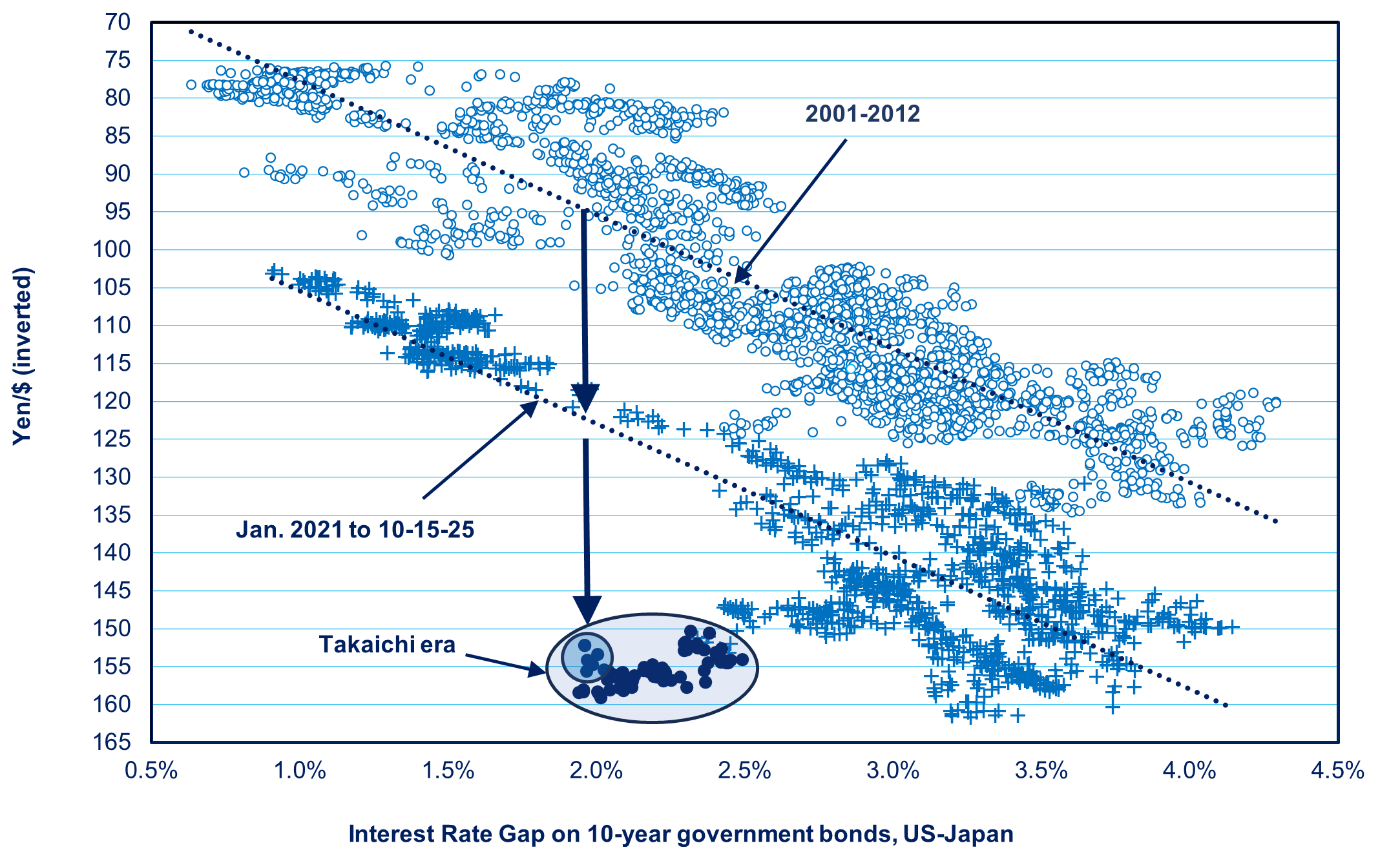
This does not mean carry dynamics, dollar strength, and global risk sentiment are irrelevant; they remain active forces in day-to-day yen pricing. But for the multi-year structural trend, the rate gap has lost much of its predictive power. Katz's summary verdict: "The yen is weak because the Japanese economy and export competitiveness are weak."
When the rate gap was at today's level in 2001-2012, the yen traded at ¥100. Today it sits at ¥157, and the gap is narrowing.
The structural explanation fits the data better over the medium term.
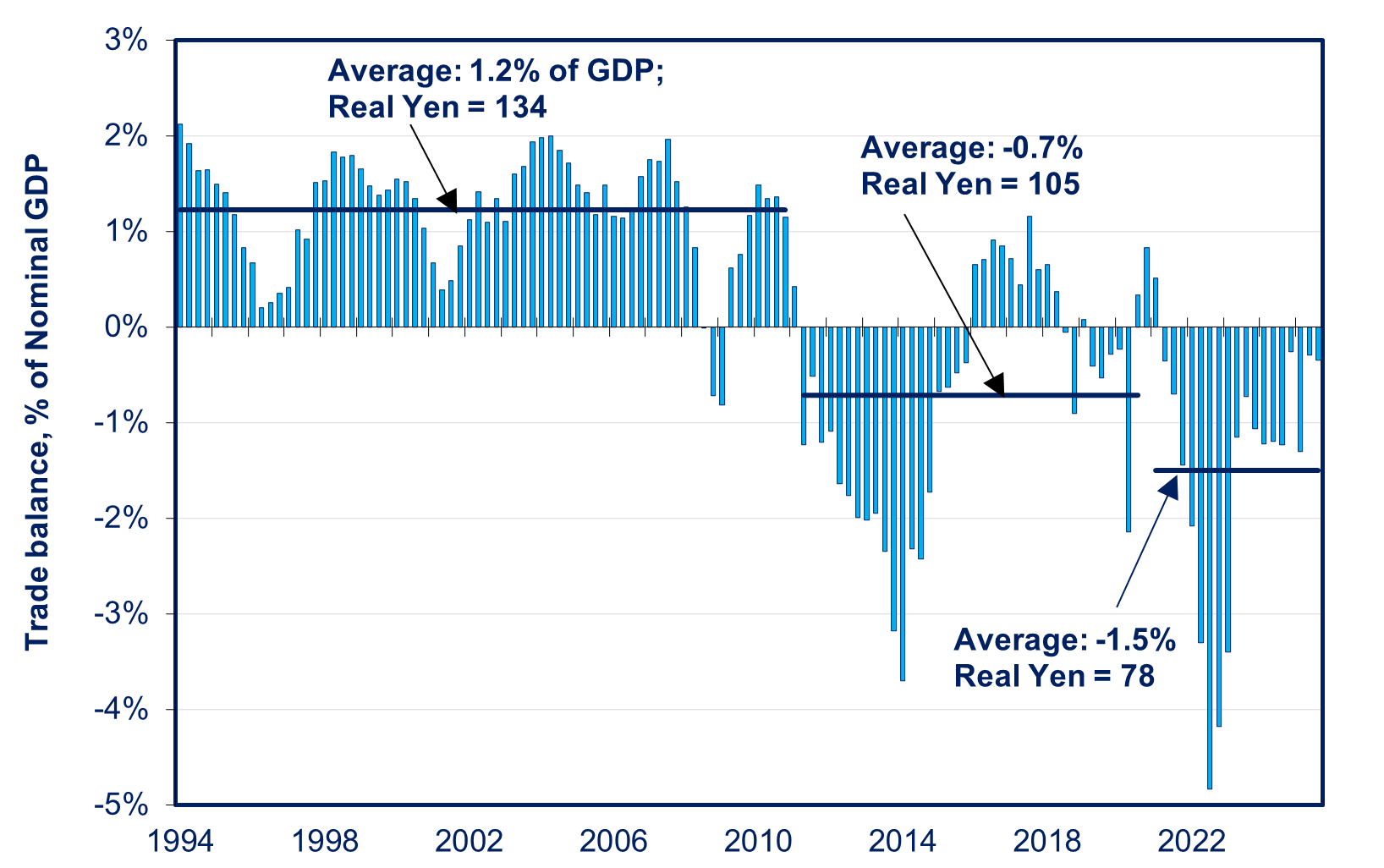
Japan has run a nominal trade deficit for most of the past decade even as the yen depreciated by roughly 43% from 2021. In theory, a cheaper yen should make Japanese exports more price-competitive and improve the trade balance. In practice, real exports over the three years through 2024 rose by approximately 5%, according to Katz's calculations.
That is a weak return from a currency that halved in value.
Much of Japan's manufacturing base had already shifted offshore during the strong-yen era, so the competitive sensitivity to exchange rate moves has structurally declined. Meanwhile, Japan's digital-services trade deficit (Japanese companies paying foreign technology firms for cloud platforms, software, and streaming services) exceeded ¥6 trillion per year in 2024, according to Japan Balance of Payments data. That structural yen selling will not close in response to a 50 basis-point rate hike.
To be sure, this is not an argument against BOJ rate normalization. There are legitimate reasons to raise rates beyond any direct effect on the yen.
Normalization restores the BOJ's conventional monetary toolkit, creates room to cut in future downturns, reduces the long-run fiscal distortion of artificially cheap government borrowing, and signals institutional credibility to investors who have watched Japan operate at the zero lower bound for two decades. Higher rates also reduce the incentive for capital to leave Japan in search of yield, even if the relationship is no longer mechanical. The argument here is narrower: that rate normalization, however desirable on its own terms, is unlikely to deliver the durable yen recovery Washington is demanding when the structural forces driving yen weakness are rooted in competitiveness and trade structure rather than monetary policy alone.
Needing two to tango
The third premise of Bessent's case, that Japan's reserve-selling meaningfully and durably raises U.S. borrowing costs, rests on a real mechanism but overstates the magnitude.
Japan's $1.24 trillion in Treasuries represents roughly 3 to 4 percent of total U.S. federal debt outstanding. Foreign holdings of U.S. debt overall have fallen from approximately 34 percent of the total to around 25 percent over the past twelve years, a structural outflow far larger than any intervention program, without triggering the sustained yield surge the reserve-selling argument implies. The Fed has well-developed instruments to offset specific episodes of foreign Treasury selling.
The more credible channel is sentiment rather than mechanics: the world's largest foreign creditor appearing as a forced seller can move yields episodically through market anxiety, even if the underlying arithmetic is manageable. U.S. officials are right to monitor this; the question is always one of magnitude and duration.
That monitoring sits awkwardly against Bessent's own prior commitments: both governments co-signed a joint statement last September explicitly endorsing Japan's right to intervene against excessive volatility, and Katayama confirmed publicly after the May meetings that Japan's reserve operations were conducted within that agreed framework. The "burning reserves" framing that preceded the Tokyo visit and the framework Bessent himself had co-signed were pointing in substantially different directions.
The carry-trade channel is similarly less acute than it was.
The defining event was August 2024, when a surprise BOJ rate increase triggered the largest single-day carry-trade unwind in years. JPMorgan estimated at the time that roughly three-quarters of speculative yen-carry positions had been closed during that episode, confirmed by Bank for International Settlements analysis of cross-border lending flows.
Residual carry exposure exists: BIS data show elevated yen-denominated lending to offshore financial centers. But the acute speculative overhang that made the trade so feared as a destabilizing force is considerably smaller than it was at the 2024 peak. If two years of sustained carry-trade unwinding have not caused the U.S. Treasury market tremors that alarmists predicted, the remaining stock is unlikely to be the trigger.
The specter of inflation
Rate increases carry their own costs in Japan that the Washington prescription tends to underweigh.
Japan's food prices have risen cumulatively by roughly 20 to 25 percent since 2021, according to Statistics Bureau of Japan data, with specific categories (notably rice) seeing year-on-year increases exceeding 25 percent as recently as early 2026. Food comprises approximately 27 percent of the Japanese household budget, unusually high among developed economies, making food inflation a politically acute issue in a way it is not in the United States.
A supply-driven price surge, caused partly by yen weakness pushing up import costs, is not the kind of inflation that rate hikes cure cleanly; it has already been moderating toward 3 to 4 percent year-on-year as of early 2026. Raising rates into that environment lifts mortgage costs and corporate borrowing expenses without directly addressing the supply-side origin of the price rises.
Japan's fiscal arithmetic offers a less alarming picture than gross-debt figures suggest, though not as sanguine as the narrowest net measure implies.
The Bank of Japan holds 46.3 percent of all outstanding Japanese government bonds, according to BOJ statistics. When the government pays interest on those bonds, much of that interest returns to the government as BOJ profit remittances, a circular flow that the OECD captures in its "general government net interest payments" series, which reached a very low level in recent years before beginning to rise as rates increase and BOJ bond purchases taper.
The gross picture is less comfortable.
The MOF projects gross interest payments on JGBs will rise from ¥10.5 trillion in the current fiscal year to approximately ¥16 trillion within three years, assuming long rates reach 2.5 percent by 2028. That is a genuine fiscal headwind. It is not a cliff edge: 88 percent of JGBs remain in domestic hands, and Japan is a net international creditor, insulating it from the kind of capital-flight dynamic that toppled peripheral European sovereigns in 2010. But it is not something that can be dismissed.
The most revealing moment of Bessent's Tokyo visit may have been what he said after the meetings rather than before them.
Arriving publicly committed to pressing for faster rate increases and framing intervention as a reserve-burning exercise that transferred costs to American borrowers, he left saying he was "confident" Governor Kazuo Ueda would "successfully guide monetary policy" and that "excess volatility is undesirable."
Tokyo read that language as an endorsement of the very intervention operations Bessent had criticized just weeks earlier, according to Bloomberg and Reuters reporting from May 12th.
The arc was wider than the Tokyo meetings alone.
Earlier this year, after a meeting with Finance Minister Katayama in Switzerland, Bessent had authorized a rate check, placing calls to major currency dealers as an unofficial warning that intervention was being considered. A former head of the BOJ's foreign exchange division described the move as something "nobody in the market had probably heard of before" in its impact on speculator positioning. That coordinated act of yen defense preceded his public "burning reserves" rhetoric by weeks.
Whether the full pattern reflects genuinely updated information gathered at each stage of technical talks, or the natural gap between public messaging and private coordination that characterizes all currency diplomacy, or some combination of both, cannot be determined from public statements alone. What is observable is that his pre-visit framing and his actual conduct, taken together, traced a considerably more cooperative arc than his rhetoric suggested.
All that meets the eye
There is a dimension of Bessent's Japan engagement that diplomatic exchanges have not surfaced but that warrants disclosure here.
Before taking office, Bessent ran Key Square Capital Management, a macro hedge fund. In 2022, Key Square posted approximately 30 percent annual returns, in part on a yen depreciation bet. Bloomberg reported in December of that year that Bessent had concluded by 2022 that the BOJ was approaching the "end-game" for its ultra-loose monetary policy, and the fund positioned accordingly. The fund profited substantially from the same yen weakness it is now Treasury policy to reverse. The factual record is clear on this point. The inference, if any, about whether prior financial positioning shapes current advocacy is for the reader to draw.
The factual record creates no automatic inference of improper motivation: investment theses change, circumstances change, and Treasury Secretaries routinely hold policy views that diverge from former fund positions. What it does create is a disclosure that readers are entitled to weigh when evaluating the relative weight to assign his advocacy. No public statement from Bessent has addressed whether his prior yen positioning informs his current policy posture.
The clock might be ticking
Japan now has roughly two more viable intervention windows before November under IMF classification guidelines, according to Bloomberg reporting from May 5th. Beyond those windows, sustained reserve operations risk reclassifying Japan as a currency manipulator.
That is a genuine constraint.
But what happens after those two windows is unlikely to be determined solely by whether the BOJ raises rates from 0.75 percent to 1 percent. A currency that weakens despite a narrowing rate differential, despite $64 billion in support operations, and despite joint diplomatic pressure from the world's largest economy is sending a signal that neither government particularly wants to hear: that the yen's slide reflects the cumulative atrophy of Japan's export competitiveness, the structural drain of its services deficit, and investor uncertainty about growth prospects that a single rate decision cannot resolve.
Bessent is right that intervention cannot paper over these dynamics indefinitely; the IMF constraint will enforce that lesson regardless. He is also right that BOJ normalization is long overdue and genuinely desirable, on its own merits of institutional credibility and policy space, even if not as the singular yen cure he has described on his way into Tokyo.
The disagreement here is not whether Japan should raise rates. It is whether doing so will deliver the currency outcome Washington is demanding, or whether both governments are, for different reasons, treating a structural problem as a monetary one.
Trump said it from Iceland. Bessent said it from Ginza. The market, and a yen that is drifting, has yet to agree with either of them.
The author is the Head of Research and Analysis at Icarus Asia, a Hong Kong-based risk and advisory business. He covered Asia's foreign-exchange markets as a journalist previously.
Notes:
Rate gap of approximately 2 percentage points sourced from Richard Katz, Japan Economy Watch (December 2025).
Historical yen trendlines (¥100 / ¥127 / ¥157 at equivalent rate gaps) sourced from Katz scatter-plot data, December 2025. BOJ JGB ownership of 46.3% from Bank of Japan statistics (December 2024).
Japan U.S. Treasury holdings of $1.24 trillion from U.S. Treasury TIC data (February 2026). MOF gross interest-payment projections (¥10.5T rising toward ¥16T by FY2028) from MOF FY2025 Fact Sheet and USNews/MOF reporting (January 2025).
Digital-services deficit of ¥6T+ from Japan Balance of Payments data, cited in Katz (December 2025). JPMorgan carry-trade estimate from Finance Magnates and BIS Bulletin No. 90 (August 2024).
Food-price cumulative figure (20 to 25 percent since 2021) from Statistics Bureau of Japan CPI data; Katz (February 2026) cited approximately 30 percent, which may reflect selected categories or a different baseline; the 20 to 25 percent figure is the more conservative reading of aggregate food CPI data.
Net interest payments: the OECD general government net interest figure is very low in recent years due to BOJ remittances and the accounting treatment of inter-governmental flows; gross JGB interest costs are higher and rising, as MOF projections show.
Bessent's post-Tokyo statements sourced from Bloomberg and Reuters (May 12, 2026). IMF intervention-window constraint from Bloomberg (May 5, 2026).
The "$280 million 40-year JGB trade" figure sourced from Bloomberg (January 22, 2026).
Trump's Davos "Iceland" statement sourced from the World Economic Forum transcript of his January 2026 special address.
Bessent's August 2025 "behind the curve" and "definite leakage" statements sourced from Central Banking (August 14, 2025) and Bloomberg Television (August 14, 2025).
Akazawa clarification ("expressing an expectation, not a formal demand") sourced from Bloomberg (August 15, 2025).
Key Square Capital Management 30% annual return and yen depreciation bet sourced from Bloomberg (December 28, 2022) and Hedgeweek (same period).
September 2025 US-Japan joint statement endorsing intervention against excessive volatility: confirmed by Finance Minister Katayama, Bloomberg/Reuters reporting (May 12, 2026); see also Yahoo Finance / Bloomberg "Bessent's Deep Grasp" (May 11, 2026).
Rate check authorization following Switzerland meeting with Katayama sourced from Yahoo Finance / Bloomberg "Bessent's Deep Grasp" (May 11, 2026); BOJ former forex division head quote from same source.
Sources & References
Every factual claim in this article is sourced below. Arguments attributed to Richard Katz represent his published analytical positions; our conclusions draw on, sometimes heavily, but are independent from his views and do not claim to represent them in full.
PRIMARY SOURCES: RICHARD KATZ, JAPAN ECONOMY WATCH AND OTHERS
Katz, Richard. "Don't Heed Panic-Mongers On Japanese Interest Rates Or Yen." Japan Economy Watch, December 15, 2025. Source for: the approximately 2.2% rate-gap figure; historical yen trendlines by era (¥100 / ¥127 / ¥156 at equivalent rate gaps); the 88% domestic JGB ownership figure; Japan real export performance (approximately 5% over three years despite 43% yen depreciation); the food-price estimate of approximately 30% from four years prior (note: aggregate Statistics Bureau of Japan food CPI data supports a 20 to 25% cumulative figure; Katz's estimate may reflect selected categories).
Katz, Richard. "Bessent Falsely Blames Japan For Stock Market Revolt Over Trump Threats Over Greenland, Part 1." Japan Economy Watch, February 3, 2026. Source for: the timeline of the January 2026 episode; the Bloomberg-reported $280 million 40-year JGB trade; the 40-year versus 10-year standard deviation distinction (six versus two); Trump's Davos "Iceland" statement; Katz's characterization of Bessent's framing as deliberate misdirection (attributed to Katz, not asserted independently by Icarus Asia).
Katz, Richard. "The Weak Yen Reflects Weak Japan." Japan Economy Watch. Source for the structural competitiveness argument and the nominal trade deficit despite yen depreciation.
Katz, Richard. "Decline of Yen 'Carry Trade' Won't Destabilize US Finances." Japan Economy Watch. Source for the foreign-holdings-of-US-debt decline from approximately 34% to 25% over twelve years without a yield crisis.
Harris, Tobias. "A new opposition leader | Japan Daily Briefing." Observing Japan. Source for Katayama's claim that the Japanese government is seeking to "reform" subsidies and "other special measures" while drawing on non-tax revenue sources.
OFFICIAL DATA & INSTITUTIONAL SOURCES
Bank of Japan. National Government Debt Statistics. Tokyo: BOJ, December 2024. BOJ JGB ownership at 46.3%; domestic institutional ownership at 88.1%.
U.S. Department of the Treasury. Treasury International Capital (TIC) System: Major Foreign Holders of Treasury Securities. Washington D.C.: Treasury, February 2026. Japan holdings confirmed at $1.24 trillion.
Japan Ministry of Finance. FY2025 Japanese Public Finance Fact Sheet. Tokyo: MOF, April 2025. Gross interest-payment projections: ¥10.5T (FY2025) rising toward ¥16T by FY2028.
Bank for International Settlements. BIS Bulletin No. 90: The Market Turbulence and Carry Trade Unwind of August 2024. Basel: BIS, 2024. Cross-border lending channel data; residual carry exposure.
Statistics Bureau of Japan. Consumer Price Index, Japan. Tokyo: Ministry of Internal Affairs and Communications, 2025-2026. Food CPI data supporting the cumulative 20 to 25% gain figure; rice sub-index showing year-on-year increases exceeding 25% in early 2026.
OECD via CEIC. General Government Net Interest Payments, Japan (% of GDP). Note: this narrow net figure reflects BOJ profit remittances to government; it is expected to rise significantly as rates normalize and BOJ tapering proceeds.
International Monetary Fund. Japan: Staff Concluding Statement of the 2025 Article IV Mission. Washington D.C.: IMF, February 2025.
NEWS & MARKET SOURCES
"Japan Bond Wipeout Was Triggered by Just $280 Million of Trading." Bloomberg, January 22, 2026. Source for the $280 million 40-year JGB trade and the illiquidity of that market segment.
"Bessent Shares View With Japan That FX Volatility Is Undesirable." Bloomberg, May 12, 2026. Source for Bessent's post-visit statement of confidence in Ueda and the "excess volatility" framing.
"Japan Has Two More Windows for Yen Intervention by IMF Rules." Bloomberg, May 5, 2026. Source for the IMF classification constraint on future intervention frequency before November.
"Japan's Battle Against the Weak Yen Is Colliding With Economic Reality." CNBC, May 7, 2026. Analyst consensus that intervention has not produced lasting results and that structural differentials persist.
"Yen Carry Trade Unwind: The $250 Billion Market Shockwave." Finance Magnates, August 2024. JPMorgan estimate that approximately 75% of speculative carry positions were closed in August 2024.
"Japan Yen Interventions Face Uphill Battle Against Structural Weakness." Nikkei Asia. Structural weakness framing and export-competitiveness context.
"Japanese Foreign Exchange Policy Riddled in Contradictions." OMFIF, December 2025. Capital outflow and services-deficit framing of intervention limits.
Trump Special Address, World Economic Forum, Davos. WEF, January 2026. Source for Trump's "Iceland" statement and his acknowledgment that the Greenland dispute caused the market drop.
"Trump Only Follows Through About 27% of the Time on Tariffs." Bloomberg, January 27, 2026. Source for the TACO trade framing and tariff follow-through rate cited by Katz.
"Bessent Gets in Touch on Japan Treasuries." Yahoo Finance, January 2026. Direct source for Bessent's "very difficult to disaggregate" and "six standard deviation" statements.
"Bessent Expects BOJ to Raise Policy Rate." Central Banking, August 14, 2025. Source for Bessent's "definite leakage" and "behind the curve" statements in his Bloomberg Television interview; the first public articulation of this argument, nine months before the May 2026 Tokyo visit.
"Akazawa Says Bessent Isn't Asking Japan to Hike Rates." Bloomberg, August 15, 2025. Source for Japan trade negotiator Ryosei Akazawa's clarification that Bessent was expressing an expectation of rate hikes, not making a formal demand — issued one day after Bessent's Bloomberg TV comments.
"Ex-Soros CIO Bessent Leads Key Square to 30% Return With Yen Bet." Bloomberg, December 28, 2022. Source for Key Square Capital Management's approximately 30 percent annual return, in part on a yen depreciation bet, and Bessent's 2022 view that the BOJ was approaching the "end-game" of its ultra-loose policy.
"Bessent's Deep Grasp of Japan Policy to Challenge Takaichi." Yahoo Finance / Bloomberg, May 11, 2026. Source for: Bessent's rate check authorization following a Switzerland meeting with Katayama; the former BOJ forex division head's quote on its unprecedented market impact; the September 2025 US-Japan joint statement framework endorsing intervention against excessive volatility; Katayama's confirmation that Japan's operations were conducted within that framework.
Disclaimer: This article presents an analytical position, that structural factors now dominate medium-term yen weakness more than the interest-rate gap does. That is grounded in cited data but represents editorial judgment, not established fact. Counter-arguments exist: carry dynamics, dollar strength, and risk sentiment drive yen pricing session-to-session, and rate normalization has benefits for BOJ credibility and capital attraction independent of its yen effects. The headline is explicitly editorial framing.