
News · Ideas · Japan, India
When the Cure Makes Things Worse
A new I.M.F. study shows that rate increases hit hardest when economies are already hurting -- precisely when central banks are most likely to reach for them.
On the last day of April, the Bank of Japan stepped into the currency market and spent roughly $34.5 billion in a single session to shore up a yen that had been sliding against a surging dollar. It was the bank's largest intervention in nearly a year and, by any measure, a show of institutional resolve. What it did not do was solve anything.
Japan imports virtually all of its oil and natural gas. Every barrel of crude it buys is priced in dollars. As the yen loses ground, that energy becomes more expensive in yen terms, pushing up inflation and putting the central bank under pressure to raise interest rates. Higher rates, in theory, support the yen by attracting capital from abroad. They also risk choking off economic growth. The dollar reserves Japan spent defending its currency that day are the same reserves it uses to pay for crude.
This is the loop that has been tightening around oil-importing economies for much of the past year.
For example in India, the central bank has been selling dollars at a pace that has pushed its net-short position in dollar contracts toward record levels near $100 billion. The country is the world's third-largest oil importer. On Thursday, the Reserve Bank of India reportedly sold the dollar "heavily" before markets opened to help the rupee recover from a series of all-time lows. This came as Bloomberg News reported that is the central bank hasn't ruled out all available options, including an interest-rate increase.
Neither Japan nor India, or dozens of others running the same arithmetic on their reserve balances has found an effective solution.
A new working paper from the International Monetary Fund argues that the trap may be harder to escape than most central banks have modeled. The study, by four economists at the specialized agency of the United Nations, provides detailed statistical evidence that interest rate increases cause far more economic damage when conditions are already bad. That is the state many oil-importing developing economies are currently in.
Asking the Right Question
The paper, "When Policy Bites: State-Dependent Monetary Policy Transmission in Emerging Markets," examined quarterly data from 11 large, inflation-targeting emerging economies with floating exchange rates: Brazil, Chile, Colombia, Hungary, India, Indonesia, Mexico, Peru, Poland, Russia and Thailand. The dataset runs from 1996 to early 2025, yielding 763 observations.
Rather than studying average effects, the economists asked a sharper question: Does the same rate increase hit differently depending on where an economy already stands?
To isolate the effects they cared about, they used private-sector forecast errors compiled by Consensus Economics -- essentially the portion of each central bank decision that professional forecasters failed to anticipate -- as a proxy for monetary policy shocks. This technique strips out rate moves that markets had already priced in, and the influence of economic conditions on both the rate decision and the outcome.
They then tracked what a 100-basis-point tightening (one percentage point) did to output and consumer prices across the following three years, comparing results under three distinct sets of conditions: the state of the business cycle, the prior monetary policy stance, and the level of trend inflation.
The timing couldn't be worse
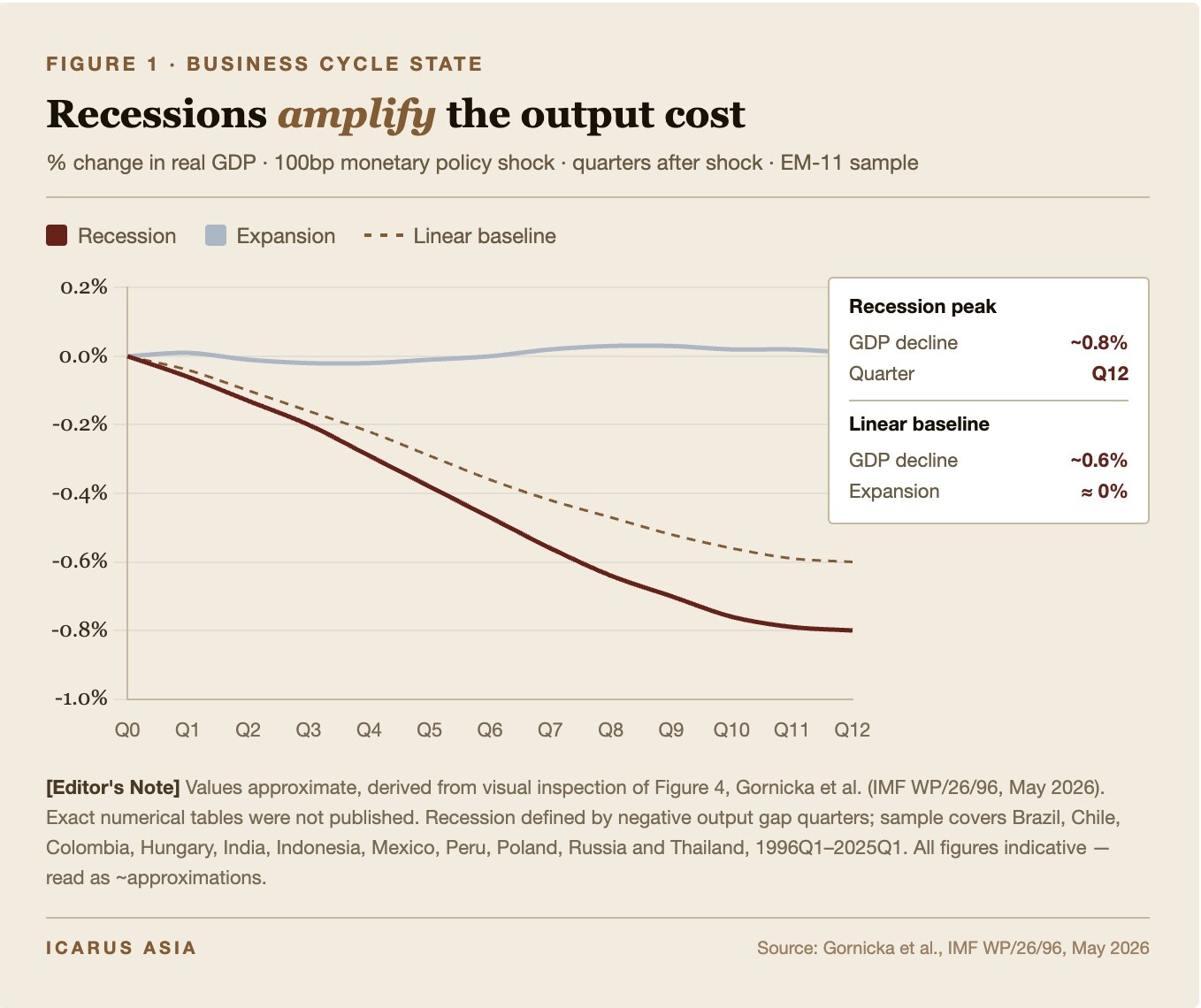
The business cycle finding is the study's starkest result.
During recessions, a one-percentage-point rate increase shrank output by roughly 0.8 percent over three years. During expansions, the same move had almost no measurable effect. The authors trace the gap to a straightforward mechanism: in a downturn, households and businesses are already running close to their borrowing limits. When rates rise, they can't absorb the added cost -- spending and investment fall harder than they would in normal times.
An Explainer
Think of a rate increase as adding weight to a backpack. Walking on flat ground with a light load, a few extra pounds barely slow you down. But if you're already carrying everything you own up a hill -- which is closer to what households and companies look like during a recession -- the same added weight can buckle your knees.
The I.M.F. paper puts numbers to that intuition. A one-percentage-point rate increase shrank output by roughly 0.8 percent when the economy was already contracting, and by almost nothing during expansions. The mechanism is debt: in a recession, more borrowers are already at or near their credit limits. Higher rates push them over the edge. In an expansion, when balance sheets are healthier, the same move gets absorbed.
The findings on monetary policy stance are closely related.
Countries that kept policy rates below their neutral level for extended periods -- as many emerging markets did during and after the pandemic -- are substantially more exposed when rates eventually rise. In those loose-stance states, the peak GDP contraction from a 100-basis-point shock runs roughly double what a standard linear model predicts. Prolonged loose policy encourages risk-taking and debt accumulation; when rates finally rise, over-leveraged borrowers hit their limits faster. Investment falls. Credit contracts sharply.
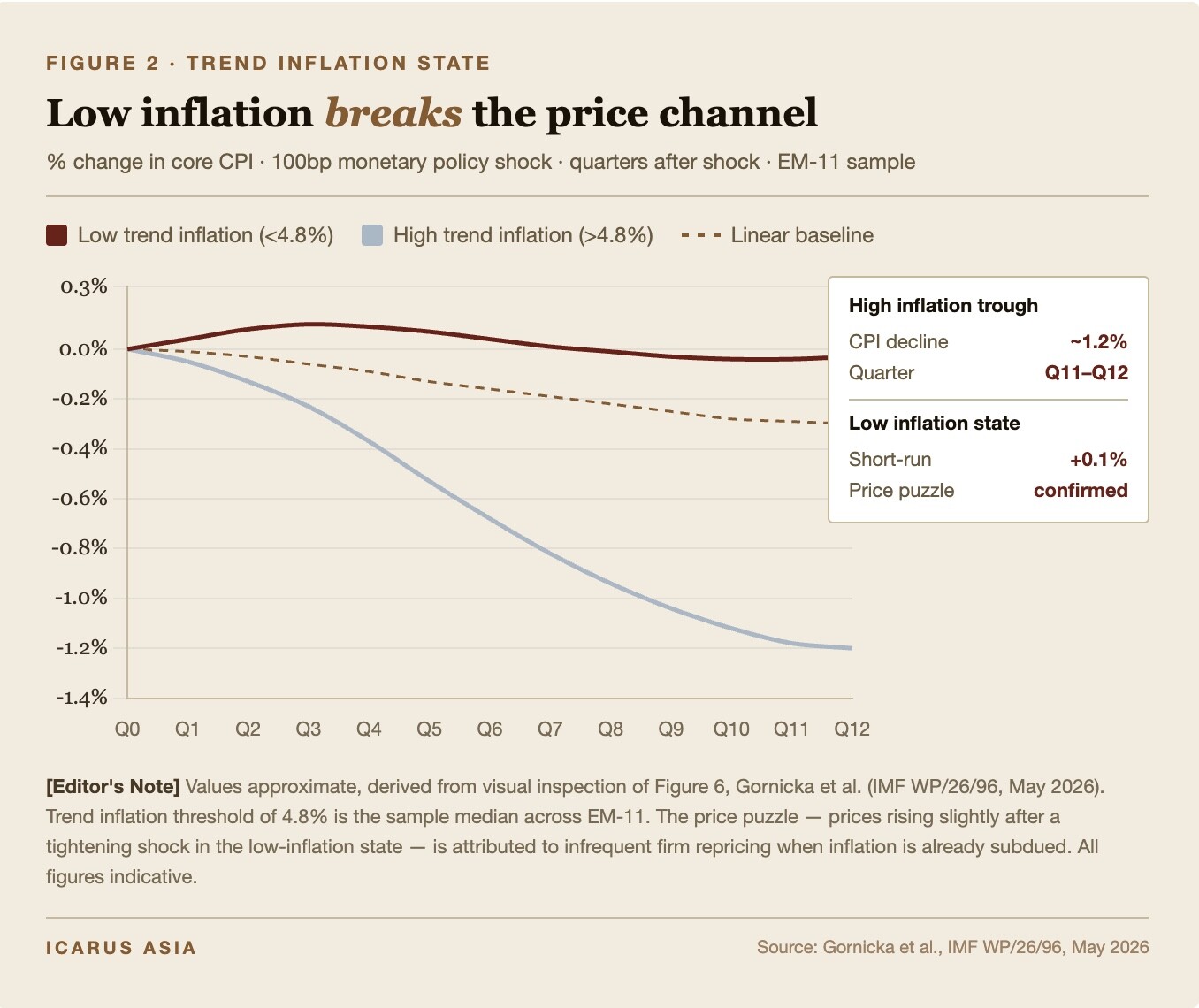
The trend-inflation finding carries its own uncomfortable logic. The economists drew the threshold at 4.8 percent, the median for the study's sample.
In countries where trend inflation -- the medium-run pace of price growth, not the volatile monthly figure -- is running below that level, a rate increase causes the most output damage: a peak GDP decline of roughly 1 percent, close to double the baseline estimate. And yet, in those same low-inflation conditions, prices barely respond. They actually rise slightly in the short run, a phenomenon the literature calls a price puzzle, which the authors attribute to how infrequently companies reprice when inflation is already subdued. Higher rates squeeze output. The prices they were meant to cool stay put.
The mirror image holds in high-inflation environments, where rate increases produce a cumulative core consumer price decline of roughly 1.2 percent over 11 quarters and relatively muted output costs. The tool works as intended only when inflation is already a problem.
For emerging markets that spent the past several years fighting post-pandemic price increases and largely succeeded, the implication is a policy reversal. Having beaten inflation down to low-trend levels, they now find themselves in the state where rate increases cause maximum economic damage and minimum price relief.
Whipping a hurting horse
Part of what makes the output effects so large runs through the banking system.
In the study's baseline estimates, a 100-basis-point tightening produces a peak decline in real credit to the private sector of roughly 1.6 percent, nearly three times the magnitude of the output decline.
The authors read that gap as evidence of credit supply effects: higher rates push down collateral values and raise perceived credit risk, prompting banks to tighten standards and cut lending even to borrowers who would otherwise qualify. The contraction in economic output arrives not only through demand -- people and companies borrowing less because money costs more -- but through supply, as credit becomes harder to get regardless of willingness to pay.
In a recession, this squeeze is sharper.
Companies that have already exhausted their credit headroom have nowhere to turn when rates rise. Investment falls faster. The exchange rate may appreciate briefly as higher rates attract some capital from abroad, but the appreciation is temporary. The output damage from the credit contraction outlasts it.
Countries that raise rates partly to defend their currencies through that initial exchange rate effect end up paying for it in weaker growth for years afterward.
Revisiting assumptions
The study is partly a methodological argument with a substantial body of prior work.
Earlier research on state dependence in monetary policy relied largely on a statistical technique the authors say produces systematically biased results in small samples -- a relevant problem for datasets covering a handful of countries over a few decades.
The most cited prior result pointed in the opposite direction: a 2016 paper by Silvana Tenreyro and Gregory Thwaites found that U.S. monetary policy was less effective in recessions, implying central banks were overestimating the growth consequences of rate increases during downturns. More recent research, using better-identified shocks, reversed that conclusion. The I.M.F. authors extend the correction to emerging markets. Their results align with recent U.S. findings by Roberto de Santis and Tommaso Tornese and by Jeremy Piger and Thomas Stockwell, both of which found recession-state effects to be larger once identification problems are addressed.
The conventional wisdom had assumed that rate increases hit hardest when economies are strong and borrowers are stretched. That logic, it turns out, describes a world where borrowing constraints bind all the time. When they bind only sometimes -- only in bad times -- the logic inverts: tightening does little during expansions, when balance sheets are healthy, and does a great deal during downturns, when they aren't.
If the models driving rate decisions are calibrated on the older, reversed finding, those decisions are systematically mispriced. The 11 central banks in the study may be deploying stronger doses than their own frameworks suggest.
Doing What Economists Do Best
The authors are explicit about what the study cannot tell a policymaker. It does not recommend a course of action. It does not model the alternative of letting a currency depreciate rather than increasing rates. It does not treat the current episode of dollar strength and capital outflows as a separate state-dependent variable -- a gap the authors flag as a direction for future research -- and its data ends in early 2025, before Japan's most recent interventions and before India's reserve position reached its reported extremes in 2026.
The 11 countries in the sample all maintain explicit inflation targets and floating exchange rates. The findings apply most directly to countries sharing those institutional features. Japan operates under a different framework; its inclusion in this discussion reflects its energy-import dependence rather than a direct match to the study's sample.
To be sure, the paper cannot tell the Reserve Bank of India, or the Bank of Japan, what rate to set. What it establishes is that the standard models those institutions rely on to estimate the cost of tightening may be undercounting the damage, and that the conditions most likely to produce that undercounting are the conditions many oil-importing emerging markets face right now.
The Clock on the Reserves
Japan and India have both demonstrated a willingness to spend tens of billions rather than let their currencies slide further. Japan's April 30 intervention of roughly $34.5 billion followed a precedent set in July 2024, when the Bank of Japan spent about $36.8 billion; reports indicate additional interventions during the early May 2026 holidays. India's Reserve Bank reported net dollar sales of $31.98 billion between January and October 2025, including $11.87 billion in October alone; by early 2026, the R.B.I.'s net-short dollar position in forward contracts was approaching record levels near $100 billion.
Those stockpiles are large but not bottomless. And the reserves being spent to support the yen and the rupee are the same reserves both countries rely on to buy the oil they cannot produce themselves.
The I.M.F. study does not resolve that constraint. It sharpens it.
The author is the Head of Research and Analysis at Icarus Asia, a Hong Kong-based risk and advisory business
Source: "When Policy Bites: State-Dependent Monetary Policy Transmission in Emerging Markets," I.M.F. Working Paper WP/26/96, Lucyna Gornicka, Sumaiyah Mirza, Vina Nguyen and Jerome Vandenbussche, May 2026.