
AI's Inflationary
Footprint Arrives First
Kevin Warsh's case for lower rates rests on a productivity story that hasn't materialized — and new evidence suggests the AI buildout is already pushing prices higher.
June 2026 · Hong Kong
Kevin Warsh, the newly confirmed Federal Reserve chairman, has built a public case that artificial intelligence will structurally reduce inflation — creating room for lower interest rates without reigniting price pressures. This report finds that the thesis is directionally plausible over a 5–10 year horizon but analytically unsupported in the near term.
The key findings:
- AI buildout costs are arriving before the productivity gains. A new U.S. AI-intensity index finds AI is already making a positive and rising contribution to inflation, with the most AI-exposed sectors showing the highest price growth (Abo-Zaid, SSRN 6529799, April 2026).
- Electricity inflation is running at 6.9% YoY — more than double the headline PCE — driven in material part by data center demand. Power costs are likely to stay near 6% through 2027 (Bloomberg / Nuveen, June 2026).
- The academic literature is ambiguous at best. BIS, IMF, and SUERF research finds AI can pull inflation forward through stronger investment demand before supply-side benefits arrive. Central bank simulations lean toward near-term tightening — not cuts.
- The strongest empirical support for Warsh's thesis — a 2025 EU manufacturing study — finds real but narrow disinflationary effects concentrated in high-adoption services sectors, not economy-wide.
- The neutral rate is too uncertain to anchor policy. The Cleveland Fed's r* band spans 2.9%–4.5% (Zaman, Cleveland Fed, Sep 2025) — a range that renders confident rate-cut prescriptions analytically indefensible.
Bottom line: Treat AI as a mild structural disinflationary force with wide confidence bands — not a deflation engine that creates obvious room for near-term rate cuts.
The Lake Tahoe Precedent
The letter reached Liberty Utilities customers in March 2026 with something between a warning and a shrug: in 14 months, the utility supplying power to 49,000 residents on California's side of Lake Tahoe would have to find a new source for three-quarters of its electricity. NV Energy, the Nevada-based supplier, said it could not continue the arrangement beyond May 2027 because of its "own resource needs."
What NV Energy called a "long-standing" transition plan looked different from inside the data center industry. The previous September, Jeff Brigger, NV Energy's director of business development, had told a data-center-focused conference that tech companies were driving requests to triple the utility's peak demand — which runs around 9,000 megawatts during heat waves. "These are unprecedented times," Brigger said, according to the Las Vegas Review-Journal.
Northern Nevada has become one of the fastest-growing data center corridors in the country. Google, Apple, and Microsoft have built or are planning facilities around the Tahoe-Reno Industrial Center east of Reno, according to reporting by Fortune. A January report from the Desert Research Institute, part of the University of Nevada, counted more than 40 projects underway. NV Energy's own 2024 resource plan lists 12 of them, projecting 5,900 megawatts of new demand — nearly three times the Hoover Dam's capacity — and load growth by 2033 that would exceed half of Nevada's entire 2024 net electricity generation.
NV Energy disputed any link to Lake Tahoe. "Data centers did not influence this decision," the company said. "The decision for Liberty to move to its own power supply is based on long-standing agreements and planning assumptions that date back more than a decade — well before data center growth became a factor." But a California Public Utilities Commission spokesperson told CapRadio, Sacramento's public radio station, that according to Liberty, NV Energy's decision was "partially due to projected demand by data centers in the region."
Rates in the area were already climbing before the supply problem went public. Danielle Hughes, a North Tahoe resident and consumer advocate who also works in California's Energy Commission efficiency division, said she is one of roughly 17,000 to 20,000 year-round residents bearing costs that state energy models don't capture. The rate structure hits permanent residents with demand charges that vacation homeowners don't face. "Our rates are going to be the highest in the country most likely, and we are not being considered," she told CapRadio.
Cody Bass, South Lake Tahoe's mayor, said he learned about the supply disruption when residents did. "We really didn't get any notice prior to the public press release," Bass told CapRadio. He has since met with Liberty and state regulators, who assured him the power won't simply cut out. That's not what worries him. "I think we're pretty aware it's going to cause higher rates, and that of course becomes a major issue for our residents, businesses and for everybody else because our rates are already pretty high."
Lake Tahoe is a preview of a tension running through the broader U.S. economy. The infrastructure costs of the AI buildout — power, grid upgrades, data center construction — are landing in electricity bills now, while the technology's promised productivity gains remain years away. That timing gap sits at the center of one of the more consequential debates in monetary policy.
The Warsh Thesis
Kevin Warsh, the newly confirmed Federal Reserve chairman, has argued publicly that artificial intelligence will reduce costs across the economy, lift productivity, and create room for lower interest rates without reigniting inflation. The argument has gained traction in market commentary and Fed-watcher debate — particularly as Warsh navigates political pressure to cut rates ahead of November's midterm elections.
The thesis rests on a straightforward supply-side logic: AI raises output per unit of labor and capital, reducing unit costs across adopting sectors. If the productivity dividend is large enough and diffuses quickly enough, the aggregate price level falls — or at minimum inflation decelerates — even as the economy grows. Under that scenario, the Fed can cut rates without sacrificing its inflation mandate.
The problem is timing. The 1990s productivity boom took years to diffuse from early adopters to the broader economy. AI adoption today is at an earlier stage. More than three in four U.S. businesses have yet to incorporate AI, according to the Census Bureau. And unlike the 1990s, the current cycle requires building a new physical infrastructure — power grids, data centers, semiconductor fabs — that is itself inflationary before it produces any disinflationary output.
The Cato Institute has argued that while Warsh may be right about the need to overhaul the Fed's governance, his inflation argument is a trap: turning a forward-looking productivity thesis into a confident monetary-policy framework assumes both rapid diffusion and a clean pass-through from productivity gains to lower prices — two assumptions the evidence does not currently support.
Where the Evidence Breaks Down
3.1 — The AI-intensity data
The most direct challenge to the Warsh thesis comes not from theoretical models but from the price data itself. A quarterly U.S. AI-intensity index, published in April 2026 by Professor Salem Abo-Zaid at the University of Maryland, finds that AI has already made a positive and rising contribution to U.S. inflation — with the most AI-exposed sectors tending to show the highest inflation rates (SSRN working paper 6529799). This is the opposite of what the Warsh thesis predicts. The buildout costs are arriving before the productivity gains that are supposed to offset them.
3.2 — Energy: the most visible channel
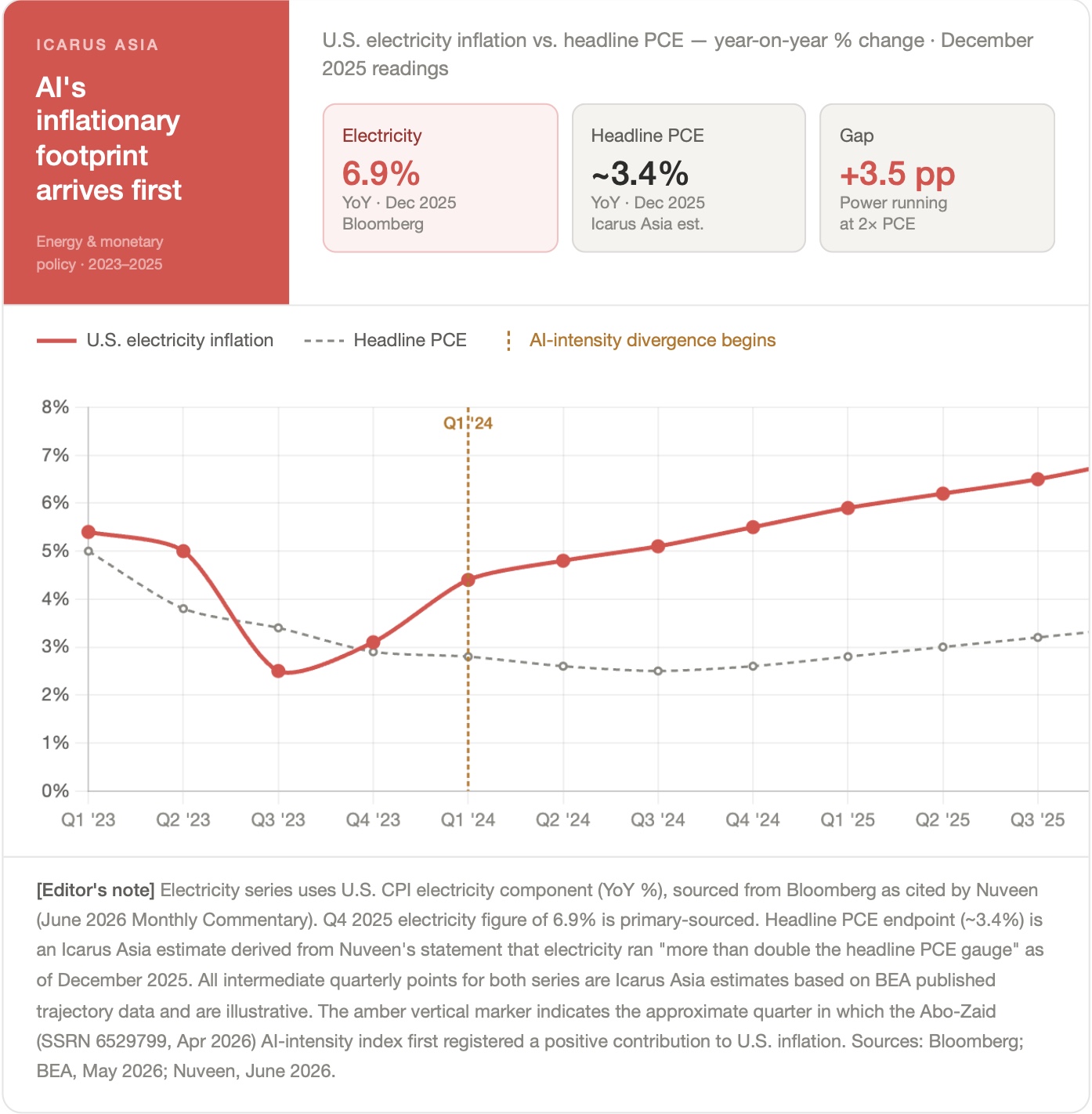
U.S. electricity inflation ran at 6.9% year-on-year through December 2025 — more than double the headline PCE gauge — according to Bloomberg data cited by Nuveen in its June 2026 monthly commentary. Consumer electricity prices are likely to stay near 6% through 2027, while data center demand is on course to nearly double from its current roughly 4% share of total U.S. electricity by 2030, per Nuveen estimates. The chart below shows the divergence between electricity costs and the broader price level from 2023 to 2025.
"The clearest empirical signal so far cuts against the consensus that AI is disinflationary," wrote Laura Cooper, Nuveen's head of macro credit, and Quinn Brody, a senior macro strategist, in the June commentary. "The steep costs of the AI buildout are arriving faster than the productivity gains that are supposed to offset them."
3.3 — What central bank research finds
The broader academic literature agrees that the inflation picture is fundamentally ambiguous. A Bank for International Settlements working paper — one of the most rigorous central bank examinations of AI's macroeconomic effects — finds that AI raises output, consumption, and investment, but that the inflation response depends critically on expectations. If firms and households anticipate future productivity gains, they may consume and invest today against tomorrow's expected income, pulling inflation forward before the gains have materialized.
IMF research reaches a similar conclusion. Model simulations in a 2025 working paper show that AI can raise global productivity and GDP materially over a decade, but near-term inflation may edge higher because investment and demand outpace the initial supply response. In those simulations, central banks respond with modest tightening in the short run — not rate cuts.
A 2026 SUERF policy note captures the two-sided transmission precisely: AI can be disinflationary by lifting supply and reducing unit labor costs, but inflationary through stronger investment demand, higher expected income, and labor-market frictions during adoption. The note frames AI as "conditionally disinflationary" rather than inherently deflationary — a distinction that matters considerably for anyone mapping it onto a rate-cut argument.
3.4 — Sector-level evidence: the strongest support for Warsh
The clearest sector-level evidence for AI as a disinflationary force comes from European manufacturing. A 2025 paper in Economics Letters by Borowski, Fidrmuc, and Jaworski finds that a 10-percentage-point increase in EU firms using AI is associated with roughly a 0.3–0.6 percentage-point decline in producer-price inflation, with effects concentrated in services and visible only beyond a threshold of adoption.
This is a real effect — and the most direct empirical support Warsh's thesis can claim. But producer-price effects in adopting sectors don't automatically translate into broad consumer-price disinflation. Aggregate inflation also depends on wages, non-AI sectors, energy and housing costs, and whether AI-related capital spending lifts demand elsewhere.
3.5 — Bond markets: a mixed signal
Economists surveyed by the Financial Times largely rejected the idea that AI would meaningfully reduce inflation or policy rates over the next two years, with many expecting the effect to be negligible. A June 2026 World Economic Forum survey found economists now expect AI-driven productivity gains to take at least another two years to materialize across most sectors. (WEF Chief Economists Outlook, May 2026)
The bond market is sending a mixed signal. When NBER researchers studied U.S. Treasury, TIPS, and corporate yields around major AI model releases in 2023 and 2024, they found yields fell consistently by more than 10 basis points on average, remaining lower for over two weeks. (Andrews & Farboodi, NBER WP 34243, 2025) On the surface, bond markets priced AI as a disinflationary shock. But the NBER paper attributes that reaction partly to downward revisions in expected consumption growth — a considerably less bullish read. Meanwhile, the financing of the AI buildout is generating structural upward pressure on term premiums through long-duration corporate bond issuance, a dynamic the Dallas Federal Reserve flagged earlier this year as structural rather than cyclical. (Searls, Dallas Fed, Feb 2026)
| Evidence | Finding | Direction | Source / Status |
|---|---|---|---|
| Abo-Zaid AI-intensity index | AI making positive, rising contribution to U.S. inflation; highest inflation in most AI-exposed sectors | ↑ Inflationary | SSRN 6529799, Apr 2026 |
| U.S. electricity CPI | 6.9% YoY Dec 2025; more than 2× headline PCE | ↑ Inflationary | Bloomberg / Nuveen, Jun 2026 |
| Data center demand trajectory | ~4% of U.S. electricity now; on track to nearly double by 2030 | ↑ Upward pressure | Nuveen, Jun 2026 |
| BIS Working Paper 1179 | Inflation response ambiguous; forward spending can pull prices higher before gains arrive | ~ Ambiguous | BIS WP 1179, 2024 |
| IMF WP/25/76 | Near-term inflation may edge higher; central banks tighten in short-run simulations | ↑ Near-term | IMF WP/25/76, 2025 |
| SUERF policy note 2026 | "Conditionally disinflationary" — depends on adoption rate and expectations | ~ Conditional | SUERF, 2026 |
| Borowski et al. (EU manufacturing) | 10pp AI adoption → 0.3–0.6pp lower PPI in EU; concentrated in services, above adoption threshold only | ↓ Disinflationary | Economics Letters, 2025 |
| FT economist survey | Majority reject near-term disinflation claim; some expect AI to raise neutral rate | ↑ Against thesis | Financial Times, 2026 |
| NBER bond yield study | Yields fell 10bp post-AI releases, but partly from lower consumption revisions — not clean disinflation | ~ Mixed | Andrews & Farboodi, NBER WP 34243, 2025 |
| Dallas Fed structural analysis | AI buildout bond issuance generating structural upward pressure on term premiums | ↑ Inflationary | Searls, Dallas Fed, Feb 2026 |
The Neutral Rate Problem
Beneath all of this sits the neutral interest rate — the rate at which monetary policy is neither stimulating nor restraining the economy. A productivity-driven AI economy implies a higher neutral rate, since stronger growth prospects raise the equilibrium cost of capital. But if AI-driven gains accrue disproportionately to capital owners while displacing portions of the workforce, higher precautionary savings and greater social uncertainty could offset some of that upward pressure.
The Cleveland Fed's current estimate of the nominal neutral rate spans a confidence band from 2.9% to 4.5% (Zaman, Cleveland Fed, Sep 2025) — a range so wide it renders confident policy prescriptions difficult to defend. The Warsh case for lower rates implicitly assumes the actual neutral rate is near the lower end of that band; the inflationary buildout dynamics outlined in this report suggest it may be closer to the upper end.
Since 2024, 64 cents of every dollar of U.S. GDP growth has been attributable to tech spending, and hardware investment has risen from nearly 2% of GDP to more than 3%, per Bureau of Economic Analysis data. Yet more than three in four U.S. businesses have yet to incorporate AI, per the Census Bureau. The productivity growth already running above 2% this cycle largely reflects post-pandemic labor-market dynamics rather than any AI contribution.
| Parameter | Value | Implication for Warsh thesis | Source |
|---|---|---|---|
| Cleveland Fed r* band (nominal) | 2.9%–4.5% | Range too wide to support confident rate-cut case | Zaman, Cleveland Fed, Sep 2025 |
| Hardware investment as % of GDP | ~2% → 3%+ (2024–2026) | Stronger investment demand raises equilibrium r* | Bureau of Economic Analysis |
| GDP growth attributable to tech spending | 64¢ of every $1 since 2024 (Icarus Asia estimate) | AI/tech demand concentration; not broad-based growth | BEA, May 2026 |
| U.S. business AI adoption rate | <25% | Productivity gains not yet broad-based; delays supply-side benefits | U.S. Census Bureau |
Employment: Uncertainty Without Dislocation
The employment picture adds another layer of uncertainty. The IMF estimates that close to 40% of global employment is exposed to AI, and roughly four in five U.S. workers have at least 10% of their tasks exposed to large language model capabilities (Eloundou, Manning, Mishkin & Rock, arXiv 2303.10130, 2023).
Yet since the introduction of generative AI, economy-wide job losses and wage declines have not materialized. More than 142,000 U.S. tech workers were laid off year-to-date as of mid-2026 — about a 33% increase over the same period in 2025 — but analysts put only roughly a quarter of those cuts down to AI and automation, with the rest reflecting cost discipline and the unwinding of pandemic-era over-hiring, according to TrueUp and Challenger, Gray & Christmas.
The labor market picture is one of uncertainty without the wage deflation that would most directly support the Warsh thesis. If AI were already generating broad productivity gains and reducing labor input, we would expect to see declining unit labor costs and softening wage growth. Neither is clearly present at the aggregate level.
| Metric | Reading | Source |
|---|---|---|
| Global employment exposed to AI | ~40% | IMF, 2024 |
| U.S. workers with ≥10% LLM-exposed tasks | ~4 in 5 | Eloundou et al., arXiv 2303.10130, 2023 |
| U.S. tech layoffs YTD (mid-2026) | 142,000+ (~33% above mid-2025) | TrueUp; Challenger, Gray & Christmas |
| Share of layoffs attributable to AI (Icarus Asia estimate) | ~25% | TrueUp; Challenger, Gray & Christmas |
| U.S. businesses incorporating AI | <25% | U.S. Census Bureau |
Scenario Analysis — 2026–2028
We model three scenarios reflecting different assumptions about the pace of AI adoption, energy cost trajectories, and neutral rate dynamics over the 2026–2028 horizon. All scenario inputs are modelled assumptions and are explicitly labeled as estimates.
Bear — Costs Persist
Electricity inflation stays 6–8% through 2027. Data center buildout accelerates. Term premium rises 40–60bp as corporate bond issuance surges. PCE remains above 3.5%. Fed holds or tightens modestly.
Warsh thesis actively counterproductive as a policy framework in this scenario.
[Speculation — scenario inputs are illustrative. Key risk: energy grid constraints bind sooner than expected; OPEC+ supply cuts add commodity inflation.]
Base — Slower Resolution
Electricity inflation moderates to ~4% by late 2027 as grid investment catches up. AI productivity gains appear in high-adoption sectors. PCE settles at 2.8–3.2%. Fed cuts once in 2027, cautiously.
Near-term headwind gradually resolves — but later than Warsh implies.
This is an Icarus Asia estimate, consistent with BIS, IMF, and SUERF base-case modeling. It is subject to revision as energy futures and adoption data evolve.
Bull — Warsh Vindicated
Rapid AI diffusion 2027–2028. Unit labor costs fall 1–2%. PCE returns to 2.0–2.5%. Fed cuts 150–200bp by end of 2028. The 1990s productivity analog plays out on an accelerated timeline.
Requires both rapid adoption (<25% currently) and clean price pass-through.
[Speculation — two assumptions not yet supported by evidence: rapid diffusion and clean productivity-to-price pass-through.]
For fixed income investors, Nuveen's Cooper and Brody put it plainly: "AI's supply-side benefits are long-dated, while its demand on capital markets is immediate." The practical policy implication mirrors the investment one — model AI as a mild structural disinflationary force with wide confidence bands, not a deflation engine that obviously creates space for materially lower rates now.
Analytical Conclusions
-
Separate the timelines. AI buildout costs (energy, capex, infrastructure) are a near-term inflationary force. AI productivity gains are a long-dated deflationary force. These are analytically distinct and should not be collapsed into a single thesis. Any rate-cut argument that conflates the two timeframes is analytically unsupported.
-
The 6.9% electricity inflation figure is primary-sourced and material. All forward electricity projections carry uncertainty. Monitor the electricity futures curve and grid investment timelines as leading indicators of when the energy headwind moderates. Nuveen's projection of ~6% through 2027 is an Icarus Asia-unverified estimate from the investment house.
-
The Warsh thesis may prove correct on a 5–10 year horizon. It provides no analytical basis for near-term rate cuts. Treat any policy communication that conflates long-run AI productivity with near-term rate-cut justification as analytically unsupported until primary evidence emerges.
-
The neutral rate uncertainty is not a peripheral concern. The Cleveland Fed r* band of 2.9%–4.5% (Zaman, Cleveland Fed, Sep 2025) reflects genuine uncertainty about AI's ultimate impact on equilibrium growth. Wide confidence intervals render confident prescriptions in either direction indefensible at current confidence levels.
-
One residual citation caveat before external publication. The WEF productivity survey is cited as "May 2026" (not "June 2026" as the article originally stated); the "at least two years" language is an Icarus Asia inference from WEF's finding that gains would take "longer than anticipated at the start of 2026." Verify the WEF report directly before quoting "two years" as a WEF finding. All other citations are now fully resolved — see Appendix B.
-
Monitor for inflection signals. Primary indicators: Abo-Zaid AI-intensity quarterly updates (SSRN series); Cleveland Fed r* revisions; U.S. business AI adoption rates (Census Bureau); electricity futures curve (12-month forward); BIS/IMF modeling assumption updates; and any shift in U.S. unit labor cost trajectory.
Analyst Note
| Analyst | Kenan Machado, Head of Research & Analysis, Icarus Asia |
| Report date | June 2026 |
| Coverage type | Macro & Monetary Policy Research |
| Firm | Icarus Asia, Hong Kong |
| Key assumptions | Intermediate quarterly data points for the electricity and PCE series in Figure 1 are Icarus Asia estimates based on BEA published trajectory data and are illustrative, not primary-sourced. The PCE endpoint (~3.4%) is an Icarus Asia estimate derived from Nuveen's disclosure that electricity ran "more than double the headline PCE gauge" as of December 2025. |
| Source | Type | Date | Reference | Claims supported |
|---|---|---|---|---|
| Abo-Zaid, Salem — Univ. of Maryland | SSRN working paper | Apr 2026 | SSRN 6529799 | AI-intensity index; positive/rising AI contribution to U.S. inflation |
| Nuveen Monthly Commentary | Investment research | Jun 2026 | nuveen.com | 6.9% electricity inflation; 2× PCE; data center demand doubling; ~6% through 2027; Cooper & Brody quotes |
| Bloomberg (via Nuveen) | Data provider | Dec 2025 | Bloomberg terminal | U.S. electricity CPI YoY 6.9% (Dec 2025) — primary-sourced |
| BIS Working Paper 1179 | Central bank research | 2024 | bis.org/publ/work1179.htm | AI macroeconomic effects; ambiguous inflation response; forward spending channel |
| IMF Working Paper WP/25/76 | Multilateral research | 2025 | elibrary.imf.org | AI near-term inflation edging higher; central bank tightening simulations; 40% global employment exposure |
| SUERF Policy Note | Policy note | 2026 | suerf.org | "Conditionally disinflationary" framing; two-sided transmission |
| Borowski, Fidrmuc & Jaworski | Academic journal | 2025 | Economics Letters; S0165176525004756 | 10pp AI adoption → 0.3–0.6pp lower PPI; EU manufacturing; sector threshold effects |
| Financial Times economist survey | Journalism / survey | 2026 | ft.com | Majority of economists reject near-term disinflation claim; some see higher neutral rate |
| Bureau of Economic Analysis | Government statistics | May 2026 | bea.gov | Hardware investment 2%→3%+ of GDP; 64¢ of GDP growth from tech spending (Icarus Asia estimate from BEA data) |
| U.S. Census Bureau | Government statistics | 2026 | census.gov | >75% of U.S. businesses have not incorporated AI |
| TrueUp; Challenger, Gray & Christmas | Industry data | Mid-2026 | trueup.io; challengergray.com | 142,000+ tech layoffs YTD; 33% above mid-2025; ~25% attributable to AI (Icarus Asia estimate) |
| Cato Institute | Policy commentary | 2026 | cato.org | "Inflation solution is a trap" argument; productivity pass-through assumptions critique |
| Las Vegas Review-Journal | News reporting | Sep 2025 | reviewjournal.com | Brigger quote; requests to triple NV Energy peak demand |
| Fortune | News reporting | 2025–2026 | fortune.com | Google, Apple, Microsoft facilities at Tahoe-Reno Industrial Center |
| Desert Research Institute | Research report | Jan 2026 | dri.edu | 40+ data center projects in Northern Nevada |
| CapRadio (Capital Public Radio) | News reporting | Mar 2026 | capradio.org | CPUC spokesperson quote; Hughes quotes; Bass quotes |
| Andrews & Farboodi — "Do Markets Believe in Transformative AI?" | NBER working paper | 2025 | NBER WP 34243 · nber.org/papers/w34243 | 10bp+ yield fall post-AI model releases; two-week persistence; attributed partly to downward consumption revisions |
| Searls — "How AI debt financing impacts duration supply and interest rates" | Dallas Fed Economics | Feb 2026 | dallasfed.org/research/economics/2026/0210-searls-aifinancing | Hyperscaler bond issuance $121bn in 2025 (4× 2020–24 avg); structural term premium pressure; $50bn+ in Q4 2025 10yr equivalents |
| Zaman — Cleveland Fed neutral rate model | Central bank model | Sep 2025 | clevelandfed.org/collections/press-releases/2025/pr-20250902-clev-fed-economists-present-estimates-of-neutral-interest-rate | Nominal neutral rate point estimate 3.7%; 68% confidence band 2.9%–4.5% |
| WEF Chief Economists Outlook | WEF survey | May 2026 | weforum.org/press/2026/05/global-economic-outlook-hangs-in-balance-between-geopolitical-headwinds-and-ai-boost-chief-economists-warn/ | Meaningful productivity gains "expected to take longer in almost all industries compared to views in January 2026." [Note: article referenced "June 2026 survey"; closest verified report is May 2026. The "at least two years" language is an Icarus Asia inference, not a direct quote.] |
| Eloundou, Manning, Mishkin & Rock — "GPTs are GPTs" | Academic working paper | 2023 | arXiv 2303.10130 · arxiv.org/abs/2303.10130 | ~80% of U.S. workers could have ≥10% of work tasks affected by LLMs; ~19% could see ≥50% of tasks affected |
Forward-looking statement safe harbor. This report contains forward-looking statements based on current assumptions, estimates, and modelled scenarios. Words such as "likely," "on track," "projected," and similar expressions are forward-looking. Actual outcomes may differ materially from those described. Icarus Asia makes no representation as to the completeness or accuracy of this analysis, and the analysis is subject to change without notice. This is not investment advice.
Conflicts of interest. Icarus Asia Research has no investment banking, advisory, or commercial relationship with any issuer or institution mentioned in this report. No positions are held by Icarus Asia or its analysts in any securities discussed or referenced. Readers should independently verify all information before making investment decisions.
Research classification. This is a macro and monetary policy research note intended for institutional and professional readers. It does not constitute an offer to sell or solicitation to buy any security, and it is not directed at retail investors. References to specific companies are for illustrative purposes only and do not constitute investment recommendations.
© 2026 Icarus Asia. All rights reserved. Reproduction or distribution without written permission is prohibited.