
News · Macro · US
The Bill Before the Boom
Nine months ago the site at Eastern Creek, a stretch of light-industrial land on Sydney's western fringe, was mostly empty. Brisbane-headquartered NextDC, Australia’s largest listed developer and operator of such…
Australia's central bank says the AI data-center rush is adding to inflation before adding to output. The same math is starting to show up from Washington to Seoul.
Nine months ago the site at Eastern Creek, a stretch of light-industrial land on Sydney's western fringe, was mostly empty. Brisbane-headquartered NextDC, Australia’s largest listed developer and operator of such facilities, had bought it in 2024 for around 353 million Australian dollars, a bet on where the city might eventually need more server capacity. Then OpenAI signed on as anchor tenant, and the bet became something bigger. A planned 550-megawatt campus that media reports valued at up to 7 billion Australian dollars, built to do nothing but run other people's artificial intelligence models.
Alongside Eastern Creek, dozens of such sites catering to the AI boom are cropping up in Australia. And according to Michele Bullock, the governor of the Reserve Bank of Australia, fueling an enormous, concentrated demand from a technology that hasn't yet proven it can pay for itself.
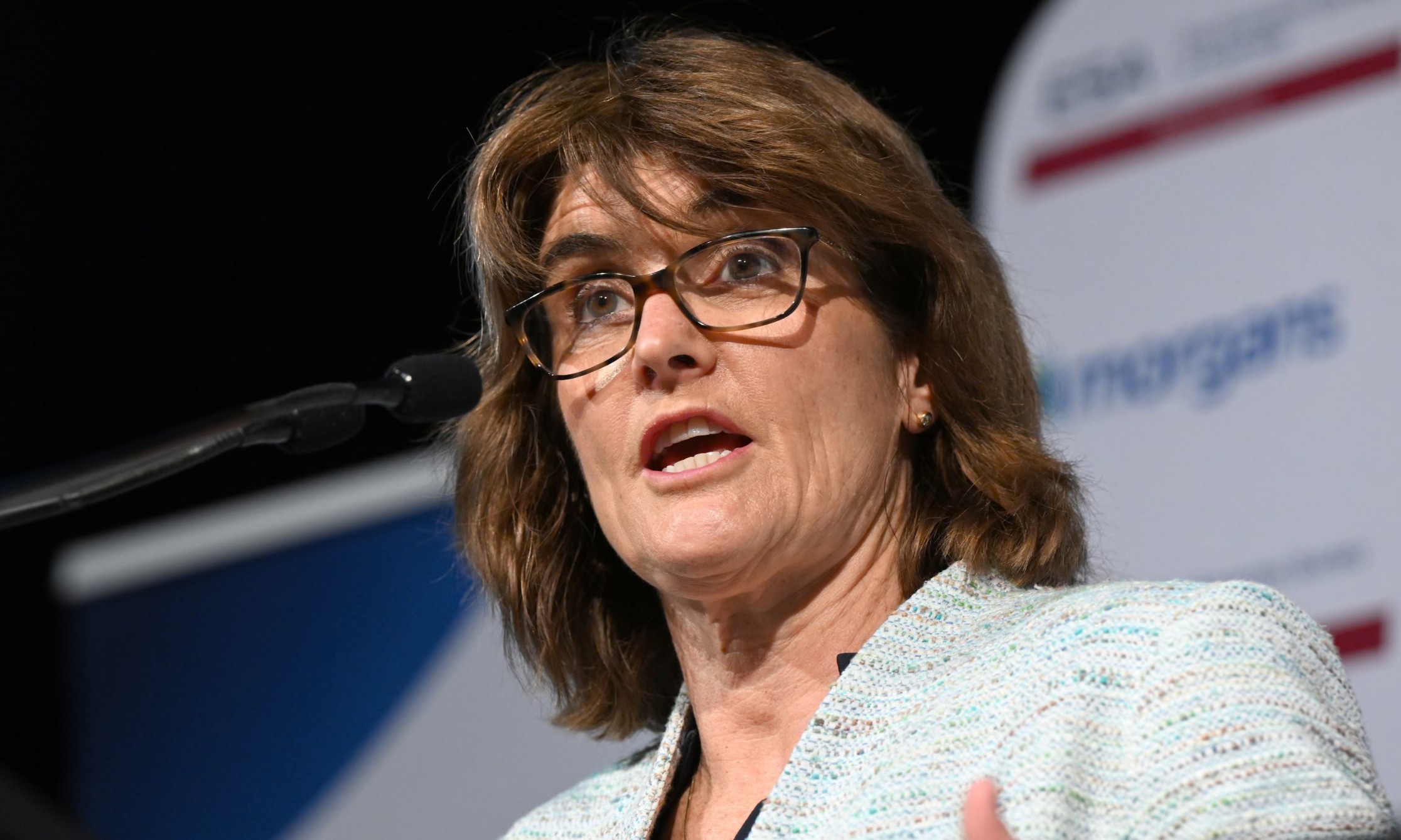
"For many countries — not all — it has been swamped by the AI side," Bullock told the House of Representatives economics committee on Sept. 18, describing how central banks that spent early 2026 bracing for oil-driven inflation from the war in the Middle East found themselves facing a second, bigger shock instead. "Business investment growth has picked up strongly," she said, "driven mostly by spending on data centres and renewable energy projects." The trouble, as she laid it out, is sequencing. The spending is pushing prices up for now. The productivity payoff it's supposed to eventually deliver is not.
The spending is pushing prices up for now. The productivity payoff it's supposed to eventually deliver is not.
Addressing that gap is a big part of why the Reserve Bank looks set to raise its cash rate for the fourth time this year at its board meeting on Sept. 28 and 29, a move money markets were pricing at roughly 90 percent odds by the end of last week. Inflation is running at 4.35 percent, more than a point above the top of the bank's 2-to-3-percent target band. Bullock's own forecasts don't see it back near the midpoint of that range until late 2027. Unemployment is at 4.5 percent, low enough by historical standards, she told the committee, that the labor market itself keeps adding to the pressure rather than relieving it.
This comes as Andrew Hauser, the RBA's deputy governor, had just come back from the United States when he testified alongside her.
What he'd seen abroad didn't calm him down. "The numbers are huge," he said. "They are huge here. They are huge in the US and in the Asia Pacific as well. Everyone knew it would be big, but I don't think anyone had put the sorts of numbers on it that we are seeing at the moment."
Everyone knew it would be big, but I don't think anyone had put the sorts of numbers on it that we are seeing at the moment. - RBA Deputy Governor Andrew Hauser
The numbers, in Australia's case, come from Commonwealth Bank research published in August.
The country's data-center pipeline now runs to roughly six gigawatts of potential capacity, about four times what was actually operating at the end of last year. CommBank puts the central investment estimate at around 150 billion Australian dollars by 2030, rising toward 220 billion if the entire pipeline gets built and fitted out. In the first quarter of this year alone, private capital spending on information, media and telecommunications rose about 90 percent from a year earlier. The bank's economists expect the build-out to add roughly six percentage points to business investment growth in 2026 and five in 2027, calling it "the dominant driver of business investment over the next few years."
Whose Inflation is it Anyway
But the part that should worry anyone hoping this boom pays for itself is that AI-related spending is a fraction of gross domestic product at around 0.2 percentage points a year, in both years.
Most of the specialized hardware, the chips, the servers, the networking gear, is imported, so a large share of the spending never directly benefits the Australian economy. What does touch it is the fight for trades. Workers, construction materials, land near substations and, above all, electricity. That's where the inflation is actually coming from. Not from the technology itself, but from everyone competing for the same finite inputs to build it.
Money markets have absorbed that message fast.
Commonwealth Bank, ANZ, National Australia Bank and Westpac had spent the winter split on whether a rate increase would even come before November. By the weekend after Bullock's testimony, all four had moved their forecasts to September.
CBA's Belinda Allen wrote that "some of these upside risks to inflation appear to be materialising" and now expects a quarter-point move to 4.60 percent at the board meeting. ANZ went further, forecasting back-to-back hikes in September and November that would take the cash rate to 4.85 percent, a level Australia hasn't seen since 2008, though ANZ's economists point mainly to Middle East oil, not data centers, for the second of those two moves. Fixed mortgage rates were repriced within days; CBA lifted its two-year fixed rate by nearly half a percentage point, to 6.82 percent.
Not everyone at the big banks reads the moment the same way.
Westpac's chief economist and a former RBA official herself, Luci Ellis, wrote in a note the same week that the data-center and renewables boom "is reshaping Australia's economic narrative and needs to be a consideration in policy settings." But she added a caution the rate-increase consensus tends to skip over: "care must be taken to avoid overstating its implications for financial conditions."
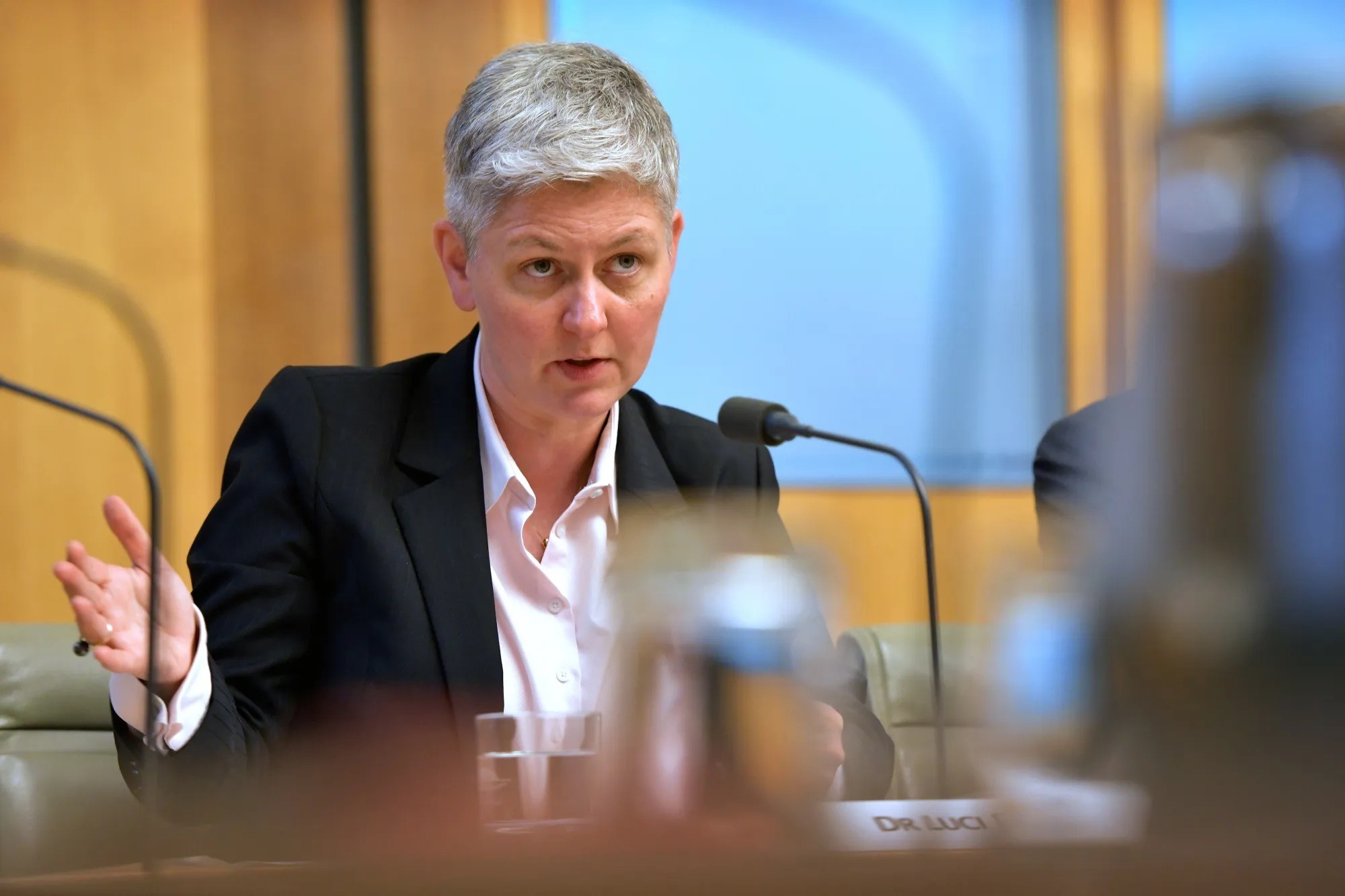
Interest rates may simply be higher than they used to be for reasons that have nothing to do with a construction boom, she argued, and it would be a mistake to credit, or blame, data centers for all of it.
Bullock herself sounded less certain in public than her committee testimony might suggest. Two days later, at a Committee for Economic Development of Australia or CEDA, lunch in Sydney, she was asked directly whether AI investment amounts to a bubble.
"Some people think it's a bubble, some people don't," she said. "I don't have a particular view one way or the other, but it's a risk that I think we're watching." She called AI "the great white hope" for productivity, the thing central bankers everywhere are counting on to eventually offset the spending, and then undercut her own line: there's still little evidence it's happening.
Some people think it's a bubble, some people don't - Michele Bullock, Governor, Reserve Bank of Australia
She cited South Korean research showing that employees using AI tools produced the same output while working an hour and a half less each week, a labor-market win, maybe, but not obviously a productivity one yet. "While people fiddle around and try and figure out what to do with this new technology," she said, "productivity actually can decline."
That puts her at odds, gently, with her own government.
Treasurer Jim Chalmers used the launch of the 2026 Intergenerational Report on Monday to call AI "the biggest economic transformation of our lifetime" and predicted "the productivity, investment and labour market impacts will be dramatic."
Chalmers's own department has reportedly been more careful with him.
Australian news outlet, Capital Brief, has reported that Treasury officials advising the treasurer concluded AI is unlikely, on its own, to rescue Australia's productivity numbers. Between the treasurer's optimism, his department's caution and the central bank's open skepticism, there is no single government line on what the boom actually means.
A Global Phenomenon
None of this is uniquely Australian, which is the part that should interest anyone outside Australia. Jerome Powell, the former Federal Reserve chair, made almost the identical point in March, after a Fed meeting.
"In the short term, what's happening is we're building data centers everywhere," he told reporters, "and that's actually putting pressure on all kinds of goods and services that go into building these things. So that's actually probably pushing inflation up."
In the short term, what's happening is we're building data centers everywhere - Jerome Powell, former Chair, Federal Reserve Board
The Dallas Fed tried putting a number to this.
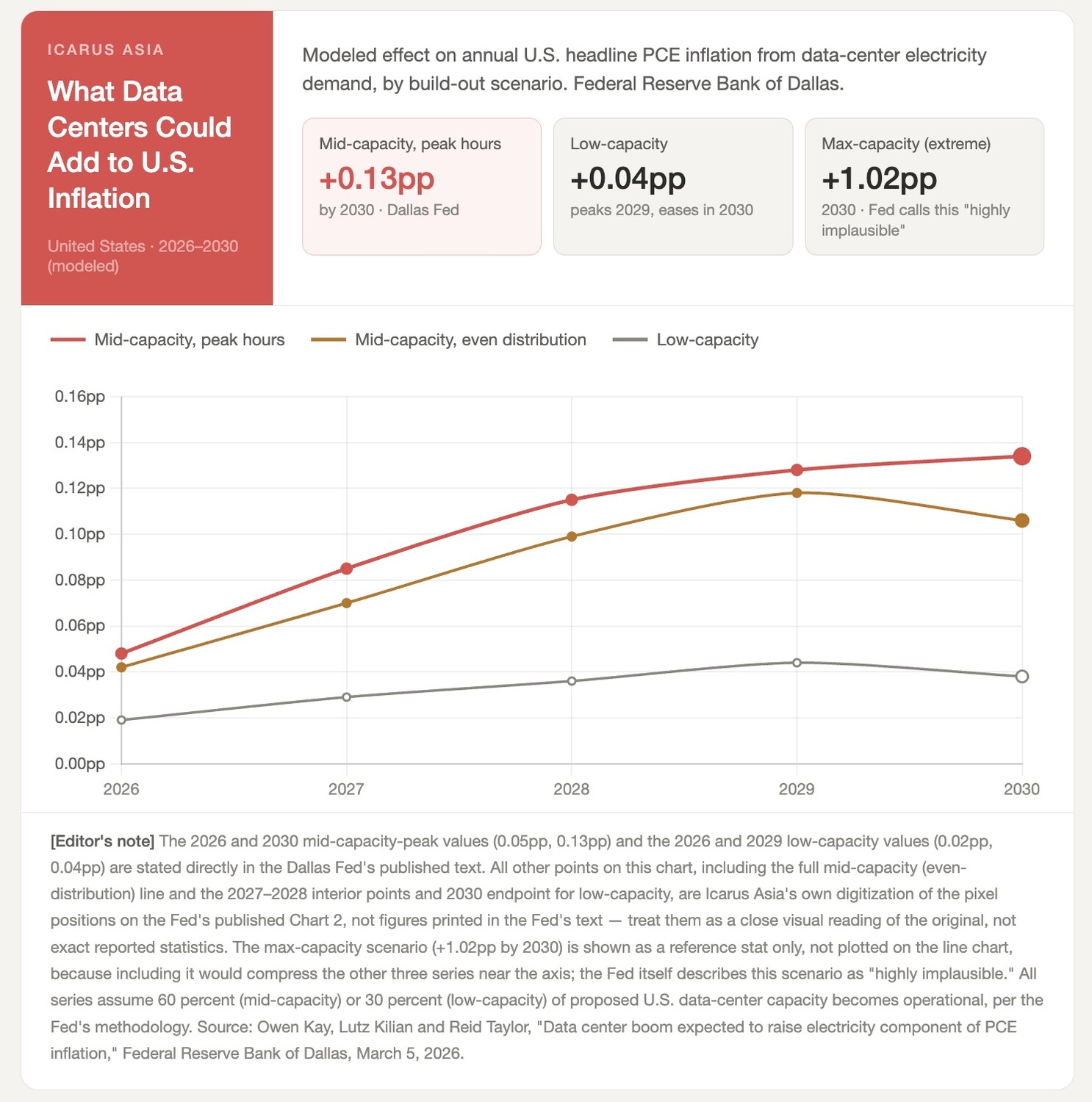
In its mid-range scenario, data centers add about 0.05 percentage points to the electricity component of the Fed's preferred inflation gauge this year, rising to 0.13 points by 2030. If renewable power capacity grows more slowly than expected, which is a live possibility given how much of the new demand is competing for the same grid connections, the researchers think that effect could nearly double.
The regional numbers back up Hauser's read that this isn't a two-country story.
Asia-Pacific's data-center development pipeline grew by 7.1 gigawatts in the first half of this year alone, according to Cushman & Wakefield, its sharpest six-month jump on record, taking the total pipeline to 26.5 gigawatts across 4.8 gigawatts under construction and 21.7 gigawatts still planned. Vacancy in existing facilities fell anyway, from 10.9 percent to 10.3 percent, because demand keeps outrunning even that much new supply.
"The challenge increasingly lies in securing the power infrastructure needed to support the next generation of AI workloads," said Andrew Green, the firm's head of data centers for the region. Developers, he said, are no longer clustering around fiber connectivity the way they used to. They're chasing wherever the power actually is.
The challenge increasingly lies in securing the power infrastructure needed to support the next generation of AI workloads - Andrew Green, APAC Head of Data Centre Group, Cushman & Wakefield
Singapore approved two new tranches of development capacity totaling 1.2 gigawatts, protecting its position as the region's premium hub even on a small footprint. South Korea is seeing the opposite. Community opposition over the strain on local power supply has forced a pause on several new projects.
Japan's constraint is another story in itself.
Grid access, which CBRE's regional research flags as a challenge "set to intensify" this year as AI workloads demand more power per rack than anything that came before them. None of Japan, South Korea or Singapore's central banks has yet said, in so many words, what Bullock said to Parliament this month.
It is not yet possible to say whether that's because the dynamic isn't playing out the same way in those economies, or because nobody has been asked the question as directly as the RBA governor.
What is possible to say is that Bullock isn't waiting to find out.
She has a rate decision in a week, an inflation problem she doesn't expect to resolve for another two years, and a boom she can't say is a bubble and can't say isn't one.
Somewhere out at Eastern Creek, the concrete keeps getting poured regardless.
The author is an Executive Director and Head of Research and Analysis at Icarus Asia, an independent financial research and market analysis firm that specializes in macroeconomic insights, structural fixed-income analysis, and liquidity trends across Asian and global capital markets.
DISCLAIMER: Not investment advice. Please do your own research and consult with a registered financial advisor.
Sources
Reserve Bank of Australia. "Opening Statement to the House of Representatives Standing Committee on Economics." Address by Michele Bullock, 18 Sept. 2026.
Capital Brief. "Data centre boom rivals war as inflation driver: RBA." 18 Sept. 2026.
Capital Brief. "Commonwealth Bank brings forward rate hike bet to September" Sept. 2026.
Capital Brief. "Treasury tells Chalmers AI won't save productivity." Sept. 2026.
ABC News. "Michele Bullock's final speech before RBA board meeting cements interest rate rise bets." 22 Sept. 2026.
ABC News. "ASX rises, RBA governor says AI data centres are 'adding' to high inflation problem." 22 Sept. 2026.
Inkl. "AI could be a bubble and is not yet making Australia more productive, Michele Bullock says." 22 Sept. 2026.
Commonwealth Bank of Australia. "Australia's data centre boom: a $150 billion investment opportunity." Newsroom, 6 Aug. 2026.
Commonwealth Bank of Australia. "RBA expected to lift interest rates next week." Newsroom, Sept. 2026.
The Adviser. "ANZ predicts back-to-back hikes as majors tip September rise." 2026.
Broker News. "Big Four Banks unite on RBA September rate hike." 2026.
Mortgage Professional Australia. "CBA, ANZ join Westpac, NAB in tipping RBA hike." 2026.
Canberra Times. "Treasurer Jim Chalmers says AI will drive productivity gains." 2026.
Fortune. "Jerome Powell: AI data centers are causing inflation and driving up electricity bills." 19 Mar. 2026.
Federal Reserve Bank of Dallas. "Data center boom expected to raise electricity component of PCE inflation." 5 Mar. 2026.
CBRE. "Asia Pacific Data Centre Boom to Continue in 2026." 2026.
Cushman & Wakefield. "Asia Pacific's data centre development pipeline reaches record 26.5GW." Aug. 2026.
The Urban Developer. "NEXTDC Plans $7bn AI Campus at Western Sydney Site." 9 Dec. 2025.