
On Borrowed Time
The joint intervention pulled USD/JPY back from a 40-year low in four trading days. It left Japan's fiscal overhang, its energy-driven trade deficit and its rate gap with Washington exactly where they were.
A squeeze, not a turn
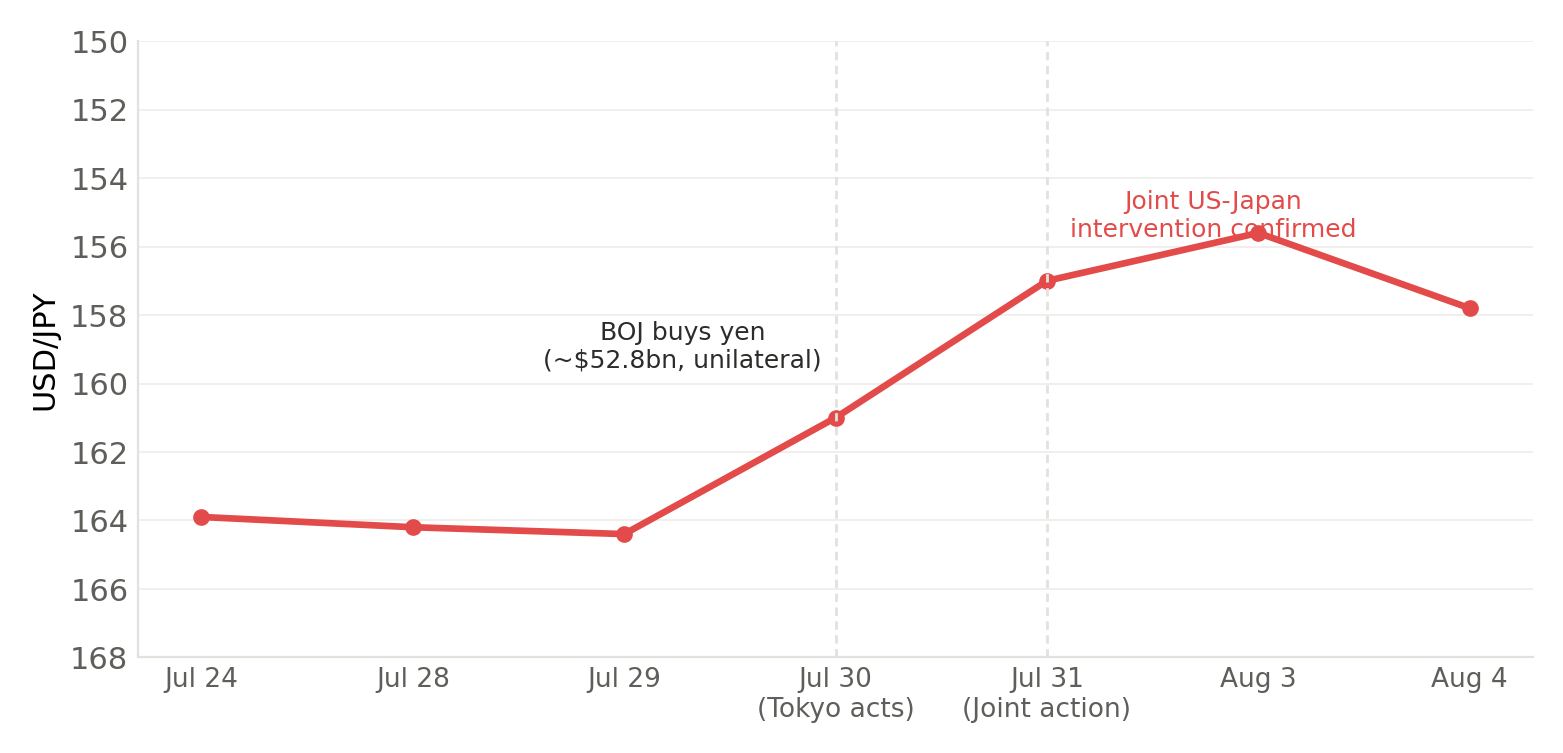
Japan and the United States bought yen together for the first time since June 1998. Tokyo went first, spending an estimated $52.8 billion on Thursday, July 30. Washington followed Friday, and the two governments confirmed the joint operation on Monday, August 3. The currency, which had slid to roughly ¥164 per dollar in late July, its weakest level against the dollar in about 40 years, rallied to around ¥157 on the day of the joint action and touched an intraday low near ¥155 the following Monday.
It worked, for four days. It did not touch the reasons the yen got to ¥164 in the first place: a debt load approaching 228% of GDP, a trade balance still bleeding from an oil-driven energy bill, and short-term interest rates in Tokyo that remain a full percentage point below Washington's even after the Bank of Japan's tightening campaign. Every economist and strategist canvassed for this note, across Northeastern University, ING, the Peterson Institute, the Official Monetary and Financial Institutions Forum and Japan Economy Watch, arrives at some version of the same conclusion: intervention smooths a disorderly move. It does not reverse a trend that fundamentals are driving.
Our base case is that USD/JPY re-weakens over the coming quarters unless two things happen at once: US data soften enough to keep the Federal Reserve from hiking further, and Japan's rate differential with Washington narrows for reasons that have nothing to do with FX intervention. Absent both, this episode is likely to be remembered the way ING's Chris Turner and Michiel Tukker frame it: an attempt to slow the dollar's rise, not reverse it.
What actually happened, and to whom
Start with the sequence, because the press coverage in the first 72 hours scrambled it. Japan's Ministry of Finance intervened unilaterally in New York trading hours on Thursday, July 30, buying an estimated ¥8.45 trillion (about $52.8 billion) against the dollar, based on a comparison of Bank of Japan account data against money-broker forecasts.3,6 That is likely the largest single-day intervention Tokyo has ever conducted. The Bank of Japan met that same day and left its policy rate at 1%, choosing not to deliver the hike to 1.25% that some traders had priced in.6 The intervention landed within hours of that decision, not before it.
The US joined on Friday, July 31. Treasury Secretary Scott Bessent confirmed the action in a post on X, writing that "Friday's coordinated foreign exchange actions countered disorderly yen movements" and that "we will not hesitate to participate in further joint intervention."1 A Reuters photograph of a notepad in front of Bessent at a cabinet meeting that day read: "To Do: Buy Japanese Yen $5-10 bil." Washington has not disclosed the actual amount.1,3,6 Japan's finance ministry confirmed the coordinated operation publicly on Monday, August 3.
ING's Turner and Tukker call it the first coordinated G7 FX intervention since the post-earthquake yen operation in March 2011, and the first joint US-Japan yen-buying intervention since June 1998, when USD/JPY was approaching 150 during the Asian financial crisis.2 The mechanics this time carried an unusual twist: rather than selling dollars directly, the New York Fed reportedly sold euros from its reserves to fund the yen purchase, acting on behalf of the Treasury.2,3 Three former US officials went on the record with Fortune to say that was an odd way to run the play. Edwin Truman, a former Treasury assistant secretary for international affairs, called it "weird," arguing that "selling a third currency would not be as effective as selling just straight dollars."3 Robin Brooks, a senior fellow at the Peterson Institute for International Economics, put it more sharply: "This kind of twist in my opinion undercuts the efficacy of US participation. FX intervention is a confidence game. The last thing you want is to give markets any kind of reason to ask questions."3
Whose money, and how much of it
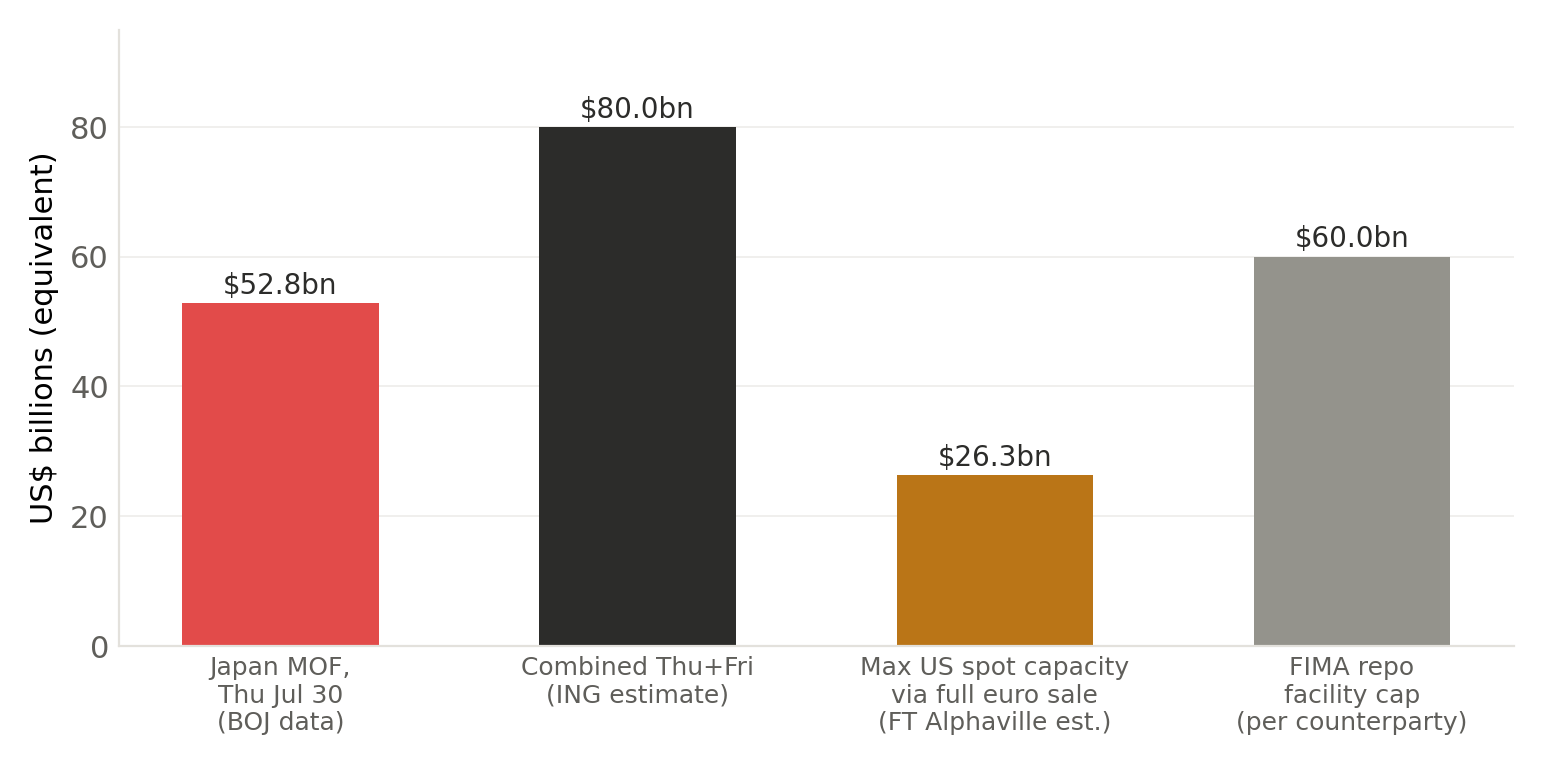
Toby Nangle's analysis for FT Alphaville puts Japan's Thursday operation at roughly $52.8 billion, consistent with the Bloomberg figure drawn from BOJ account data.3 Richard Katz, writing on his Japan Economy Watch Substack after a same-day CNN interview, cites BOJ data suggesting Tokyo sold almost $59 billion to buy yen in that operation, a modestly higher estimate using a different data cut.6 ING's own tally of Thursday and Friday combined puts total intervention, Japanese and American, at close to $80 billion equivalent.2
On the US side, the numbers get murkier fast, and that is itself informative. Nangle notes that total US foreign-exchange reserves, split between the Treasury's Exchange Stabilization Fund and the Federal Reserve's System Open Market Account, run to roughly $38 billion, of which about 69% sits in euro-denominated assets and the rest in yen.2,3 Treasury's own international reserve position data for late July 2026 back that up closely: euro holdings across both accounts (securities plus deposits) come to roughly $26 billion, yen holdings to roughly $12 billion, for a euro share right around 69%. If the New York Fed had liquidated every euro asset in both accounts to fund yen purchases, Nangle calculates the maximum spot capacity would be about $26.3 billion, a bit less than half the size of Japan's Thursday trade alone.3
Both ING and FT Alphaville flag that Washington could instead have transacted in forwards, which would let the notional trade run well above the cash-reserve ceiling, at the cost of an outright net short euro position and concentrated counterparty exposure to dealer banks.2,3 Either way, the conclusion is the same: the US leg of this operation was built to signal, not to move the exchange rate on volume. Mark Sobel, who spent four decades at Treasury and now chairs the US arm of the Official Monetary and Financial Institutions Forum, made the point bluntly to Fortune: "The US is unwise to enter the market in support of the yen, even if it makes a small profit in doing so, unless it is part of a Japanese plan to tackle the fundamental issues driving yen weakness. After all, the Treasury's Exchange Stabilization Fund isn't a hedge fund."3
The FIMA option, and why Bessent wants it bigger
Japan is the largest foreign holder of US Treasuries, with more than $1.14 trillion outstanding.1 Selling any meaningful slice of that to raise intervention dollars would push Treasury yields higher at a moment Washington can least afford it, given record US deficits and the ordinary reliance on foreign buyers to absorb new issuance.2 The alternative is the Fed's FIMA repo facility, which lets foreign central banks borrow dollars against Treasury collateral for up to seven days rather than selling the bonds outright, capped at $60 billion per counterparty.2 Bessent has publicly pushed for the facility to be "upsized," which tells you the current cap is a real constraint on how much intervention firepower Tokyo can raise this way without touching its Treasury holdings directly.2 If intervention needs to recur at anything like Thursday's scale, that $60 billion ceiling gets tested quickly.
The fundamentals the intervention didn't touch
William Dickens, professor emeritus of economics and public policy at Northeastern, put the academic consensus as plainly as it gets: "Economists are of the overwhelming opinion that interventions in currency markets are a fool's game when they are trying to prevent depreciation that is being driven by fundamentals."1 Three forces are doing that driving, and none of them moved on July 30 or 31.
A debt load that constrains everything else
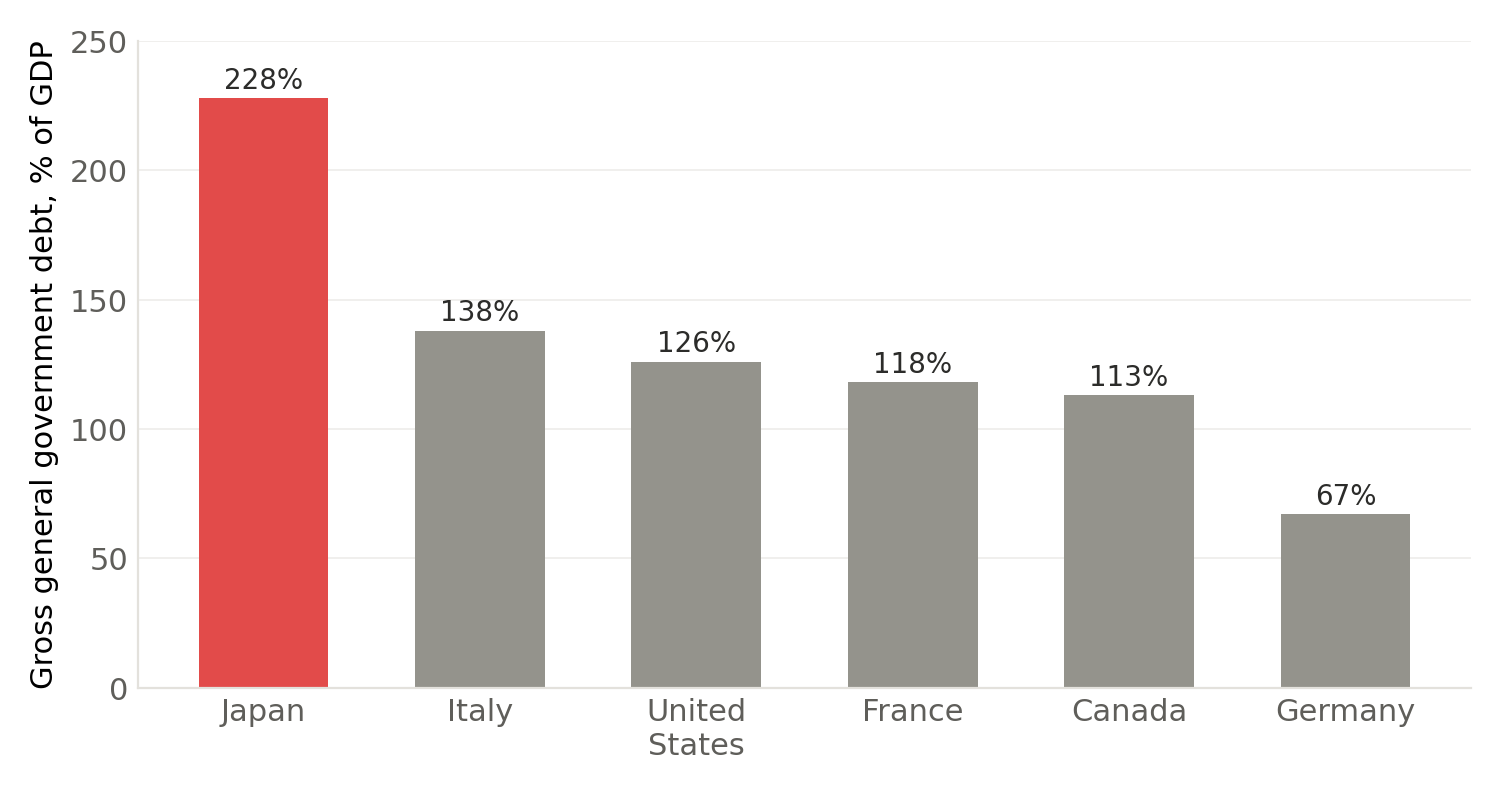
Japan's gross public debt sits at 227.8% of GDP in 2026, according to the IMF's most recent Article IV consultation, the highest ratio among advanced economies by a wide margin.1 Fabricius Somogyi, who studies international finance at Northeastern, frames the mechanism: the Bank of Japan has spent years buying government bonds to hold yields down, because higher rates would make refinancing that debt stock dramatically more expensive.1 That is the real reason the BOJ moves in quarter-point increments while inflation and a weak currency argue for faster tightening. An aging, shrinking population adds a second constraint on top: rising pension and healthcare spending against a shrinking tax base narrows the room to tighten fiscal policy even if the central bank wanted room to raise rates faster.1
An energy bill that never let up
Japan imports nearly all its crude oil and refines almost none of it domestically. The war in Iran and the tariff regime out of Washington have both pushed global energy prices higher through 2026, and Japan has no choice but to pay the bill in dollars.1 William Dickens is direct about where that leads: as long as oil stays elevated, Japan runs "huge trade deficits" that keep weighing on the currency, intervention or not. His view of how this resolves without a change in the energy backdrop is stark: "In these situations, the speculators almost always win."1
A rate gap that stopped explaining the exchange rate
The standard story links yen weakness to the gap between US and Japanese interest rates: cheap yen funding, invested in higher-yielding dollar assets, is the textbook carry trade, and it has been a real feature of this market for years.1,2,7 Frank Claus, head of investment services Belgium at BNP Paribas Fortis, has spent three decades watching this exact channel, and he flags the second-order risk: unwind a carry trade fast enough, with a sharp yen rally, and equities, bond yields and broader financial conditions all move with it. Currency shocks rarely stay inside the FX market.7
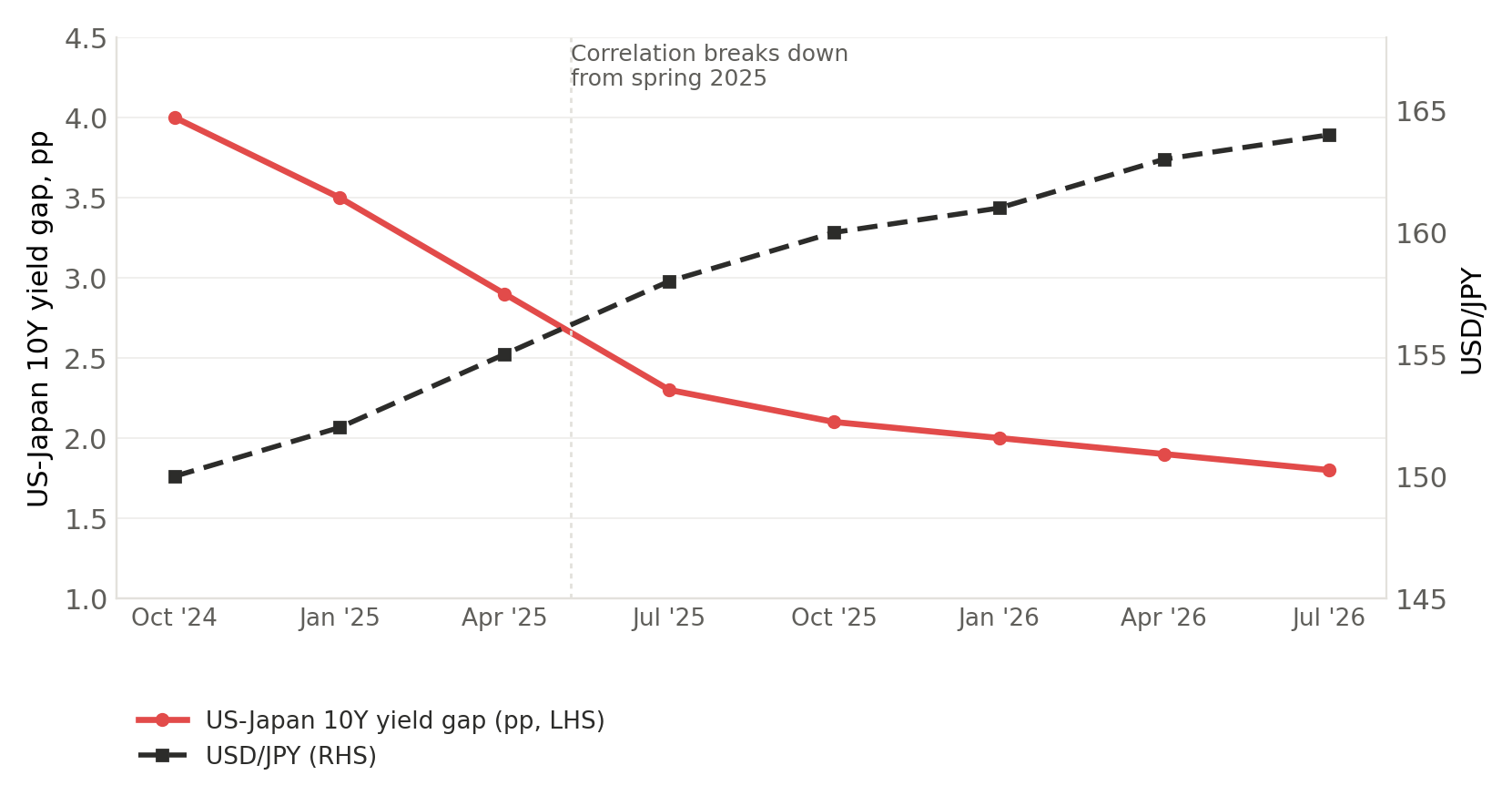
Richard Katz's data complicate the simple version of this story. The US-Japan 10-year yield gap halved, from around 4 percentage points in October 2024 to less than 2 points by the time of the intervention. On the textbook logic, that should have pulled the yen stronger. Instead it weakened further, from roughly ¥150 to ¥164.6 Katz's read: "Many of the experts cited in the press focused on only one fundamental, the gap between American and Japanese rates. They argue that if the Bank of Japan hikes rates, that will do a lot to boost the yen... [but] the data says that higher rates in Japan will not be enough to reverse the yen's fall very much."6 Bessent himself appears to hold the simpler version of the theory. He has been publicly vocal about his "expectation" that the BOJ will hike again and his concern that the central bank is falling behind the curve, according to Katz.6 If Katz is right that the correlation broke down in spring 2025, a BOJ hike alone will not deliver the durable appreciation Washington may be counting on.
"In these situations, the speculators almost always win."William Dickens, Northeastern University
The rates channel: what's driving JGB yields higher
Japan's 10-year government bond yield has been grinding to levels last seen in the early 1990s, and the 30-year has set repeated records through 2026 amid quantitative tightening from the BOJ and reduced bond purchases that have strained market liquidity.2 ING's rates desk flags a specific, measurable symptom: slopes in two-year forward swap curves across G10 currencies tend to move together, but the JPY curve currently stands out as far steeper than its peers, evidence that investors are demanding a bigger term-risk premium to hold long-dated JPY exposure.2
Some of that premium is homegrown, tied to Japan's own debt dynamics. Some of it is imported. Kevin Warsh was confirmed as Federal Reserve chair on May 13, 2026, by a 54-45 Senate vote, the closest confirmation vote for a Fed chair in the modern era, and his early tenure has been marked by rising long-end Treasury yields even as he holds the policy rate steady, a pattern financial press has covered as the bond market questioning his inflation-fighting credibility.4 The 30-year Treasury yield closed at 5.21% on July 30, its highest level since 2007, and the New York Fed's own term-premium estimate rose 26 basis points in July alone, accounting for essentially all of that month's rise in the 10-year yield with none of it coming from expected policy rates.4,5 Bill Dudley, the former New York Fed president, named what the market is now charging in plain terms: a higher risk premium in the long end. Economists at Bank of America and Apollo's Torsten Slok read the move the same way.4
Takuji Okubo at Japan Macro Advisors has built this into his JGB curve model as what he calls the "Warsh factor": a one-standard-deviation risk-premium shock that he assumes has been building since Warsh took office in May, will keep building until November, and then recede by half as the rest of the FOMC reins him in.5 On his numbers, that adds 10 to 15 basis points to the 10-year and 30-year JGB forecast at end-2026. His main forecast, which assumes the BOJ hikes to 1.25% in October and to a 1.5% terminal rate in March 2027, has the 10-year JGB yield rising from 2.82% in July 2026 to 3.12% by year-end and 3.28% by end-2027, while the 30-year climbs from 4.33% to a peak near 4.5% around this year-end before easing back toward 4.02% by end-2027 as the Warsh shock partially unwinds. An alternative scenario, with a faster BOJ path to a 1.75% terminal rate, lifts the front end and belly of the curve more than the long end: about 15 basis points more on the 10-year by end-2027, less than 10 basis points more on the 30-year.5 Okubo is explicit that the Warsh factor is uncertain and subject to revision as the FOMC's internal dynamics play out; treat the specific basis-point path as one analyst's model, not a consensus forecast.
A rising US term premium of that kind does not stop at the US border. It raises the required return on duration everywhere, JGBs included, and a steeper JGB curve in turn makes FX-hedged US Treasuries look relatively less attractive to Japanese investors than domestic JGBs, which matters given how much of the demand for US debt has historically come from Japan.2 The practical read-through: a BOJ hike alone does not simplify this picture. Higher short-end policy rates in Tokyo could narrow the near-end rate gap with Washington, which is FX-supportive on its own. But if long-end term premia keep rising through the same global risk-repricing channel, the JGB curve steepens further and the perceived risk of holding Japanese duration rises with it, which can offset some of the currency benefit of the rate hike itself.2 Rising JGB yields and term premia also raise the odds that Japanese institutions rotate more of their portfolios toward domestic JGBs over time, at the margin reducing demand for FX-hedged US Treasuries and feeding back into US yields, and from there back into USD/JPY.2
Why the politics point away from a bigger campaign
For now this is a bilateral operation between Washington and Tokyo, not a G7 or G20 one, and ING sees that staying true through the rest of the year. Prime Minister Sanae Takaichi's growth-first fiscal agenda, alongside years of loose monetary policy, has left many G20 members inclined to view yen weakness as a problem of Japan's own making rather than market dysfunction that warrants collective action.2,3 The next scheduled venue for a broader push is the G20 Finance Ministers and Central Bank Governors meeting in Asheville, North Carolina, with deputies meeting August 29-30 and ministers and governors August 31 through September 1.2 ING rates the odds of explicit multilateral backing coming out of that meeting as low, given the G20's longstanding preference that exchange rates be market-determined except in clearly disorderly conditions. Treat Asheville as a checkpoint on political appetite, not a likely trigger for a new multilateral FX regime.2
There is a precedent worth watching, though, and it did not make it into most of the coverage of this episode. In October 2025, Treasury extended a $20 billion ESF-backed swap facility to Argentina and used the fund to help stabilize the peso ahead of that country's midterm elections; Argentina ultimately drew about $2.5 billion and repaid it in full before year-end.2,3 Turner and Tukker read the two episodes together as a signal about Treasury's own posture, not just about Japan: "Taken together, the Argentine and Japanese episodes suggest a Treasury that is becoming more willing to use the ESF in support of broader economic and geopolitical objectives. That marks a notable departure from the relative passivity that has characterised US foreign exchange policy for much of the last two decades."2 They also caution against pushing the comparison too far. Argentina was facing an acute balance-of-payments crisis; Japan remains one of the world's largest creditor nations, and Washington's willingness to support the yen more plausibly reflects a view that the currency has moved well below levels its fundamentals would justify. ING says as much directly: "we share Bessent's view that the yen remains materially undervalued."2 That is a useful corrective to a note built mostly around why intervention fails. The skeptics and the Treasury agree on the diagnosis, a currency trading cheap to fair value. They disagree on whether buying it in the spot market is the cure.
ING's own suggestion for what might actually work is telling, because it isn't intervention. The 2024 reforms to Japan's NISA tax-free investment accounts made it easier for retail savers to put money into overseas equities, and that shift has been a real contributor to the capital outflows pressuring the yen.2 ING argues that a policy aimed the other way, broadening the appeal of domestic assets such as JGBs to Japanese retail savers, would do more for the currency over time than another round of FX purchases. That is a structural fix aimed at the flow of savings, not a one-off shock to the spot rate, and it is the kind of policy lever Tokyo controls that Washington does not.
What the last intervention actually taught us
The most relevant precedent isn't 2024. It's three months ago. Japan already spent an estimated $70 billion on FX sales in April and May, and USD/JPY traded to a new high of 164 anyway.2 That is the strongest single piece of evidence for this note's thesis, and it comes from ING, not from us: a nine-figure unilateral intervention, on its own, did not even hold the line, let alone reverse the trend. Whatever this week's joint operation adds beyond the April/May attempt is the signalling value of US participation, not incremental firepower. Japan's 2024 intervention campaign is the precedent for when this playbook does work, and ING is candid about why: it coincided with a genuine turn in the US rate cycle, as softening data cleared the way for three 25-basis-point Fed cuts later that year.2 The intervention bought time and smoothed the transition. It was not, on its own, the thing that turned the trend. Nothing comparable has happened yet on the US side this time. ING's house forecast has USD/JPY declining to 158 by year-end 2026 and to 152 by end-2027, but that call is explicitly conditioned on US data softening enough to keep the Fed on hold and on the rate differential narrowing from there.2 Strip out those conditions and, in Turner and Tukker's words, "even coordinated intervention risks being remembered as another attempt to slow the dollar's rise rather than reverse it."2
Katz's Substack commentary, published the same day as his CNN interview, reaches a similar place from a different angle. Most experts he cites in the press doubt the move will hold for more than a short period. This joint action likely carries more psychological weight than a solo Japanese intervention, because it puts "some fear into the hearts of traders" that Washington now has skin in the game, and Katz expects that to buy more time than Tokyo could on its own.6 But it does not touch the fundamentals that have weakened the yen by roughly a third since early 2021: rising import costs for food and energy, and an export sector whose competitiveness still depends on a currency this cheap.6
Market implications and positioning
Near term (weeks to roughly three months)
Treat large short-yen positions as vulnerable to further squeezes. Bessent has said Washington will not hesitate to intervene again, and both Tokyo's public statements and ING's reading of the situation suggest a lower bar for re-entry if USD/JPY retests the ¥164 area or moves in a way authorities read as disorderly.1,2 US participation stays constrained by reserve size, so any repeat is more likely to lean on signalling and the FIMA channel than on outright spot volume, at least until Bessent gets the upsized facility he has asked for.2 Any renewed intervention that produces a sharp yen rally risks forcing a partial unwind of yen-funded carry positions, with spillover risk into EM FX, credit spreads and global equities, a dynamic Frank Claus has flagged repeatedly from the practitioner side.7,1,6 Positioning around US data releases and Fed communications deserves extra weight through this window: a policy surprise landing on top of an intervention episode is the more likely source of a sharp, short-term move than the intervention itself.
Medium term
Our base case, drawn from ING, Northeastern and Katz's independent analysis converging on the same point, is a yen that gradually re-weakens unless US activity and inflation data soften enough to take further Fed hikes off the table.1,2,6 Rising JGB term premia argue for Japanese long-end yields staying elevated relative to recent history, which should keep pulling domestic institutional demand toward JGBs and away from FX-hedged Treasuries at the margin, a rotation that could add to US yield pressure even as it supports JGBs directly.2 The most probable path from here looks like a sequence: intervention-driven squeezes, followed by renewed yen weakness as the underlying fundamentals reassert themselves, repeated as needed.1,2,6
What we're watching
- US data and the Fed path. Activity, inflation and labor-market releases that bear on whether Warsh's Fed can hold the line, since a narrower rate gap without further hikes is ING's own precondition for a sustained move lower in USD/JPY.
- JGB term premia and the US-Japan differential. Watch the 10- and 30-year JGB points specifically. They embed whatever premium the market is charging for Fed-chair uncertainty and shape the relative-value case between JGBs and FX-hedged Treasuries.
- Japanese institutional flows into and out of US Treasuries, and FIMA usage. A material reduction in Japanese UST holdings, or a request to lift the $60bn FIMA cap, would both be signs that the intervention is straining Japan's own balance sheet.
- The ESF's August 30 disclosure. By law, Treasury must report the ESF's monthly financial statement, including new agreements and liabilities, to Congress within 30 days of month-end. The report covering July, due around August 30, is the first real chance to see what the US actually bought.
- Carry-trade positioning. Watch EM FX, credit spreads and global equities for signs of yen-funded carry unwinds around future intervention episodes, not just USD/JPY itself.
- Oil prices and Japan's trade balance. As long as energy costs stay elevated, Dickens's argument holds: the trade deficit keeps weighing on the yen regardless of intervention.
- NISA reform and Japanese savings flows. Any policy move to broaden the appeal of domestic assets to Japanese retail investors would, per ING, do more for the yen structurally than another round of FX purchases. Watch for signals out of Tokyo on this front.
- G20/G7 signalling out of Asheville. We rate the odds of explicit multilateral backing as low, but the meeting is a genuine test of how much political capital other G20 members are willing to spend on a stronger yen.
Conclusion
The joint intervention did what interventions do well: it disrupted a one-way market, forced position-squaring, and bought Tokyo and Washington time to be seen doing something about a currency move that had become politically uncomfortable on both sides of the Pacific. It did not touch Japan's debt load, its energy bill, or the rate gap that a growing body of evidence suggests no longer explains the exchange rate on its own. Absent a genuine turn in the US data and rate cycle, our base case is that the yen resumes its slide once the current squeeze runs its course, and that this episode gets filed alongside the intervention playbook of the past three decades: useful for buying weeks, not evidence of a reversed trend.
This note reflects Icarus Asia's independent analysis and synthesis of primary reporting, official data and third-party research current as of August 4, 2026. Forecast figures (e.g., ING's USD/JPY path) represent third-party house views current at time of publication and are subject to revision. This document is provided for institutional clients for informational purposes only and does not constitute investment advice, a research recommendation, or a solicitation to transact in any security or currency.
- Tanner Stening, "US-Japan joint intervention in the yen may have worked, for now, experts say," Northeastern Global News, Aug. 3, 2026.
- Chris Turner and Michiel Tukker, "Washington joins the fight for the yen," ING Think, Aug. 3, 2026; supplementary ING FX Talking house forecast.
- Toby Nangle, "How big was the American JPY intervention?," FT Alphaville, Aug. 2026; Mia Osmonbekov, "America's 'weird' and 'unwise' intervention in the Japanese yen," Fortune, Aug. 3, 2026 (quoting Mark Sobel, Robin Brooks and Edwin Truman).
- Kevin Warsh's confirmation vote (54-45, May 13, 2026) per CNBC, "Kevin Warsh wins Senate confirmation as the next Federal Reserve chair," and C-SPAN Senate roll-call coverage. Context on early tenure per CNBC ("Analysis: Fed Chairman Warsh's credibility in question," July 29, 2026; "Markets heard a dovish Kevin Warsh," July 31, 2026) and CNN Business ("The bond market to Kevin Warsh," July 29, 2026).
- Takuji Okubo, "The Warsh Factor in the JGB Curve," Japan Macro Advisors (Substack), Aug. 3, 2026, and accompanying chart-data pack. Forecast figures are Okubo's proprietary model output, current as of publication and explicitly subject to revision; treat as one analyst's house view, not a consensus estimate.
- Richard Katz, "CNN Interviews Me On Joint US-Japan Intervention To Strengthen the Yen," Japan Economy Watch (Substack), Aug. 4, 2026.
- Frank Claus, LinkedIn post, "Three Decades in Financial Markets Have Taught Me One Lesson: Never Underestimate Currencies," BNP Paribas Fortis, Aug. 2026.