
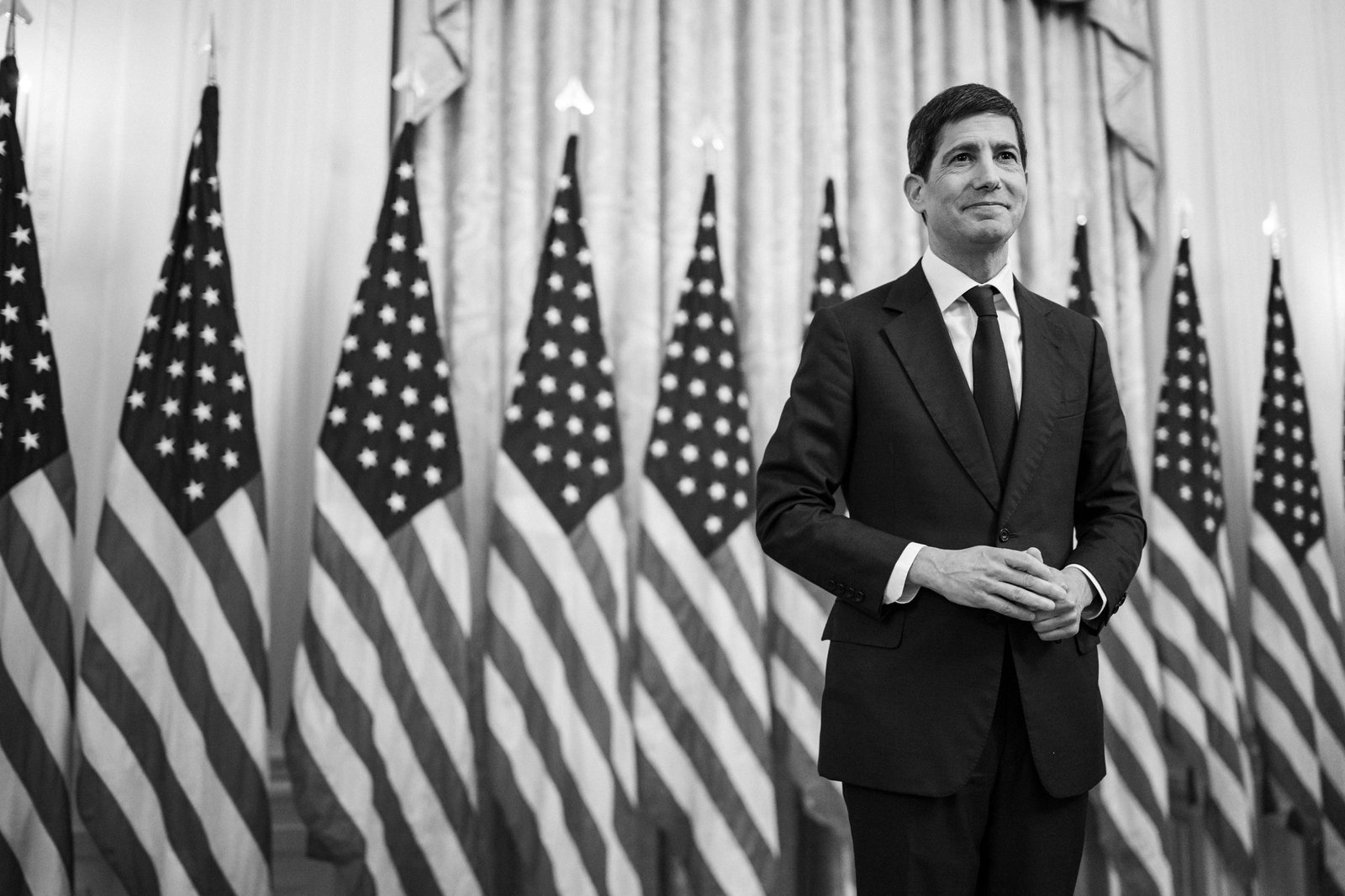
Why Kevin Warsh Keeps Wall Street Guessing
A 9–3 hold, three hawkish dissents, and the return of price discovery to the bond market
Why Kevin Warsh Keeps Wall Street Guessing
A 9–3 hold, three hawkish dissents, and the return of price discovery to the bond market
Key Takeaways
- The FOMC held the federal funds target range at 3.50–3.75 percent on 29 July by a 9–3 vote. Cleveland's Beth Hammack, Minneapolis's Neel Kashkari, and Dallas's Lorie Logan dissented in favor of a 25 basis point hike — the widest dissent of Chairman Kevin Warsh's two meetings to date, delivered on a hold rather than a cut.
- Chairman Warsh reaffirmed a deliberate minimal-guidance communication doctrine, arguing that markets, not the Committee's own rhetoric, should price incoming data. The 30-year Treasury yield rose to approximately 5.23 percent intra-meeting, a 19-year high, while the 10-year moved from roughly 4.61 percent to 4.69 percent.
- The three named dissents raise the visibility of the Committee's reaction function. June's hold was unanimous (12–0), but the accompanying Summary of Economic Projections showed 17 of 18 officials assessing inflation risk as tilted to the upside, foreshadowing the July split.
- Growth of roughly 20 percent year-over-year in AI-related high-tech equipment and software investment has surfaced as an unresolved analytical question for the Committee: whether chip- and AI-infrastructure-driven price pressure constitutes a broader inflationary dynamic or a narrow, transitory shock.
- A five-workstream institutional reform agenda — spanning communications, balance sheet policy, data, productivity and jobs, and inflation frameworks — is underway, with the inflation framework workstream weighing a shift toward a trimmed-mean measure in place of the headline PCE price index.
- With forward guidance withdrawn, we view incoming data prints as carrying materially higher market-moving weight than under prior chairs. Our base case is that positioning should track the dissent count and the Committee's revealed reaction function rather than anticipated Fed language.
I.The Decision and Vote Breakdown
The Federal Open Market Committee held its target range for the federal funds rate at 3.50 to 3.75 percent at its 29 July meeting. The vote was 9 to 3, with Cleveland Fed President Beth Hammack, Minneapolis Fed President Neel Kashkari, and Dallas Fed President Lorie Logan dissenting in favor of a 25 basis point increase. This is the widest dissent of Chairman Warsh's chairmanship to date, notable in that it occurred on a hold decision rather than a proposed cut; no participant favored easing.
The accompanying statement was brief. The Committee characterized economic activity as expanding at a solid pace despite elevated uncertainty tied to the conflict in the Middle East, noted strong productivity growth and capital investment, and described job gains as having kept pace with the workforce with unemployment little changed. Inflation was described as elevated relative to the Committee's 2 percent objective, attributed in part to supply shocks in sectors including energy. The statement concluded: "The Committee will deliver price stability."
| Parameter | Level | Source |
|---|---|---|
| Federal funds target range | 3.50%–3.75% (held) | FOMC statement, 29 July 2026 |
| Interest on reserve balances (IORB) | 3.65%, effective 30 July | Implementation Note, 29 July 2026 |
| Standing overnight repo rate | 3.75% | Implementation Note, 29 July 2026 |
| Standing overnight reverse repo rate | 3.50%; $160bn per-counterparty daily cap | Implementation Note, 29 July 2026 |
| Primary credit rate | 3.75% | Implementation Note, 29 July 2026 |
| Committee vote | 9–3 (Hammack, Kashkari, Logan dissenting for +25bp) | FOMC statement, 29 July 2026 |
II.Reading the Dissents
The composition of the dissent is, in our view, more informative than its existence. Hammack, Kashkari, and Logan are established voices on the hawkish side of the Committee rather than surprise dissenters. Logan stated in a 16 July speech that she favored "modestly higher" rates. Hammack, in a LinkedIn post published on the eve of the pre-meeting blackout period, cited business contacts describing "broad-based" inflation, while noting she would enter the meeting with an open mind. Kashkari's dissent is the least telegraphed of the three and constitutes the first primary-source confirmation that he has aligned with the hawkish bloc on this question.
Other Committee communications in the run-up to the meeting were directionally consistent. Governor Christopher Waller indicated on 13 July that softer June inflation data would incline him toward patience — implying the converse held true as well. Vice Chair Philip Jefferson stated on 16 July that "in a scenario where actual inflation does not start to cool down soon...it could be appropriate to reconsider our current policy stance."
The June meeting provides useful contrast. The Committee held the same 3.50–3.75 percent range by a unanimous 12–0 vote, but the accompanying Summary of Economic Projections was materially more hawkish beneath the surface: 17 of 18 participants assessed inflation risk as tilted to the upside, and the median year-end 2026 projection moved higher relative to March. Forty-two days later — the interval Chairman Warsh cited in his own opening remarks — that latent hawkishness materialized as three dissenting votes on a hold. We read this progression, not the hold decision itself, as the meeting's principal signal: the pace of policy, not its direction, is now the active point of disagreement.
III.Communication Doctrine: Minimal Guidance by Design
Chairman Warsh has, across his two meetings to date, maintained a consistent posture of minimal forward guidance. In his 29 July opening statement, he stated: "There is no soft inflation target, there is no soft implicit target — not on this Committee's watch. There is only a target, and it is 2 percent." He further stated that five-plus years of above-target inflation "cannot be cured in nine weeks, or by a single month of modest price decreases."
Warsh also addressed the intermeeting rise in Treasury yields directly, characterizing the move as "among the most significant in the last two decades, ranking around the top decile or so," notwithstanding an unchanged policy rate. His stated rationale is that the absence of guidance compels markets to price incoming data directly rather than anticipate Committee rhetoric.
Market participants are learning to play the ball, not the referee—and market prices will continue to respond in the direction and magnitude they see fit. Chairman Kevin Warsh, Press Conference, 29 July 2026
Warsh characterized this shift as "a change for the better," stating the Committee is "just getting started" in reducing the informational role of official commentary relative to market pricing.
IV.Intellectual and Career Background
Chairman Warsh's minimal-guidance posture is consistent with positions he has held for over a decade. In February 2011, he resigned from the Federal Reserve's Board of Governors, having been the only sitting governor to publicly question the continuation of the Committee's second round of quantitative easing. His stated concerns centered on the risk that sustained asset purchases would foster financial-market dependence on central bank liquidity, enable continued fiscal expansion without market discipline, and misallocate capital in ways requiring subsequent correction.
Following his departure from the Board, Warsh held positions at Stanford's Hoover Institution, as the Shepard Family Distinguished Visiting Fellow in Economics, and at the Graduate School of Business. He studied under Milton Friedman as a Stanford undergraduate. In an April 2026 Hoover Institution interview conducted ahead of his Senate confirmation, Warsh stated: "I believe what Milton and you just channeled, which is inflation is a choice," a framing he repeated in his confirmation testimony before the Senate Banking Committee.
Career Summary
Warsh graduated from Stanford University in 1992 and Harvard Law School in 1995, subsequently spending seven years in Morgan Stanley's mergers and acquisitions group. In 2002, he joined the National Economic Council as a special assistant for economic policy under the Bush administration, working on matters related to the Sarbanes-Oxley Act. In 2006, at age 35, he became the youngest governor in Federal Reserve history, serving through the 2008 financial crisis alongside Chairman Ben Bernanke and Vice Chairman Donald Kohn. Bernanke's memoir describes Warsh as his most frequent counterpart on crisis-era conference calls; journalist David Wessel characterized him as "Bernanke's bridge to Wall Street chief executives." On 20 September 2008, Warsh received an ethics waiver to negotiate directly with his former employer, Morgan Stanley, as the firm's conversion to a bank holding company was approved the following day.
After leaving the Board in 2011, Warsh joined Duquesne Family Office, the investment firm led by Stanley Druckenmiller, and served on the boards of UPS and Coupang. Following the expiration of Chairman Jerome Powell's term in May 2026, President Trump's selection narrowed to Warsh and then-National Economic Council Director Kevin Hassett. Warsh was nominated on 30 January 2026, confirmed by the Senate, and sworn in as the 17th chairman of the Federal Reserve on 22 May 2026.
V.Institutional Reform Agenda
Communication policy represents one component of a broader institutional review. Chairman Warsh has established five task forces, incorporating external experts alongside Federal Reserve staff: communications, led by former Bank of England Governor Mervyn King; balance sheet policy, led by Harvard's Karen Dynan, the University of Chicago's Raghuram Rajan, and Harvard's Jeremy Stein; data, led by Harvard's Raj Chetty, former Walmart CEO Doug McMillon, and the University of Chicago's Kevin Murphy; productivity and jobs, including Marc Andreessen and Microsoft's Asha Sharma; and inflation frameworks, led by Thomas Sargent and Harvard's Greg Mankiw.
The inflation frameworks workstream carries the most immediate policy relevance. Chairman Warsh has publicly characterized the data used to assess inflation as "quite imperfect" and has indicated a preference for a trimmed-mean measure over the Committee's traditional headline gauge, the personal consumption expenditures price index. Proponents argue that a trimmed-mean approach filters transitory price shocks, including energy spikes, to reveal underlying trend inflation more clearly. Critics counter that such measures can understate inflation during broad-based cost shocks — a live risk given current conditions — and could slow the Committee's response to a genuine, non-transitory overshoot.
In July 2025, prior to his nomination, Warsh characterized his intended approach as "regime change" and cited a "credibility deficit" attributable to his predecessors. Subsequent rhetoric has moderated considerably; one market analyst characterized the shift as "regime change, but in a velvet glove," reflecting substantive change pursued through a collegial internal process rather than public confrontation.
VI.Market Reaction and the Guidance Trade-off
The bond market's response to the 29 July meeting was pronounced. During Chairman Warsh's remarks, the 30-year Treasury yield rose as much as 14 basis points intraday to approximately 5.23 percent, its highest level since 2007. The 10-year yield moved from approximately 4.61 percent to 4.69 percent over the same window. Veteran Fed watcher Jon Hilsenrath characterized the episode directly, stating that Warsh "didn't convey the message clearly or explicitly, and the bond market puked on him" — a market participant's characterization that we note without adopting as the desk's own assessment.
This outcome is, in our assessment, a direct consequence of the minimal-guidance framework rather than a communications failure in the conventional sense. Chairman Warsh has stated his preference that markets price data rather than Committee commentary; the 29 July reaction is consistent with that stated objective, even if the resulting move in long-duration rates was larger than historical norms for an unchanged policy rate.
VII.Skeptics' Critique
Claudia Sahm, chief economist at New Century Advisors and a former Federal Reserve economist, has argued that the Committee has conflated the withdrawal of forward guidance with the withdrawal of any articulated reaction function. Ahead of the July press conference, she stated: "What is really helpful is to know, what are the contingency plans? What would it take for the Fed to raise rates? What data are you looking at? How are you evaluated? What's your timescale?" Her position is that a central bank may decline to forecast its policy path while still disclosing the variables and thresholds informing its decisions — a distinction she argues the Committee has not maintained.
A separate line of critique concerns Chairman Warsh's professional background. A February 2026 essay published by ProMarket, the journal of the University of Chicago's Stigler Center, situates Warsh's 2008 ethics waiver — permitting him to negotiate his former employer's rescue as a sitting governor — within a broader argument that Wall Street-originated officials at the Federal Reserve influence which market conditions are treated as emergencies. This is presented as a structural argument concerning institutional incentives rather than an allegation of individual misconduct, and predates the current chairmanship; it has resurfaced in connection with Warsh's record of expressing inflation concerns during the 2008 crisis, including in the period surrounding the failures of Bear Stearns and Lehman Brothers.
VIII.Open Analytical Questions
Chairman Warsh identified four questions the Committee continues to weigh, without resolving any of them in his public remarks: first, the extent to which five-plus years of above-target inflation should condition current policy; second, whether differing sources of recent economic shocks — pandemic-era supply chains, tariffs, energy disruptions, and AI-related capital investment — warrant differentiated policy responses; third, whether AI-related capital expenditure growth constitutes a genuine inflationary dynamic or reflects disproportionate analytical attention to a narrow, visible category of price increases; and fourth, the degree of policy accommodation currently being provided through the balance sheet relative to the federal funds rate.
The AI-capex question warrants particular attention. Growth in high-tech equipment and software investment of approximately 20 percent year-over-year is, per Chairman Warsh, large enough to influence the Committee's inflation assessment. A capital expenditure cycle that expands AI-related hardware supply would be disinflationary over time; one concentrated in near-term memory and logic chip pricing would represent a narrower shock that the Committee should be cautious not to extrapolate into broader policy. We regard this as an unresolved Committee question rather than a settled analytical view, consistent with Chairman Warsh's own framing.
IX.Implications for Positioning and the Path Forward
Ahead of the meeting, fed funds futures open interest reportedly reached a record above 900,000 contracts, with pricing implying approximately a one-in-three probability of a hike and negligible probability of a cut. The Committee delivered the modal outcome, a hold; the element least reflected in pre-meeting positioning was the magnitude of the dissent.
Our base case is that a Committee posting its widest dissent to date, under a chairman who has withdrawn forward guidance, implies elevated sensitivity to each incoming data print relative to prior regimes. Three sitting regional presidents are on record favoring an immediate hike. Softer inflation data in August and September would likely support a further hold; firmer data would place the Committee's hawkish bloc in a position to force the issue at the subsequent meeting, with some possibility of additional officials joining that bloc given the hawkish tilt already evident in June's Summary of Economic Projections.
A 50 basis point move has been discussed in market commentary as a low-probability tail scenario; nothing in the 29 July statement, Implementation Note, or press conference confirms or precludes this outcome at a future meeting, and we do not incorporate it into our base case. For rates desks, we view the practical implication as follows: positioning should track incoming data and the Committee's revealed reaction function — as evidenced by the composition and size of dissents — rather than anticipated Federal Reserve commentary, which the chairman has indicated will remain minimal.
X.Risks / What Would Change Our View
Softer Inflation Prints (August–September)
A sustained downside surprise in core inflation data over the next two prints would likely validate a further hold and reduce the probability of near-term hawkish dissent expansion. This would support our base case that data trajectory, not Committee language, is the dominant driver of the next decision.
Expansion of the Hawkish Bloc
A fourth or fifth participant joining Hammack, Kashkari, and Logan in favoring a hike — plausible given the hawkish skew already evident in June's Summary of Economic Projections — would materially raise the probability of a rate increase at the September or subsequent meeting and would represent a faster-than-expected shift in the Committee's median view.
Evidence of Destabilizing, Rather Than Clarifying, Uncertainty
Should the minimal-guidance framework produce disorderly rather than orderly repricing in rates markets — for instance, intermeeting yield moves of the magnitude observed on 29 July recurring with greater frequency or in a manner that impairs market functioning — this would challenge Chairman Warsh's stated view that the current approach represents "a change for the better," and would raise the probability of a partial return to more conventional forward guidance.
AppendixSources, Methodology, and Disclosures
Sources and Methodology
This note is based on four primary Federal Reserve documents released 29 July 2026 (the FOMC statement, the Board's Implementation Note, and the preliminary transcript of Chairman Warsh's press conference), the 17 June 2026 FOMC statement and accompanying Summary of Economic Projections, and official Federal Reserve remarks by Governors Waller, Cook, and Jefferson and Dallas Fed President Logan. It also draws on reporting and commentary from financial and general news media, including characterizations of market reaction and third-party critique, which are attributed to their respective sources throughout. The press conference transcript is marked "PRELIMINARY" by the Federal Reserve; direct quotations drawn from it are subject to revision against the final transcript. Historical and biographical material concerning Chairman Warsh's career is drawn from named, dated public sources; where a cited claim originates in opinion commentary rather than primary reporting, this is noted in the text.
Not Investment Advice. This document is provided for informational purposes only and does not constitute investment, legal, tax, or accounting advice, nor an offer or solicitation to buy or sell any security or financial instrument. Recipients should consult their own advisors before making any investment decision.
Forward-Looking Statements. This report contains forward-looking statements, estimates, and projections based on current assumptions and information believed to be reliable as of the date of publication. Actual outcomes may differ materially from those expressed or implied. Icarus Asia Research makes no representation or warranty, express or implied, as to the accuracy or completeness of this analysis.
Independence and Conflicts of Interest. Icarus Asia Research maintains no investment banking relationship with, and holds no financial position in, any issuer, institution, or instrument referenced in this report. Views expressed reflect the independent judgment of the Rates Strategy Team as of the publication date and are subject to change without notice.
Distribution. This report is intended solely for institutional clients, including asset managers, hedge funds, pension funds, sovereign wealth funds, and corporate treasuries, and may not be redistributed, in whole or in part, without the prior written consent of Icarus Asia Research.