
News · Rates & FX · Japan, US
A Drift in Tokyo Could Unsettle the Global Carry Trade
Japanese Prime Minister Sanae Takaichi may have bought time by announcing extra spending to tide over high prices. But her willingness to spend is being closely watched by investors around the world as it signals danger…
Japanese Prime Minister Sanae Takaichi may have bought time by announcing extra spending to tide over high prices. But her willingness to spend is being closely watched by investors around the world as it signals danger for the yen-funded positions that power American tech stocks.
Prime Minister Sanae Takaichi faces a predicament as old as democratic politics itself: energy prices are devastating household budgets, an election looms, and constituents demand relief. In late May, she announced an extra 3 trillion yen in spending--roughly $19 billion--to subsidize electricity and fuel costs, a move designed to address immediate pressures before voters head to the polls.
She was careful, however, to assure markets that this fiscal measure would not expand overall government borrowing. The funding, she explained, would come from better-than-expected tax revenues and lower deficits elsewhere--a fiscal adjustment, in her telling, without fiscal consequences.
Markets proved unpersuaded.
Within days, Japanese 10-year government bond yields climbed to around 2.7 percent, a level unseen in three decades. The budget announcement itself was too modest to justify such a move; the real concern was what it revealed about political incentives. The government had demonstrated a willingness to spend its way out of a crisis at the precise moment when the Bank of Japan was attempting to wring inflation from the economy--a fundamental misalignment between fiscal and monetary authorities.
This collision between fiscal impulse and monetary restraint reverberates far beyond Tokyo, striking at the foundation of one of global markets' most essential hidden assumptions: that Japan will remain a reliable source of cheap funding. That expectation, accumulated over years through billions of transactions, depends on both political restraint and stable interest rates. Takaichi's budget suggested that neither can be taken for granted.
This collision between fiscal impulse and monetary restraint reverberates far beyond Tokyo, striking at the foundation of one of global markets' most essential hidden assumptions: that Japan will remain a reliable source of cheap funding.
The deeper implication concerns the Bank of Japan's room to maneuver.
If the government stands ready to deploy fiscal measures whenever political pressure mounts, the central bank cannot assume it possesses the latitude to tighten aggressively. This calculus matters profoundly for one of finance's largest and most consequential--if largely invisible--bets: the yen carry trade, a strategy that hinges on Japan's willingness to maintain low rates while investors funnel borrowed yen into higher-yielding assets abroad.
The BOJ confronts a genuine dilemma.
Inflation remains sticky, and the bank has raised its growth forecast for fiscal 2026 to just 0.5 percent from 1 percent while lifting its core inflation projection to 2.8 percent--a combination that typically demands monetary tightening. Yet each basis point increase in rates intensifies the burden on Japan's massive debt load, simultaneously inviting political pressure for additional government spending to cushion households from the resulting pain. The feedback loop is evident, and it constrains the central bank's ability to act decisively.
For the multitude of investors holding yen-funded positions--a population far larger than conventional wisdom suggests--these constraints carry acute significance.
A tempestuous bargain
The mechanics of the yen carry trade are deceptively straightforward.
Borrow in Japan at rates near 0.25 percent, convert proceeds to dollars, purchase Treasury bonds yielding 5.2 percent, and pocket the differential. For more than a decade, this simple arbitrage became one of the most crowded trades in global finance, with positioning that eventually transcended traditional notions of a discrete strategy.
At such scale, the trade functioned as something far more structural. Research shows that yen borrowed abroad correlates more closely with American credit conditions than with factors in Tokyo itself--meaning that when credit spreads widen or equity volatility spikes, carry positions unwind in tandem, creating a transmission mechanism that links Japanese monetary conditions directly to risk appetite in New York.
The strategy harbors a single fundamental vulnerability: the collapse of the interest-rate spread between the two currencies.
When Japanese yields rise, American yields fall, or the yen strengthens, the profit margin erodes with startling speed. The August 2024 episode provided a compressed illustration of this dynamic. After the BOJ raised rates just 15 basis points, carry traders worldwide confronted a sudden mathematics problem: the spread had narrowed, rendering positions less attractive. Worse, as traders rushed to close positions, they bought yen to repay loans, driving the currency sharply higher and triggering a vicious feedback loop.
According to analysis by JP Morgan cited in market research, between 65 and 75 percent of global carry positions unwound within days. Forced liquidations cascaded through global markets, the VIX spiked above 60, and Japanese equities plunged 12 percent in a single session.
The episode lasted mere weeks, yet it exposed the magnitude of leverage embedded in the system and how acutely sensitive that leverage remained to BOJ surprises. What emerged most clearly was not a temporary dislocation but rather a structural problem: a policy configuration that rewarded complacency and punished sudden changes. The carry trade remained mathematically attractive—the interest spread persists at roughly 5 percentage points—but the margin of safety had visibly eroded.
Takaichi's Castle
Stripped of rhetorical flourish, Takaichi's budget delivers a single clear message: the Bank of Japan cannot assume the government will accept the pain that accompanies aggressive monetary tightening.
Energy prices remain elevated due to Middle East tensions, pushing import costs higher and keeping inflation persistent while real household incomes contract. In normal circumstances, a central bank would simply tighten against this backdrop--the pain necessary, inflation control paramount. Japan, however, occupies different terrain.
Debt-servicing costs within the 122.3 trillion yen general-account budget have already increased more than 10 percent, while interest rate assumptions embedded in budget projections have climbed to 3 percent, their highest level in nearly three decades. Each rate increase tightens fiscal constraints; each squeeze on household incomes generates political pressure for additional spending. The cycle is self-evident, and it narrows the BOJ's effective policy space.
Takaichi's decision, far from being reckless, represents rational political calculation--and therein lies its danger for investors holding yen-funded positions.
Takaichi's decision, far from being reckless, represents rational political calculation--and therein lies its danger for investors holding yen-funded positions.
As central bank officials gathered in Tokyo this week, Bank of Japan Governor Kazuo Ueda cautioned that temporary energy shocks could be persistent. The BOJ has previously signaled it will remain "data dependent," a euphemism for gradual moves undertaken while monitoring political resistance. This translates into tightening that proceeds slowly, creating conditions in which the carry spread might remain profitable longer than economic fundamentals would otherwise suggest. But the word "might" performs considerable labor in that sentence.
When the Spread Collapses
Consider the mathematics of a plausible scenario.
A U.S. slowdown unfolds--not a crash, merely weaker growth sufficient to prompt Federal Reserve rate cuts. Treasury yields drift downward from 5.2 to 4.5 percent. Carry profitability evaporates. Some positions begin unwinding gradually.
Simultaneously, should Takaichi or her successor face a more severe energy shock or deeper household distress, another spending package emerges. Bond investors, sensing fiscal drift, demand higher compensation. Japanese government bond yields shift from 2.7 to 3.2 percent. The spread that represented 5 percentage points of carry profit narrows to 1.3 points--a level at which the trade ceases to be rational.
Positions begin closing en masse. Traders sell dollar-denominated assets to raise cash, buying yen to repay loans and trigger a self-reinforcing cycle: yen strength cascades into margin calls on leveraged positions, generating forced selling that accelerates yen appreciation.
In the August 2024 unwind, the USD/JPY exchange rate showed a negative 0.92 correlation with the VIX--as the yen strengthened, equity volatility spiked in perfect synchronization.
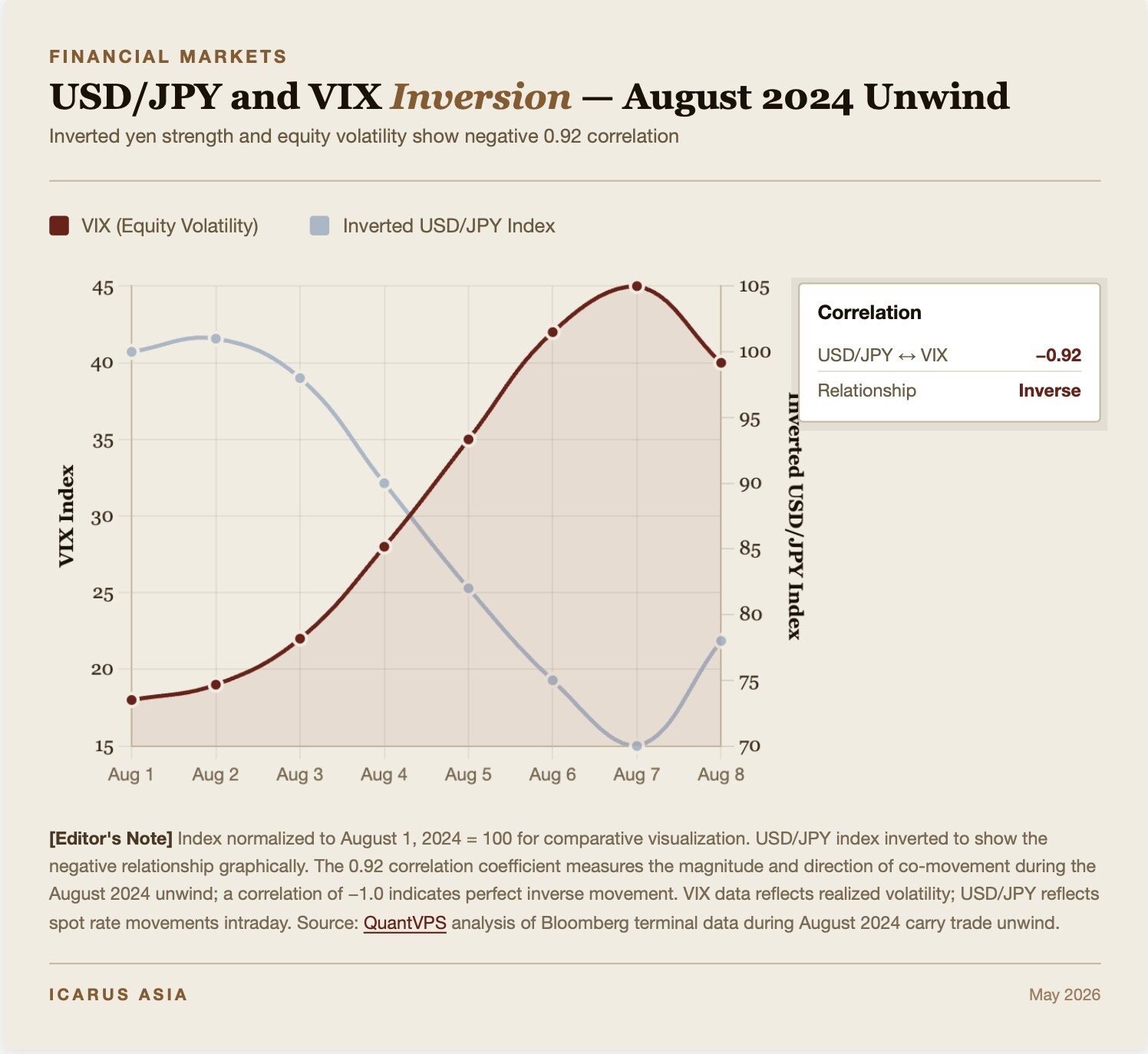
According to analysis cited in market research, a disorderly unwind would combine "high borrowing costs in Japan, a strengthening yen and a decline in global asset prices"--all three simultaneously, creating a liquidity crisis rather than a mere correction.
For American equities, particularly technology and high-growth stocks that have absorbed substantial yen-funded capital flows, the consequences would be severe. The question is not whether such an unwind could occur, but whether current equity valuations adequately incorporate this tail risk.
Better Than Before
Yet this is not simply a rerun of August 2024. The market structure has shifted in subtle but meaningful ways.
Carry traders who sustained losses in the previous episode have reduced leverage and added hedges, monitoring exposure daily rather than assuming the trade's permanence. A similar-sized BOJ surprise would likely produce a considerably smaller unwind, given that fewer traders remain fully exposed.
More significantly, the domestic institutional ownership of Japanese government debt provides substantial absorption capacity. Some 88 percent of Japanese debt is held domestically, with the Bank of Japan owning more than half and domestic life insurers, banks, and pension funds controlling another 40 percent. These are not marginal players trading reactively; they are structural holders whose return requirements are satisfied at current yield levels. A life insurer holding a 30-year JGB at 2.3 percent has found acceptable returns and has no incentive to flee.
This matters profoundly.
Unlike emerging markets dependent on foreign flows, Japan possesses the capacity to absorb external shocks. A sell-off driven by foreign re-pricing would likely be absorbed by domestic buyers--perhaps reluctantly, perhaps at higher yields, but absorbed nonetheless, providing a stabilizing force absent in more vulnerable economies.
Japanese life insurers have been adjusting their holdings in measured fashion, shifting from superlong bonds into intermediate maturities as yields rose--a reallocation that appears orderly rather than panicked. The BOJ, despite mounting pressure, has signaled its intent to proceed gradually, with Governor Ueda declining to lock himself into preset schedules and retaining flexibility to pause should conditions deteriorate sharply.
There exist, in short, mechanisms capable of absorbing stress. Whether they would function effectively if multiple strains converged simultaneously remains an open question.
The Weak Bull Case
Investors maintaining carry positions contend that the strategy remains fundamentally profitable and likely to remain so. The 5-percentage-point spread persists at attractive levels, domestic Japanese buyers continue absorbing bonds, and the BOJ would hesitate to tighten into recession.
These points possess merit, yet they rest on increasingly fragile foundations.
According to analysis of currency market dynamics, the yen is no longer functioning as a pure safe haven. It operates instead as a funding currency, strengthening in genuine risk-off episodes not because it is inherently safe but because carry positions are unwinding. In a global credit crisis, the yen might yet appreciate, though for distinctly unfavorable reasons.
Additionally, foreign investors have become increasingly consequential in JGB auctions, bringing with them price sensitivity. A significant widening of American credit spreads would likely trigger selling rather than buying, pushing JGB yields higher and compressing the term premium that makes longer-dated bonds attractive in the first instance.
The bullish case thus requires: stable rates, non-deteriorating U.S. credit conditions, government forbearance from additional spending, and BOJ tightening managed without breaking financial conditions. Each assumption is individually plausible; collectively they demand a remarkably narrow path forward.
What's Actually at Stake
Economically, the supplementary budget represents a trivial adjustment. Politically, it communicates volumes.
It signals to the BOJ that fiscal discipline cannot be presumed. It warns bond investors that additional spending packages may follow. It tells carry traders that the foundational conditions enabling profitable funding positions are shifting.
For the American investor holding technology equities purchased with borrowed yen, the implication is straightforward: profits depend entirely on a 5-percentage-point spread between Japanese and American rates. That spread faces vulnerability from dual directions--the BOJ tightening narrows it while American slowdown forces exits simultaneously.
The math is unforgiving.
The bond market has begun pricing some of this risk; JGB yields sit near historical highs, and equity valuations suggest broad comfort with continued financial stability. Yet positioning data indicates carry traders have reduced rather than eliminated exposure, suggesting incomplete recognition of downside risk.
The risk inheres no longer in hidden channels or obscure mechanics. It is visible to anyone posing the appropriate questions. What remains uncertain is whether markets have priced it adequately.
Based on current valuations, the answer appears to be no.
The author is the Head of Risk and Analysis at Icarus Asia, a Hong Kong-based risk and advisory business
Not investment advice. Please do your own research.
SOURCES
CNBC: Japan's Takaichi unveils $19 billion extra budget, reassures on bond issuance
CNBC: Bank of Japan raises benchmark rates to highest in 30 years
Nikkei Asia: Japan long-term bond yields hit record highs amid fiscal concerns
MenthorQ: The Yen Carry Trade and Its Global Implications Guide
BIS Bulletin: The market turbulence and carry trade unwind of August 2024
StoneX: Yen Carry Trade Unwind Threatens U.S. Dollar Stability
Insurance Business: Japan midsize life insurers cut exposure to superlong government bonds
CNBC Africa: Safe-haven currencies might not be so safe after a volatile year
Yahoo Finance: Foreign Traders Seize on Japan Bonds, Sparking Volatile Era