
The debate among economists and bond investors has quietly shifted to not whether a fiscal reckoning is coming, but whether it arrives as an inflation shock, a default scare, a currency crisis, or something slower and harder to see.
By Kenan Machado, May 9, 2026
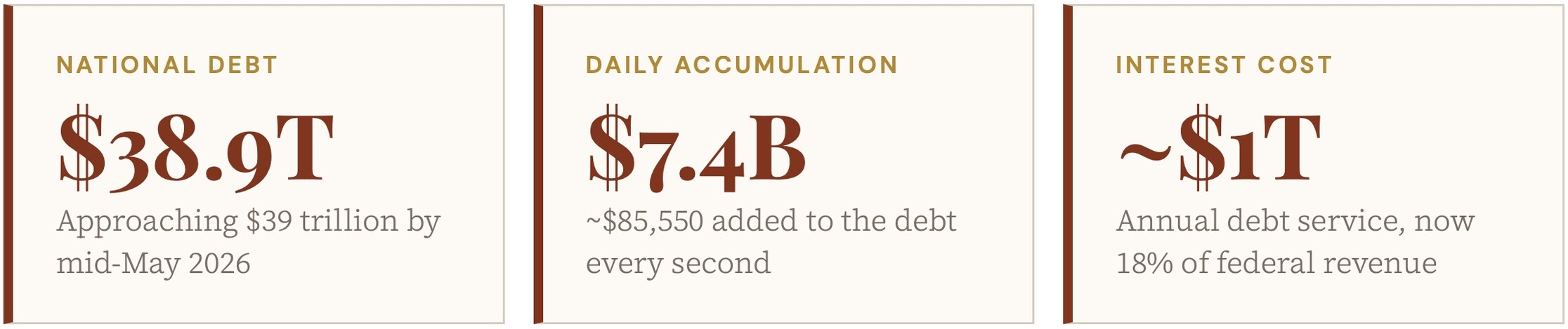
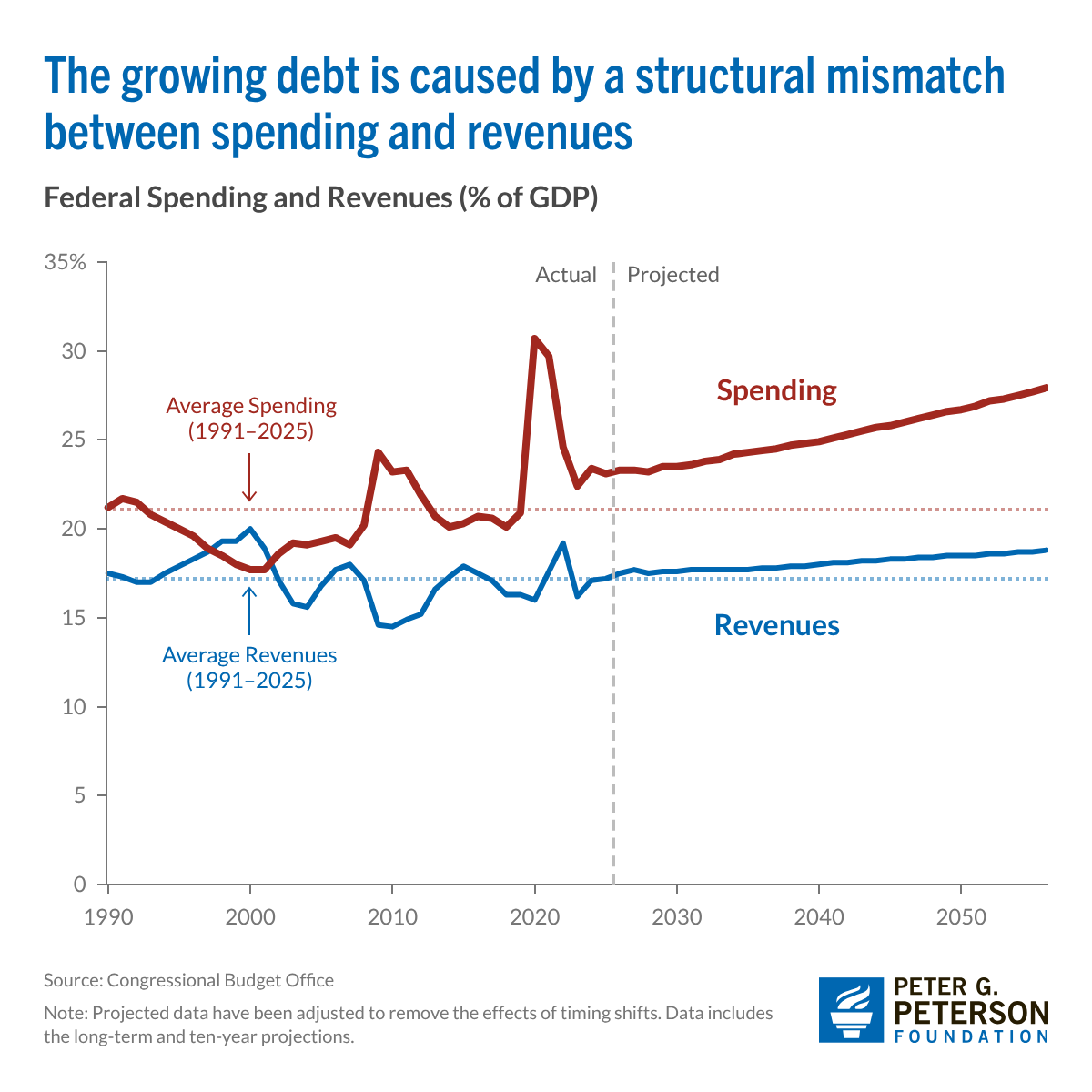
The U.S. national debt has hit $38.91 trillion and is adding roughly $7.4 billion a day, more than $85,000 every second. Interest payments swallowed nearly $1 trillion last year, surpassing what the Pentagon spent. The annual deficit is running at an estimated $2 trillion, with no credible plan in Washington to close it.
There is no longer serious disagreement about whether this trajectory is sustainable. It isn't.
The debate now, among policy analysts, bond investors, and the kind of former officials who write op-eds because they can no longer hold press conferences, is about sequencing. Which of several possible fiscal crises arrives first, and whether the political system will act before bond markets force its hand.
A January 2026 analysis by the Committee for a Responsible Federal Budget catalogued six distinct crisis forms the current path could produce: a financial crisis, an inflation crisis, an austerity crisis, a currency crisis, a default crisis, and a "gradual crisis": the slow erosion of living standards that never generates a single alarming headline but ultimately costs more than an acute shock.
The report warned that several could arrive together.
Its conclusion was unusually direct for a Washington think tank: "Without a course correction or major change in circumstance, some form of crisis is almost inevitable."
What the Wall Street Warning Signs Look Like
Jamie Dimon, chief executive of JPMorganChase, told investors in April 2026 that "some kind of bond crisis" was on its way as the federal deficit kept expanding. Jeffrey Gundlach, who runs DoubleLine Capital and manages one of the biggest bond funds in the country, said in a May 2026 webcast that he now expects some form of U.S. debt restructuring, and has already positioned for it: long gold and inflation-linked assets, short long-dated Treasuries.
Neither man is a chronic pessimist by professional temperament. That is part of what gives their warnings weight.
The analytical consensus across government accountability reports, Congressional Research Service filings, and academic legal scholarship holds that a hard, insolvency-driven default on U.S. Treasuries remains a tail risk rather than a base case. The dollar still anchors global trade. The Treasury market has no real rival in depth or liquidity. And unlike Argentina or Greece, the U.S. issues debt in its own currency, which means it is technically never forced to default, only ever choosing to.
That distinction, however, contains its own problem. Printing money to service debt avoids a default crisis by creating an inflation one. Neither path is without serious cost.
Three Times America Has Nearly Defaulted, or Crossed the Line
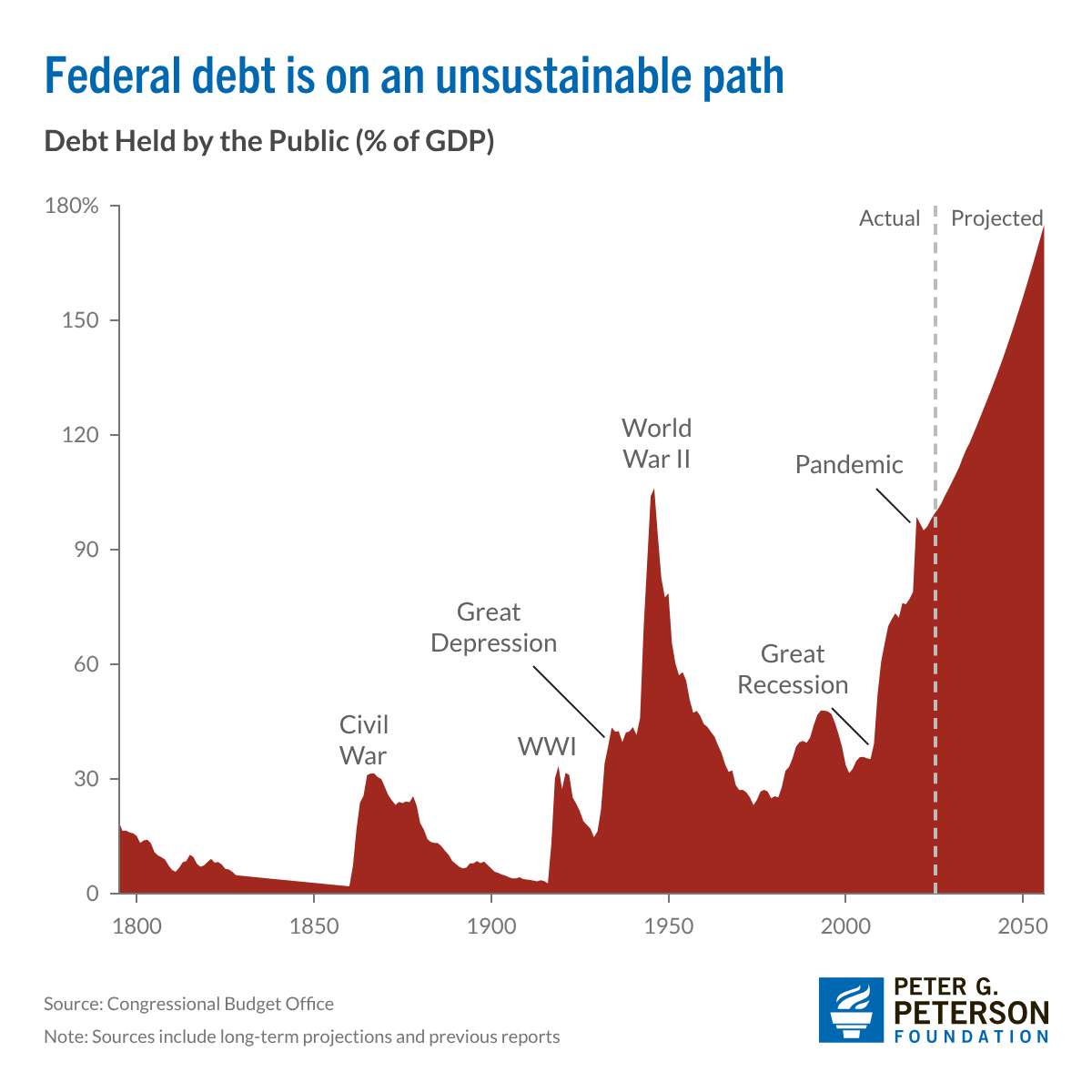
The federal debt held by the public is projected to reach 137% of GDP within a decade of blowing past the peak of 106% of GDP in 1946 as the US tried to spend its way to win World War II.
To be sure, the U.S. hasn’t ever defaulted on its debt, not technically.
“More generally, the concept of default stems from contract law…,” according to Andrew Austin, an Analyst in Economic Policy with the the Congressional Research Service’s Government and Finance Division. “...and thus may be ambiguous because contract terms may be private or contracts may be incomplete, in that the consequences of some contingencies are left unspecified.”
“For instance, the terms under which Treasury securities are offered lack any mention of payment delays or nonpayment,” he says. “The ambiguity of the term "default" leads many third parties to develop their own definitions to monitor compliance with promises to pay.”

The conventional narrative that the U.S. has never defaulted is somewhat cleaner than the actual record. The Congressional Research Service identifies three episodes in which the federal government failed to honor its obligations fully, on time, or in the terms originally promised.
The first came in 1814. Congress had dissolved the first Bank of the United States three years earlier, leaving Treasury without a central fiscal agent. Federal revenue depended almost entirely on customs receipts that maritime blockades had largely eliminated. The government was routing funds through 94 local banks, and Treasury dollars in Philadelphia couldn't settle obligations in New York. Interest payments in certain regions went unpaid. An operational failure rather than a political choice, but a default by most definitions.
The second was deliberate. In 1933 and 1934, the Roosevelt administration voided gold clauses embedded in federal bond contracts: the provisions that guaranteed repayment in gold-equivalent value and protected creditors against currency debasement. Bondholders received their nominal dollars but lost the real value the contract had promised. The Supreme Court ruled 5-4 in Perry v. United States that Congress lacked the authority to abrogate those clauses in its own debt, then declined to award damages anyway, reasoning that prior deflation had already compensated the difference. A strategic restructuring dressed in legal pragmatism.
The third episode, in the spring of 1979, was neither strategic nor dramatic, just embarrassing. A debt-ceiling standoff delayed Treasury auctions. The Bureau of the Public Debt was mid-migration to a new automated system. Small investors had flooded in, chasing the high T-bill yields of the Volcker era, and the back office buckled. About $122 million in redemptions went out late to individual investors. Treasury yields on the affected bills jumped 60 basis points the day the delays surfaced. Later estimates put the added annual borrowing cost at approximately $12 billion, a steep price for what was essentially a clerical failure.
Note: The three historical episodes above are drawn from Congressional Research Service analysis (CRS Report R44704) and academic research published in the Boston College Law Review on rollover risk in sovereign debt. The 1979 yield figures and cost estimate are sourced from those documents. All three incidents are independently documented in the academic and government literature.
The Mechanism Wall Street Is Actually Watching
Sovereign debt crises, in academic literature, typically get framed as solvency problems: a government that simply owes too much. The more immediate operational concern for the U.S. is different. What the Boston College Law Review terms rollover risk is the government becoming unable to refinance maturing debt at manageable rates, not because it is insolvent on paper, but because confidence evaporates faster than auctions can clear.
The math is uncomfortable.
Half of all federal debt needs to roll within two years. More than 70% of privately held debt matures within five. The reliance on short-term issuance keeps current interest costs low, until the moment it doesn't. A U.S. Government Accountability Office review of post-2011 debt-ceiling standoffs found that six of twelve were resolved only days before the government would have run through its cash and extraordinary measures. The GAO was explicit: a last-minute deal might not prevent a technical default regardless, given the time required to schedule auctions and process payments once statutory authority is restored.
The Center on Budget and Policy Priorities estimates that under the House budget plan, which does include a borrowing-limit increase, the ceiling would likely be hit again by fall 2026. The CRFB has mapped a cluster of fiscal deadlines converging before year-end. This machinery has cycled through brinkmanship before. What has changed is the margin. It keeps getting thinner.
Who Holds the Debt, and How It Has Changed
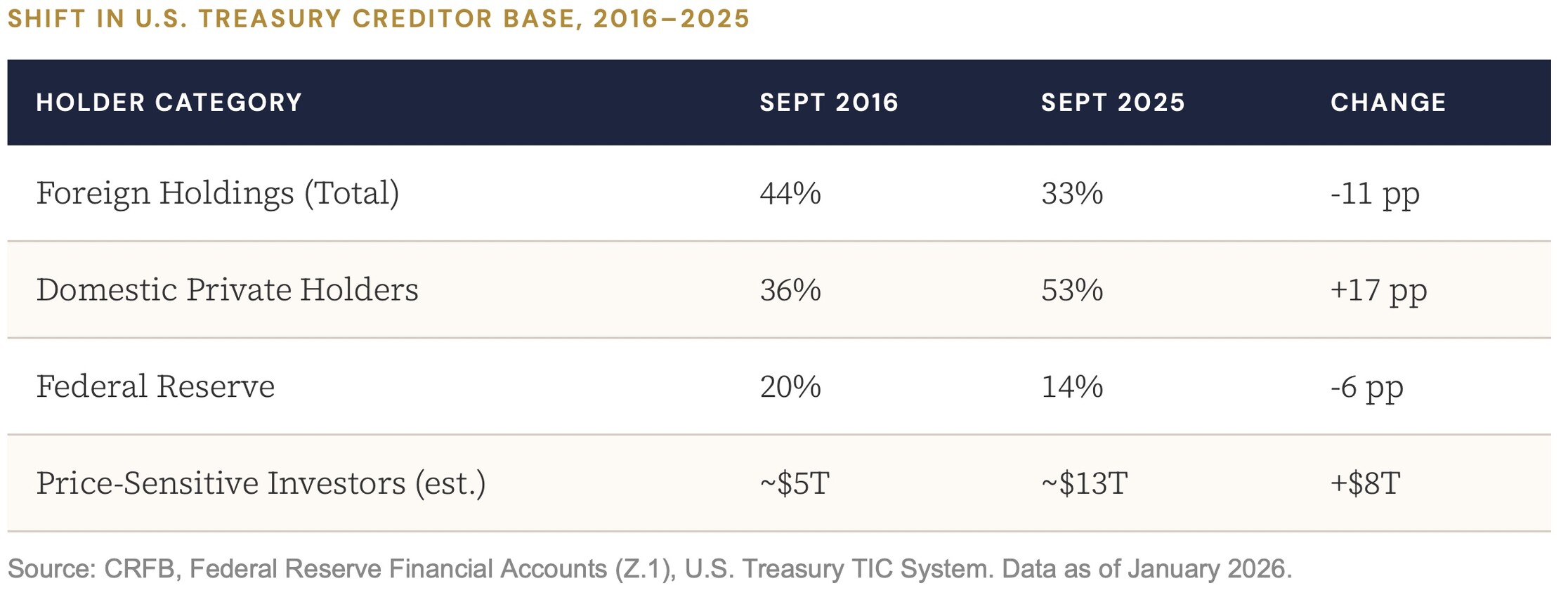
A decade ago, foreign investors held 44% of publicly held Treasury debt, providing a stable base with partly geopolitical motivations: countries accumulating dollars to anchor their currency regimes. By early 2026, that share had fallen to 33%. Domestic private holders now account for 53%. The Federal Reserve, whose holdings expanded sharply during quantitative easing, holds 14%, according to CRFB estimates compiled from Federal Reserve flow-of-funds data and Treasury International Capital reports.
The composition matters more than the headline percentages. CRFB estimates roughly $13 trillion, about half the publicly held debt, now sits with price-sensitive investors: mutual funds, money-market funds, households, and foreign private entities. Nine years ago that figure was around $5 trillion. These creditors move when yields move. A disorderly rate spike would reach a far larger share of the creditor base than it would have in any prior stress episode.
The Interest Rate Trap
One metric has become a quiet obsession among fiscal analysts: the share of federal revenue consumed by interest. In 2021, debt service took less than 10 cents of every dollar the government collected. Last year it was 18 cents, nearly double in four years, with no crisis required to get there. Under the CBO's long-term baseline, that share reaches nearly 30% of revenue by 2055. Under a more adverse scenario modeled by CRFB, in which revenue and non-entitlement spending return to historical averages, interest could consume 70% of federal revenue by mid-century. At that point the federal budget would effectively be a debt-servicing operation with social programs attached.
The dynamics can become self-reinforcing. Higher debt pushes rates up. Higher rates inflate the interest bill. The larger interest bill expands the deficit. The larger deficit raises the debt. Economists call this a debt-interest spiral. The U.S. is not yet in one by most technical definitions, but the gap between its borrowing cost and its economic growth rate has been narrowing steadily. Each year that Congress defers action narrows it further.
The Legislation Making It Worse
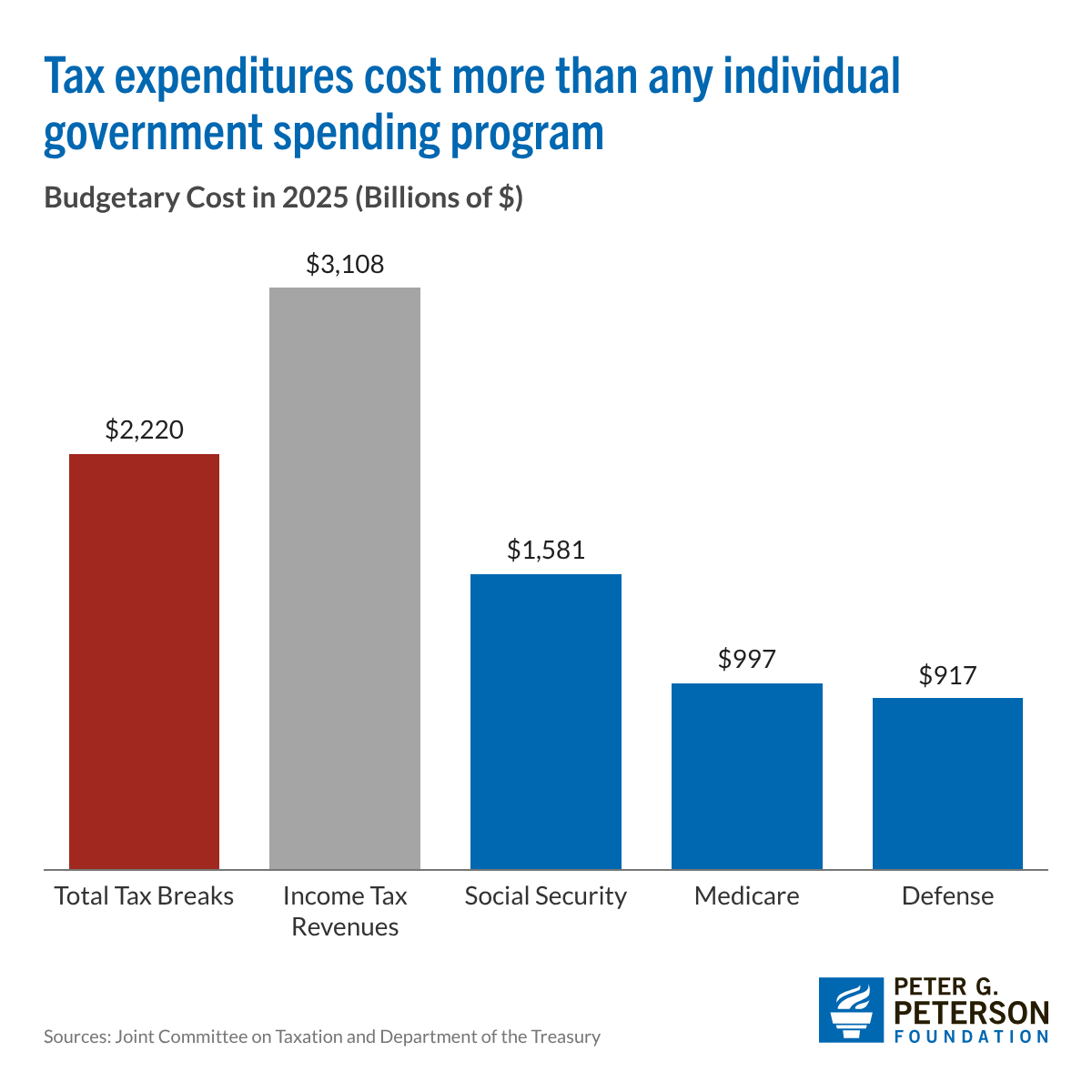
Against that backdrop, the major fiscal legislation moving through Congress in 2026 points in the wrong direction. The "One Big Beautiful Bill Act," which extends the 2017 tax cuts and layers on additional spending provisions, would raise the structural fiscal gap to 2.4% of GDP, according to the Center for American Progress. The Brookings Institution assessed the bill's early fiscal impact as deeply negative. The CRFB's own analysis put the ten-year deficit addition in the trillions.
There is a secondary effect the headline numbers don't fully capture.
Markets don't just react to borrowing levels; they react to what the borrowing signals. The CRFB's January 2026 paper specifically lists large new unfunded legislation as one of the potential catalysts for a fiscal crisis, not only because of its direct impact, but because of what it tells investors about whether Washington takes its debt seriously. A 2022 UK government came perilously close to triggering a gilts crisis simply by proposing an unfunded tax cut. It backed down within weeks. The U.S. has more credibility in reserve. Credibility, however, is not an unlimited resource.
The Slow-Motion Version No One Is Watching
The scenario that receives the least attention may ultimately be the most consequential. A CBO model from spring 2025 traced what happens if debt drifts toward 250% of GDP over 25 years without triggering a sharp contraction. Compared with a scenario where debt holds at 100% of GDP, the CBO found that by 2050, real income per person would be 8% lower, average interest rates on government debt would be 24% higher, and interest payments would consume an additional 38 percentage points of revenue. Annual GDP growth would slow by about a third.
These are large numbers by historical standards. GDP and GNP have never contracted more than 2% in any single year since 1950, meaning the cumulative drag of unchecked debt would exceed the worst single-year shock the postwar economy has recorded. But it would arrive so gradually that no single Congress, no single administration, would face a clear moment of political accountability for it.
Japan is the cautionary reference.
Government debt has sat above 200% of GDP for years. An acute crisis has not materialized. The policies that prevented one, including yield curve control, sustained central bank bond purchases, and rates held near zero for decades, also suppressed economic dynamism. Real GDP has grown roughly 10% over two decades, about 0.5% per year. The country is technically stable. It is also, in per-capita terms, considerably poorer than it might have been. That is the implicit trade-off the U.S. is being offered, and one the current policy debate has not fully reckoned with.
What a Hard Default Would Actually Cost
A Moody's Analytics report published in 2023 estimated that even a short technical default, lasting only a few weeks and not rooted in excessive debt, would cut output by 4%, eliminate 6 million jobs, and wipe out roughly a third of the stock market. Those figures are for a contained episode. A J.P. Morgan analysis cited in academic rollover-risk research put the GDP haircut at around one percentage point, with additional long-run damage from reduced foreign demand for Treasuries and persistently higher borrowing costs.
The second-order effects are where the deeper danger lies. U.S. Treasuries underpin trillions of dollars in repo and derivatives collateral chains. A default doesn't just hit the bond market; it propagates through the shadow banking system in ways that are genuinely difficult to model and hard to contain once they begin. The GAO has noted that an emergency Federal Reserve response, specifically accepting defaulted Treasuries as collateral, would itself invite political attacks capable of damaging the central bank's perceived independence. That matters, because an independent Fed is one of the few institutional buffers between the U.S. and the kind of inflation spiral that has historically followed fiscal dominance.
Each round of brinkmanship chips away at something real. The 2011 debt-ceiling standoff was resolved before default and still cost the government an estimated $1.3 billion in extra interest that fiscal year, according to GAO's 2012 review. A more serious episode would cost more, and the credibility damage would linger longer. The dollar's reserve-currency status, flagged by both GAO and Brookings as a key casualty of a genuine default, is worth preserving not only for the borrowing advantage it provides but for the geopolitical leverage it underwrites: the ability to enforce sanctions, track illicit finance, and project financial power abroad. Lose that, and the tools that might replace it are not obvious.
Congress has not passed a budget on time since 1997. The political system has a reasonable track record of reacting to acute deadlines; its record on slow-moving structural problems is considerably less reassuring.
The federal government is adding roughly $85,550 to the national debt every second. Meanwhile, committee hearings are being held.
The author is the Head of Research and Analysis at Icarus Asia, a Hong Kong-based risk and advisory business.
REFERENCES
U.S. Senate Joint Economic Committee — National Debt Reaches $38.91 Trillion, Increased $2.70 Trillion Year over Year, accessed May 9, 2026
Committee for a Responsible Federal Budget — Treasury & Markets Anticipate At Least $2 Trillion FY 2026 Deficit, 2026
Committee for a Responsible Federal Budget — What Would a Fiscal Crisis Look Like? January 22, 2026
Moneywise — Jamie Dimon warns ‘some kind of bond crisis’ is coming as US deficit soars, 2026
DoubleLine Capital — Jeffrey Gundlach on U.S. Debt, Private Credit and Gold (The Julia La Roche Show), May 2026
Congressional Research Service — Has the U.S. Government Ever Defaulted? (CRS Report R44704), updated December 8, 2016
Boston College Law Review — Rollover Risk: Ideating a U.S. Debt Default (academic research on sovereign rollover risk and debt-ceiling mechanics)
U.S. Government Accountability Office — Fiscal Health Reports and 2024 Debt-Ceiling Analysis
Center on Budget and Policy Priorities — Under House Budget Plan, Debt Limit Would Likely Be Reached by Fall 2026 Despite Increase, 2026
Committee for a Responsible Federal Budget — Upcoming Congressional Fiscal Policy Deadlines, May 4, 2026
Congressional Budget Office — The Budget and Economic Outlook: 2026 to 2036, 2026:
Congressional Budget Office — Long-Term Budget Outlook, Spring 2025
Center for American Progress — President Trump’s ‘Big Beautiful Bill’ Raises the Fiscal Gap to 2.4 Percent, 2026
Brookings Institution — One Big Beautiful Bill? A Preliminary Assessment, 2026
Moody’s Analytics — Default impact estimates for a short technical default, 2023
Federal Reserve / U.S. Treasury — Financial Accounts of the United States (Z.1) and Treasury International Capital (TIC) System; CRFB estimates based on these sources, data current as of January 2026
Office of Debt Management — Treasury Presentation to Treasury Borrowing Advisory Committee, May 9, 2026
U.S. Department of the Treasury — Treasury Announces Marketable Borrowing Estimates, May 9, 2026. For source table and data access here.
Disclaimer: This article is for institutional research and educational purposes only and does not constitute investment advice. No material non-public information was used.