
News · Markets · India
An Exuberant Market is No Place for Short Sellers
Short sellers exposed Enron, Wirecard and Nikola years before regulators caught up. A fraud conviction, a decade of rising stocks, and a Reddit mob have pushed them out of the business. The gap they leave is real.
In January 2025, Nathan Anderson sat down and wrote what amounted to a resignation letter addressed to the whole financial industry.
Anderson ran Hindenburg Research, a firm so small it operated with a handful of analysts and so feared it could wipe billions from a company's market value in an afternoon.
Hindenburg had targeted Nikola, whose founder was later convicted of fraud. It had gone after Gautam Adani's Indian conglomerate, temporarily erasing more than $150 billion in market value and triggering a parliamentary inquiry. It had called Carl Icahn's holding company a "Ponzi-like" structure paying dividends from investor money. In each case, regulators eventually confirmed what Hindenburg had published first.
Anderson's letter mentioned none of that. He said he was tired.
"The intensity and focus," he wrote in a letter to investors announcing Hindenburg's closure, "has come at the cost of missing a lot of the rest of the world and the people I care about." Thirteen months later, a federal jury in Los Angeles convicted Andrew Left of Citron Research on 13 securities-fraud counts.
The short sellers were already leaving. The verdict made it faster.
Shooting the Messenger
Left's case took two years to get to trial and about two weeks to resolve.
He'd run Citron Research for years, publishing bearish reports on companies including China Evergrande and Valeant Pharmaceuticals — sometimes right, sometimes wrong, usually noticed. Prosecutors argued he had gamed his own commentary: publishing research, watching the stock fall, then covering his short position in the window between publication and price recovery. A jury found that persuasive. He faces up to 20 years, though white-collar sentences routinely fall short of statutory maximums. He's indicated he may appeal on First Amendment grounds.

The industry's reaction fell along predictable lines. Short sellers said the conviction would chill legitimate research; companies and their advocates said it was overdue. Neither side had much new to say.
The more uncomfortable question, and the one that cuts across both camps, is what happens to the frauds that short sellers would have caught.
Ecce Homo
The U.S. Securities and Exchange Commission's record here isn't flattering.
Enron's off-balance-sheet structures were flagged by short sellers years before the SEC opened an investigation. Valeant's revenue recognition was questioned by Citron and others while regulators were still deciding whether to look. Wirecard, the German payments company, turned out to have fabricated roughly €1.9 billion in cash — a fact that short sellers and a small group of journalists had been arguing for years while German regulators threatened to prosecute the reporters rather than the company. Nikola's founder filmed a truck rolling downhill and presented it as a hydrogen power demonstration; Hindenburg spotted it. Add Adani Group, add Icahn Enterprises. The pattern runs long enough that calling it coincidence takes effort.
Frank Zhang, an accounting professor at Yale School of Management who has assigned Left's research in his courses, told Bloomberg News that if the verdict has a chilling effect on activist short research and public communication, it would "ultimately affect market efficiency and price discovery." That's probably right. The harder thing to calculate is which specific frauds go uncaught, and for how long.
The Writing on the Wall
The structural pressures on short sellers predate June 2026 by a decade.
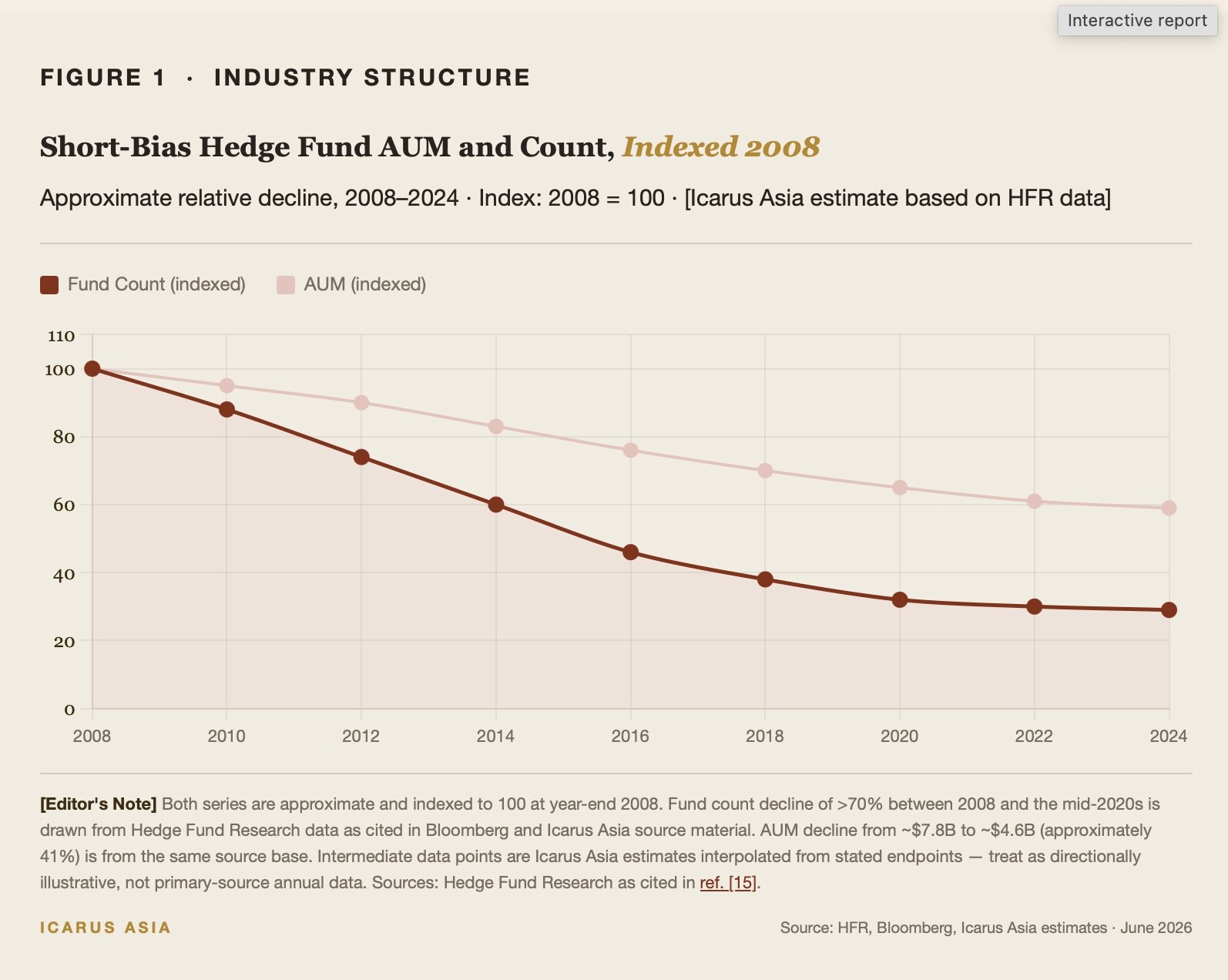
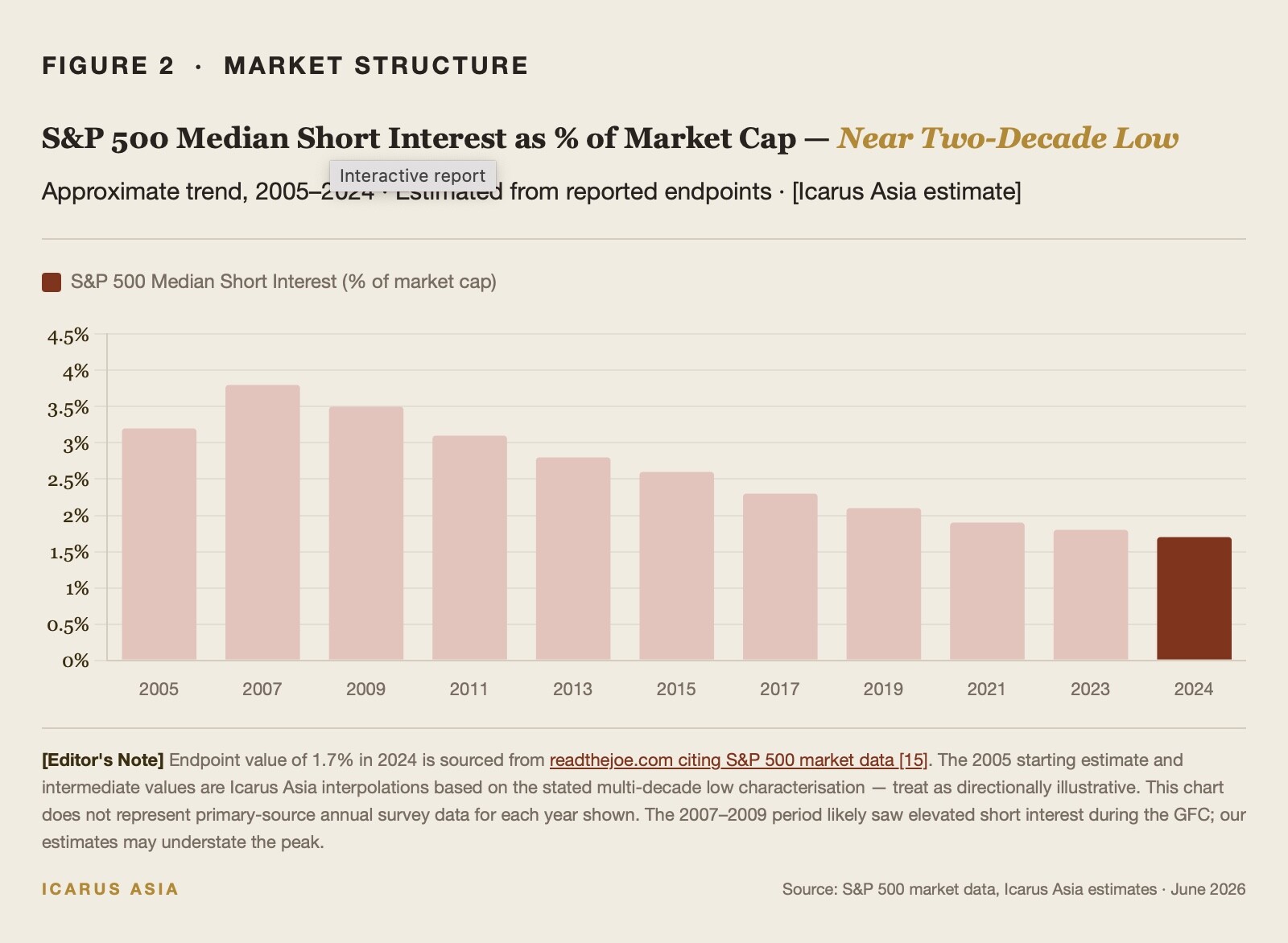
Short-bias hedge funds managed roughly $7.8 billion at their peak. By 2024, that figure had dropped to approximately $4.6 billion, according to HEDGE FUND RESEARCH INC data. The number of dedicated short-bias funds fell by more than 70 percent between 2008 and the mid-2020s. Median short interest in S&P 500 stocks sat at approximately 1.7 percent of market capitalization in 2024, near its lowest point in roughly two decades.
Some of this is arithmetic. Short sellers profit when stocks fall.
The S&P 500 roughly quadrupled in the decade after the 2008 financial crisis, then roughly doubled again through 2024, with a handful of technology companies doing most of the work. Staying short in that environment meant paying borrow costs, managing margin calls and waiting for mean reversion that kept not happening.
Jim Chanos, who ran the most recognized short-selling firm in history and called Enron before it collapsed, closed his funds in 2023 and told investors the long-short business model was under pressure. The math had caught up with him.
The 2021 meme stock episode introduced a different kind of pressure.
Pump Up the Stonk
Coordinated retail investors on WallStreetBets drove GameStop from around $20 to nearly $500 in days, explicitly to punish short sellers. Melvin Capital Management LP, one of the more respected long-short funds in the business, lost 53 percent that January and never fully recovered. Citron Capital, Left's fund, was on the wrong end of the same trade and largely stopped publishing research on individual stocks afterward.
Mehrdad Samadi, PhD, a finance professor at Rutgers University, told Bloomberg the structural shift was real.
"The increased participation of retail investors and the introduction of zero-commission trading by retail brokerages really spurred coordinated meme stock trading and short squeezes," Samadi said. He added that a short seller making a 12-month bet on fundamentals now had to price in the possibility that Reddit disagrees before the thesis plays out.
Carson Block of MUDDY WATERS CAPITAL LLC has mentioned receiving death threats. That's not a market dynamic — it's just what the job became.
A High Burden of Proof
The Left verdict is complicated because the underlying conduct is complicated.
The case didn't turn on whether Citron's research was wrong (much of it wasn't) but on the trading pattern around publication. Prosecutors argued Left was running something closer to a scheme: generate market-moving commentary, then profit from the price reaction before other investors could respond. That's distinct from publishing research, maintaining a short position, and covering months later when the thesis has played out or proven wrong.
Prosecutors argued Left was running something closer to a scheme: generate market-moving commentary, then profit from the price reaction before other investors could respond
The legal line between those two things is now blurrier than it was before the verdict.
It's possible the ambiguity is intentional — that uncertainty itself is meant to deter the most aggressive tactics. But activists who believe they're on the right side of that line now face a jury-trial test they'd rather not run.
The argument that regulators will fill the gap is optimistic in a way the historical record doesn't support. Artificial intelligence tools may eventually lower the cost of forensic accounting enough to change that. Maybe. The technology exists; the institutional incentive structure that would deploy it against well-lawyered companies doesn't quite yet.
Perback Capital Partners, a short-selling fund backed by Schonfeld Strategic Partners Fund LLC, returned money to investors this month after failing to grow its assets.
It's a footnote, not a headline. But it fits the pattern.
Nate Anderson left because the job cost too much personally. Jim Chanos left because the economics stopped working. Andrew Left is awaiting sentencing.
The short sellers had their problems, some of them serious. But they were catching things nobody else was looking for. Markets should probably figure out who does that now.
The author is the Head of Research and Analysis at Icarus Asia, a risk and advisory firm based in Hong Kong.
Sources
Academic & Peer-Reviewed Research
Boehmer, E. et al. "Shorting flows, public disclosure, and market efficiency," Journal of Financial Economics, ScienceDirect.
"Short selling, informational efficiency, and extreme stock price adjustment," International Review of Economics & Finance (2024), ScienceDirect.
"Manipulation, panic runs, and the short selling ban," Journal of Economic Theory (2024), ScienceDirect.
"Short selling, informational efficiency, and extreme stock price adjustment," Review of Economics (2024), IDEAS/RepEc.
"The impact of short-selling and margin-buying on liquidity," Pacific-Basin Finance Journal, ScienceDirect.
University of Aberdeen. "The COVID-19 Pandemic, Short Sale Ban, and Market Efficiency" (PDF), AURA Research Portal.
Regulatory & Policy Research
CEPR Discussion Paper DP17725. "Short Sale Bans May Improve Market Quality During Crises."
Office of Financial Research, U.S. Department of Treasury. "Are Short-selling Restrictions Effective?" Working Paper 23-08.
State Street Global Advisors. "The Effectiveness of Short-Selling Bans"
Industry & Professional Association Sources
Managed Funds Association. "Short Selling Is Essential for Healthy Markets."
Charles Schwab. "Short Selling: The Risks and Rewards."
Panda, A. "The Crucial Role of Short Selling in Financial Markets: Evidence and Insights," LinkedIn Pulse.
Recent Market Developments & News Coverage
Wall Street Journal. "Wall Street's Pre-Eminent Short Seller Is Calling It Quits," January 2025.
CNBC. "Hindenburg Research founder says he's closing short-seller research shop," January 2025.
CNN. "Hindenburg's exit marks the end of an era for swashbuckling short-sellers," January 2025.
Yahoo Finance. "Hindenburg Research shutting down highlights 'wear and tear' of activist short selling," January 2025.
Solutions Atlantic. "Activist Short Selling Firm Hindenburg Research Shuts Down," January 2025.
ReadTheJoe. "Short Interest Plummets to Two-Decade Low of 1.7% as S&P 500 Hits New Highs."
News Sources
Bloomberg. "Andrew Left Found Guilty in Case That Spooked Short Sellers," June 2026.
New York Times. "What a Short-Seller's Conviction Might Mean for Wall St.," June 2026.
Yahoo Finance. "Short seller Andrew Left convicted of securities fraud," June 2026.
The Guardian. "Short seller Andrew Left convicted of securities fraud," June 2026.
Virginia Lawyers Weekly. "Short seller Andrew Left to stand trial in LA over manipulation charges," May 2026.
Business Insider. "What Is Short Selling? Strategies, Risks, and Rewards."
Vanderbilt Business. "New Study Finds Aggregate Decline in Hedge Fund Performance," May 2021.
Institutional Investor. "How Regulators Killed Hedge Funds."
Yale Alumni Magazine. "The fraud detective"