
News · Markets · US
In Musk We Trust
On the morning of May 20, a 277-page document landed on the Securities and Exchange Commission's servers, and for a few hours it triggered intense market speculation and commentary across financial media.
SpaceX is asking public markets to bet a reportedly $2 trillion on AI data centers, a contract cancellable in 90 days, and one man's ability to run six companies at once. Wall Street is considering it.
On the morning of May 20, a 277-page document landed on the Securities and Exchange Commission's servers, and for a few hours it triggered intense market speculation and commentary across financial media.
The document was SpaceX's (Space Exploration Technologies Corp.) S-1 — the registration statement that precedes a public offering — and it contained, among other things, a $28.5 trillion total addressable market claim, a contract with Anthropic worth $1.25 billion per month, and a plan to deploy artificial intelligence compute satellites into low-Earth orbit by 2028. The company seeking to go public at a reportedly $1.75 trillion to $2 trillion valuation*, a number that would make it, if it held, the fourth-largest publicly traded company in America. The proposed ticker is SPCX.
Our mission is to build the systems and technologies necessary to make life multiplanetary, to understand the true nature of the universe, and to extend the light of consciousness to the stars - SpaceX
What the document also contained — buried in the footnotes and disclosure language that S-1 filings are specifically designed to obscure through volume — were details that told a different, more complicated story.
The Anthropic contract can be cancelled in 90 days. The $28.5 trillion market is approximately a quarter of global GDP. The company generated a net loss of $4.9 billion last year. The bridge loan used to clean up its balance sheet before the offering comes with provisions that could require SpaceX to hand large portions of its IPO proceeds directly to creditors. And controlling the whole enterprise, with more than 80 percent of the voting power, is Elon Musk — a man currently running, by any reasonable count, six significant companies at once.
None of this is secret. All of it is disclosed. That's the thing about SpaceX's S-1: it's not a fraud. It's something stranger and, for investors, potentially more treacherous. It's a document that tells the truth about an extraordinary company in a way specifically structured to make the extraordinary sound ordinary, and the speculative sound inevitable.
What follows is what the S-1 actually says, stripped of the pitch.
Three Companies, One Price Tag
To understand what SpaceX is selling, you first have to understand what it's become.
The company that launched its first rocket in 2006 — and failed three times before succeeding on the fourth attempt — is no longer primarily a rocket company. It is, at least by the structure of its S-1, a conglomerate: a launch business, a satellite broadband operator, and an artificial intelligence company, all bundled together and offered to the public at a single price.
The bundling is recent.
In February 2026, SpaceX acquired xAI — Musk's AI venture, home of the Grok chatbot and the Colossus data center in Memphis — and retroactively consolidated it into its financial history going back to 2023. It did the same with X, formerly Twitter. The result is that the 2023 and 2024 numbers in the filing do not reflect the standalone rocket-and-Starlink business that most investors had previously been analyzing. They reflect a combined entity that didn't exist in that form at the time.
By combining virtually unlimited solar power in space with our industry-leading launch costs and satellite manufacturing capabilities, we believe we can deliver compute over time at a fundamentally lower cost structure than is possible on Earth - SpaceX
This matters because the three businesses inside the new SpaceX are not at all alike.
The satellite broadband operation — Starlink — is real, profitable, and growing. In 2025 it generated $11.4 billion in revenue and approximately $7.2 billion in what the company calls segment-adjusted EBITDA, a profitability measure that strips out various costs. A 63-percent margin, for a business that has to continuously manufacture and launch satellites, is genuinely impressive. Starlink has 10.3 million subscribers as of the first quarter of this year, up from 2.3 million in 2023. It works.
The launch business — what SpaceX calls the Space segment — generated $4.1 billion in 2025 revenue and a modest $653 million in adjusted EBITDA. The numbers look small partly because SpaceX spent roughly $3 billion in the same year developing Starship, its next-generation rocket, and expensed most of that cost immediately rather than capitalizing it. The S-1 frames Starship as foundational infrastructure whose payoff will come later, when it enables cheaper satellite launches, national security payloads, and eventually — the company hopes — orbital AI computing. Whether that bet pays off is the most consequential unknown in the filing.
And then there's the AI segment: xAI, X, Colossus, and Grok. In 2025 it generated $3.2 billion in revenue, spent approximately $12.7 billion on capital equipment, and lost about $6.35 billion at the operating level. In the first quarter of 2026, it generated $818 million in revenue and lost $2.47 billion. The AI segment's capital expenditure in a single quarter — $7.7 billion — exceeded what SpaceX's Space and Connectivity segments spent on capex combined in all of 2025.
Add everything up, and the company SpaceX is offering to the public generated $18.7 billion in 2025 revenue, a $2.6 billion operating loss, and a $4.9 billion net loss. In the first quarter of 2026, the trend got worse, not better. AI losses accelerated.
The $2 trillion valuation is being placed on that.
*Note: The initial SpaceX S-1 filing does not list an exact share price. The price fields on the cover page are intentionally left blank. The formal Initial Public Offering (IPO) price per share will be determined later during the company's investor roadshow based on institutional demand. The prospectus is tied to a rumored valuation upwards of US$1.5 trillion derived from a tender offer US$421 a share prior to a 5-for-1 stock split. An updated prospectus (such as a 424B filing) will be released shortly before trading begins, containing the finalized per-share pricing range.
The Math That Has to Work
Before working backward from the price, it's worth pausing on what the price actually implies about the business that exists today. At the midpoint of the indicated range — $1.875 trillion — and using SpaceX's 2025 financials, the company is asking investors to pay roughly 100 times its annual revenue and somewhere between 265 and 303 times its adjusted EBITDA. For context, Alphabet trades at around 6 times revenue. Even the most expensive AI infrastructure companies, at the peak of the current cycle, have rarely breached 20 times revenue with positive margins. SpaceX is asking for five times that, on a business that is currently losing nearly $5 billion per year. The multiples are not a red flag on their own — every transformational company looks expensive on trailing numbers. But they establish, before a single assumption is made about the future, how much faith the price requires.
We believe that our current space efforts will catalyze transformative breakthroughs that could reshape terrestrial industries and lead to the emergence of new trillion-dollar markets on the Moon, Mars, and beyond - SpaceX
There is a useful exercise you can run on any company with a large speculative valuation. It involves working backward from the price to the earnings the company must eventually generate to justify it.
At $2 trillion, assuming a long-run free cash flow yield of 7 percent — reasonable for a company of this scale and ambition — SpaceX needs to eventually produce about $140 billion in annual free cash flow. Converting that to the earnings measure used in the S-1, and accounting for taxes, maintenance capital, and working capital needs, the figure reaches somewhere in the range of $233 billion in adjusted EBITDA at maturity.
Note: These assumptions — the 7 percent yield, a 10 percent cost of capital, 3 percent terminal growth, and a 60 percent EBITDA-to-free-cash-flow conversion — are this author's own analytical framework. They are not projections provided by SpaceX, and different inputs will produce different results. They are presented here as a way of making the valuation's implicit assumptions explicit.
We believe we have identified the largest actionable total addressable market (“TAM”) in human history - SpaceX
The company generated $6.6 billion of adjusted EBITDA in 2025. That figure is sourced directly from the S-1's segment disclosures.
That's a roughly 35-fold increase required at $2 trillion. At $1.5 trillion, it's about 27-fold. At $1 trillion — a meaningful discount to the current indicated range — it's still 18-fold. Think of them as the minimum conditions the valuation requires — what must be true for the price to make sense.
Break it out by segment and the picture sharpens further.
If Connectivity eventually accounts for half of earnings — reasonable given it's the only business generating real cash today — it would need to produce $117 billion in adjusted EBITDA from a 2025 base of $7.2 billion. That's a 16-fold increase in the earnings of a business whose revenue per customer has been falling for three consecutive years. The AI segment, currently losing money in absolute terms on an adjusted basis, would need to swing to $82 billion of profit. Space would need to reach $35 billion from $653 million.
This is not impossible. A company that captures a dominant position in AI infrastructure, builds the world's cheapest launch platform, and scales Starlink to 50 million subscribers could, theoretically, generate numbers like these. People who make the bull case for SpaceX are not being irrational. They're making a legitimate argument about what happens if Elon Musk is right.
The problem is the price. At $2 trillion, investors are paying the full price of the dream, in advance, before a single one of the most consequential questions has been answered.
The Contract That Isn't
Nothing in the S-1 captures the document's style of disclosure better than its treatment of the Anthropic relationship.
In May 2026, Anthropic — the AI safety company backed by Google and Amazon — agreed to pay SpaceX $1.25 billion per month for access to computing capacity at Colossus and Colossus II, the xAI data centers. Multiply that out and you get approximately $45 billion over three years, a figure that has been widely reported as a landmark contract validating SpaceX's AI ambitions.
While the S-1 filing characterizes this as a contract, the 90-day termination clause effectively renders it closer to a month-to-month commitment than a multi-year revenue guarantee. Either party can terminate on 90 days' notice.
We do not want humans to have the same fate as dinosaurs - SpaceX
The S-1 discloses this clearly. What it doesn't do is calculate the implication for investors: the entire $45 billion is visible revenue only 90 days at a time. Three months of committed revenue. On a $3 billion-per-month capex program.
This matters for a specific reason that the S-1's presentation obscures. In the language of financial analysis, there's a meaningful difference between contracted backlog — revenue a company can count on receiving absent a specific breach — and cancellable usage arrangements. The former supports financial planning, credit facilities, and long-term investment. The latter carries limited committed visibility beyond the notice period. Anthropic's arrangement with SpaceX falls into that second category.
The calculus gets more interesting when you consider the ecosystem.
Anthropic simultaneously buys computing capacity from Nvidia and Google Cloud. Its primary product, Claude, competes directly with xAI's Grok. SpaceX, through xAI, is competing with Google and Amazon for the same AI workloads that Google and Amazon, through their investment in Anthropic, are partially funding. The $1.25 billion per month is real. The permanence of it is not.
Model it conservatively, as any good analyst should, and the Anthropic revenue looks less like a multi-year revenue stream and more like a rolling, cancellable option that could disappear — legally, cleanly, with 90 days' notice — the moment Anthropic builds or rents sufficient capacity elsewhere.
The $10 Billion Escape Hatch
In April 2026, SpaceX entered into an agreement that has received considerably less attention than the Anthropic deal, despite being arguably more consequential for the offering's risk profile.
The company acquired the right to purchase Cursor — an AI-powered coding environment with a significant developer following — at an implied valuation of $60 billion. This option is presented in SpaceX roadshow materials as a strategic opportunity: combine Cursor's developer reach with Colossus compute power and you get, in the company's telling, "the best programming and knowledge-work AI."
The terms of walking away from that option are worth reading carefully.
If SpaceX chooses not to exercise the right, or if SpaceX materially breaches the agreement and Cursor terminates, SpaceX owes Cursor a $1.5 billion termination fee plus an $8.5 billion deferred services fee. Ten billion dollars total, payable in cash or Class A stock depending on timing.
For context: standard M&A break fees run two to four percent of deal value. Here the fee is approximately 17 percent of the $60 billion option strike. If SpaceX exercises the option and acquires Cursor, it will have paid $60 billion for a software company founded in 2022. If it doesn't, it will have paid $10 billion to walk away. There is no outcome here that doesn't cost SpaceX a remarkable sum of money.
The S-1 mentions this in the risk factors. It does not dwell there. On the road show, the emphasis lands on upside optionality. The emphasis in a cold reading of the document should land on the break fee — a $10 billion penalty payable under specific conditions, accruing to a company planning to raise perhaps $80 billion in its IPO while simultaneously running $30 billion annually in AI capital expenditure.
The Market That Ate the World
Buried deep in SpaceX's S-1, after the financial statements and before the exhibits, is a claim that deserves to be read aloud in a quiet room.
"We believe we have identified the largest actionable total addressable market in human history," the filing states. SpaceX estimates this market at $28.5 trillion.
The breakdown: roughly $370 billion in space-related solutions. About $1.6 trillion in Starlink broadband and mobile services. And then — the number that requires a moment to absorb — approximately $26.5 trillion in artificial intelligence, including $22.7 trillion attributed to "enterprise AI applications."
That $22.7 trillion figure is, depending on the year and exchange rate you use, somewhere between a fifth and a quarter of global GDP, excluding China and Russia. It is roughly equivalent to the entire annual economic output of the United States, the European Union, and Japan combined.
SpaceX did not arrive at this number through a granular product-by-product analysis. The S-1 provides no customer adoption curves, no pricing assumptions, no market share scenarios. The figure appears to be drawn from third-party estimates of artificial intelligence's potential impact on global economic productivity — framing a macroeconomic productivity estimate as a revenue opportunity without the bottom-up methodology that would make it an actionable market assessment.
The approach is familiar from previous technology cycles. State a very large number. Note that even capturing a small percentage of it would be enormous. Omit the methodology that produced it. By the time anyone examines the assumptions closely, either the company has grown into the narrative or the narrative has been quietly revised.
At $28.5 trillion, SpaceX needs to capture only 0.7 percent of its stated market to justify a $200 billion business. The math sounds reassuring. The S-1 does not provide the evidence to support it.
Deal or No Deal
On May 6, two weeks before the S-1 filing, Reuters reported that SpaceX had filed plans for a $55 billion chip manufacturing facility in Texas, calling it Terafab, to be developed in partnership with Tesla and Intel. The potential total investment, if expanded across phases, could reach $119 billion, the reporting said. The chip independence narrative — SpaceX building its own GPU supply chain, breaking free from Nvidia dependency — ran through financial media for days.
The S-1 describes the Terafab arrangement with Tesla as a "general framework" agreement. It notes that any specific projects — including timelines, milestones, and capital expenditures — "will be subject to separate negotiations that have not yet been determined."
Electrek reported that SpaceX's own filing characterizes the collaboration as "very early stages" with no finalized deal on specifics. An investor reading only the headlines would have a materially different understanding of Terafab's status than an investor reading the actual disclosure language.
This isn't fraud. Companies announce frameworks that later become deals. SpaceX may build Terafab. Tesla may commit capital. Intel may participate. But as of the IPO filing, the sum total of the commitment is: "We talked about this. We'd like to do something. Details TBD."
Presenting Terafab as a de-risked chip-supply moat requires assigning meaningful probability to a set of negotiations that have not yet been concluded. The S-1's own language does not support that characterization. Investors who price it in are pricing in an announcement, not a deal.
On Thin Ice
The debt side of the S-1 requires close reading, though not because the numbers are shocking in isolation.
In early 2026, SpaceX refinanced approximately $22 billion of debt associated with X, xAI, and other Musk ventures, replacing it with a single $20 billion bridge loan carrying an interest rate of approximately 4.58 percent. The refinancing cut annual interest costs roughly in half. It also moved the debt — previously tied to individual Musk companies — onto SpaceX's balance sheet, making SpaceX responsible for it.
The bridge loan matures in September 2027 and includes two optional three-month extensions. It also contains a provision that, if SpaceX has not otherwise refinanced or repaid the loan, the company may be required to use its IPO proceeds to pay it down within six months of the offering.
Run the scenarios forward. If the IPO goes well — strong demand, strong aftermarket, the stock holds — SpaceX uses proceeds to retire the bridge, perhaps terms out the remainder with bonds at reasonable rates, and the debt becomes a manageable line item. Coverage ratios improve. The company proceeds.
If the IPO goes poorly, or the stock falls sharply after listing, the situation compounds. SpaceX may be forced to direct a large portion of whatever it raised toward creditors rather than capital expenditure. The AI segment is running at $30 billion annually in capex and losing money. Starship development costs billions per year. Every dollar sent to bridge repayment is a dollar not funding the growth that justifies the valuation.
The lender group that extended the bridge loan is reported to include institutions that also lend to Musk's other companies. The S-1 risk factors acknowledge that cross-default language connecting SpaceX's obligations to stress at X or xAI could create complications. The exact language of those provisions will appear in the debt footnotes of the final filing, and it is precisely the kind of text that institutional investors, and mom-and-pop investors betting their pensions, should read in full before committing capital.
If You Bill It, Will They Pay?
Starlink's financials are the most compelling part of the SpaceX story. They're also the part that, looked at carefully, raises the most immediate questions about the long-term math.
When Starlink went from 2.3 million paid subscribers in 2023 to 10.3 million in the first quarter of 2026, the subscriber growth was roughly four-and-a-half times. But look at what happened to revenue per subscriber over the same period.
Average revenue per user — the industry's standard measure of how much each customer generates per month — has followed a consistent downward path across every disclosed period. All figures below are sourced directly from SpaceX's S-1 filing:
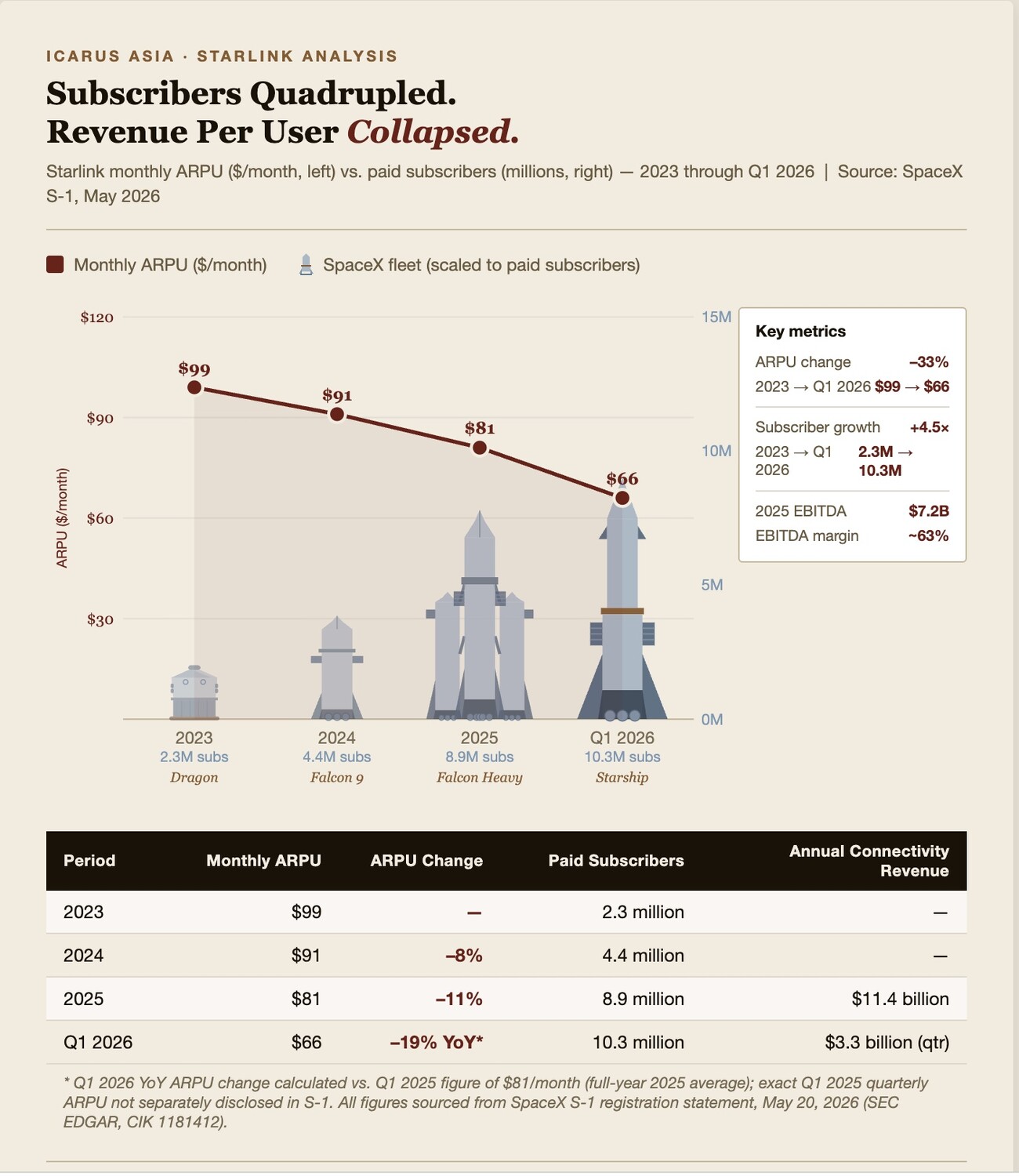
That's a 33-percent decline in ARPU over three years, and the S-1 does not present it as a temporary dip. The direction of travel is consistent, quarter after quarter, year after year.
The explanation is straightforward.
Starlink's subscriber growth has been concentrated in lower-income geographies and in wholesale and bundle arrangements that carry lower per-user economics than the original U.S. residential service. To serve those markets, SpaceX has had to offer lower prices. As those subscribers become a larger share of the mix, the blended average falls.
The revenue line has held up because the subscriber count grew fast enough to more than offset the price compression. Four-point-five times more subscribers at a 33-percent lower price still produces more revenue. But the math only works for so long. If ARPU continues falling while subscriber acquisition slows — as it will eventually, because every market saturates — the revenue growth that has been masking the unit economics problem stops masking it.
We operate under a set of core execution principles that we refer to as “The Algorithm,” a five-step iterative process that we use as our guiding principles day-to-day. We make the requirements less dumb, delete unnecessary processes or parts (embracing the principle that the best part is no part), only then optimize the necessary processes or parts, and then accelerate cycle time (many entities have launched once; no one other than us has ever launched over 100 times per year), and automate only proven processes after the first four steps are completed. We apply the Algorithm across every aspect of our organization, creating a cultural and operational standard of excellence that has defined SpaceX since inception - SpaceX
Analysts who project Starlink revenue of $30 billion or $50 billion at maturity typically assume one of two things: either subscriber counts reach 50 million or more, or ARPU reverses. Neither assumption is obviously wrong, but both require specific conditions that aren't currently prevailing.
At 20 million subscribers — roughly double today's count — at $65 per user per month (approximately where ARPU sits today), Starlink generates about $15.6 billion in annual revenue. That's meaningful growth from $11.4 billion in 2025, but it's not a $50 billion business. Getting to $50 billion requires subscriber counts approaching 60-70 million at current ARPU, or a reversal of the ARPU trend that runs against everything the market has demonstrated so far.
Starlink, at $7.2 billion in adjusted EBITDA on $11.4 billion in revenue, is a genuinely good business. The harder question is whether it's worth $700-900 billion — the rough implied value if you allocate roughly half of SpaceX's market cap to Connectivity. A satellite broadband company trading at over 100 times its adjusted EBITDA.
The Man Behind the Curtain
Every SpaceX conversation eventually arrives at the same place: Elon Musk.
The S-1 contains 147 references to Musk by name. He is described as "essential" to the company's operations, strategy, vision, and culture. The risk factors note that SpaceX's success is "substantially dependent on the continued services and performance of Mr. Musk." They acknowledge that he "devotes significant time" to Tesla, X, xAI, Neuralink, and The Boring Company, and that these competing obligations "may have adverse effects on his availability and time devoted to SpaceX."
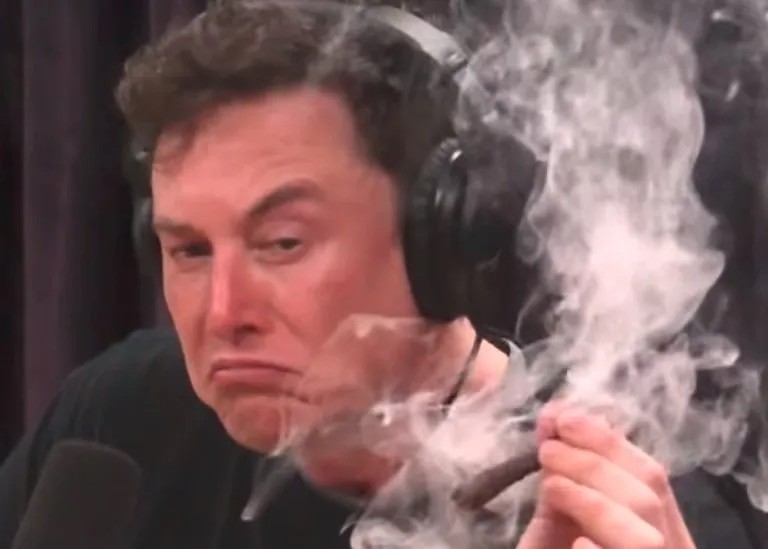
This is standard S-1 risk language, but the specifics here are genuinely unusual.
Musk is not a founder who stepped back from operations while retaining a board seat. He is operationally central to all three SpaceX segments simultaneously. He directs the Starship program. He sets Starlink's pricing and market strategy. He runs xAI, the AI segment, as its chief executive. He controls the company's voting power — more than 80 percent via Class B high-vote shares — meaning that no matter how the public float performs, Musk decides everything that matters until he decides otherwise.
Certain of our AI products, including Grok, offer features or modes designed to generate more candid, direct, or less reserved or irreverent outputs, such as “Spicy” Imagine Mode and “Unhinged” Voice Mode - SpaceX
The controlled-company structure is legal, disclosed, and not unusual in tech. What's unusual is the concentration of exposure. At every other technology company that has gone public with dual-class shares — Google, Meta, Snap — the founders were running one major enterprise. Musk is running six. His attention is a constraint that doesn't appear on any balance sheet.
The related-party risks that flow from this are real and underdisclosed.
SpaceX and Tesla are negotiating Terafab together. SpaceX's bridge loan was used to retire xAI debt. X provides distribution for Grok. SpaceX launch services could potentially be priced to favor xAI over external customers, or vice versa. The S-1 discloses these relationships in general terms and states they are reviewed by SpaceX's board. The board's independence — in a controlled company where the controller also sets its operational strategy — is a question worth asking.
The Orbital Ambition
Of everything in SpaceX's S-1, the orbital AI compute proposal is the most ambitious and the least substantiated.
The idea is this: SpaceX will deploy satellites designed not to relay internet signals but to run AI computations. The satellites would draw power from continuous sunlight, leverage the vacuum of space for cooling, and process data closer to the edge of the network than any Earth-based data center can. As early as 2028, the filing says, SpaceX plans to begin deploying these orbital compute nodes. The company has filed regulatory applications seeking authorization for up to one million satellites for this purpose.
We intend to establish lunar‑based manufacturing capabilities, including factories to produce large‑scale AI compute satellites - SpaceX
One million satellites. For comparison, there are currently estimated to be roughly 8,000 active satellites of all types in orbit around Earth.
The S-1 provides no capital expenditure estimate for orbital AI compute. It provides no regulatory timeline — satellite operations in international airspace require coordinated authorization from multiple national regulators and international bodies. It provides no technical specification for how the thermal management problems of running high-performance computing in a vacuum would be addressed at scale. It acknowledges orbital debris risks briefly in the risk factors.
Our organizational philosophy fosters an engineering- and data-led culture that embraces failure as an essential learning opportunity and is maniacally focused on efficiency and speed - SpaceX
What the filing does provide is the vision: that SpaceX, by virtue of its launch cost structure and constellation expertise, could build a computing layer in orbit that no earth-bound competitor could match. If that vision is realized, the strategic implications are enormous. If it isn't — if the regulatory, technical, or capital obstacles prove more substantial than the filing suggests — the orbital compute thesis simply doesn't exist.
It should be modeled as a call option, not a base case.
The Satellite You'll Never See
There's a detail in Starlink's operational disclosures that doesn't make the headlines but matters more than most things that do.
SpaceX's Redmond, Washington facility produces approximately 70 Starlink satellites per week. That's about 3,600 per year, a manufacturing scale that would have seemed implausible a decade ago. The S-1 treats this as evidence of SpaceX's industrial execution capability, which it is.
Here's what the S-1 doesn't say: how long each satellite lasts.
Low Earth Orbit (LEO) satellites in Starlink's orbital band typically operate for five to seven years before atmospheric drag or deliberate deorbit ends their service lives — an industry-standard estimate based on orbital mechanics and observed Starlink deorbit patterns. The filing does not provide satellite operational life targets, replacement cadence assumptions, or per-unit manufacturing costs. At seven years, a 60,000-satellite constellation — SpaceX's apparent long-term target for broadband service alone — requires replacing roughly 8,600 satellites per year just to maintain its size. At five years, the replacement requirement jumps to 12,000 per year, more than three times current production capacity.
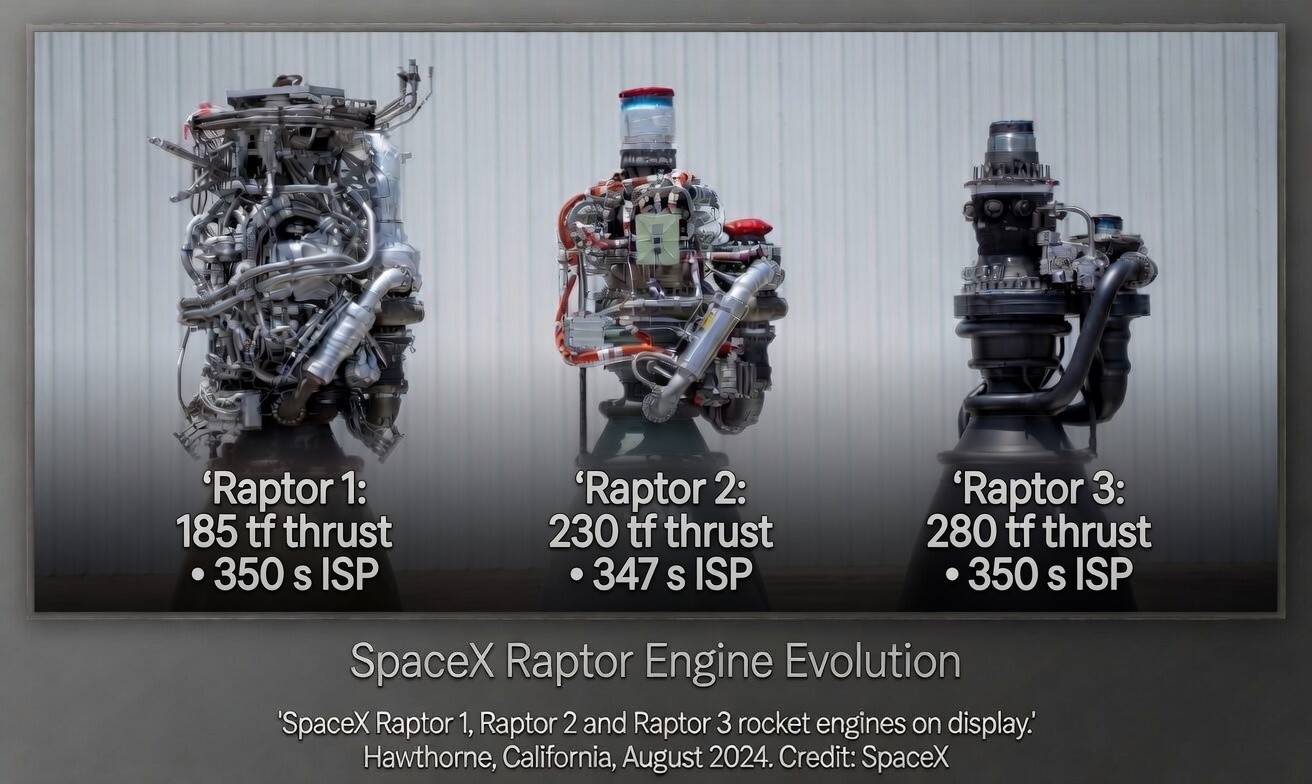
Every one of those replacement satellites requires a launch. Every launch costs money. Starship is intended to dramatically reduce the per-kilogram cost of reaching orbit, and if it works as SpaceX projects, the unit economics of constellation maintenance should improve significantly. Lower per-kilogram launch costs make that burden affordable; they don't eliminate it.
Financial models that project Starlink EBITDA growing 10 or 16-fold from today's level need to account for the sustaining capital expenditure that keeps the constellation alive. SpaceX's filing doesn't give you the numbers to do that calculation. It gives you the satellite production rate, the constellation ambition, and the Starship promise. The math connecting them is left to the investor.
What Bulls Get Right
The case against SpaceX at $2 trillion is not the same as the case that SpaceX is overvalued at any price. The distinction matters.
Starlink's technical moat is real. No competitor has its orbital infrastructure, its launch costs, its spectrum licenses, or its manufacturing scale. Competitors trying to replicate what SpaceX has built in Starlink would need decades and tens of billions of dollars to get close. In the interim, SpaceX can serve geographies and use cases that no other provider can serve. That's a durable advantage.
The Colossus upside — the AI dual-monetisation flywheel — is also a legitimate idea. If Grok achieves meaningful enterprise adoption, if internal xAI research workloads scale alongside model capability improvements, and if external compute demand grows in parallel, Colossus becomes something genuinely valuable: a self-reinforcing compute infrastructure where internal usage justifies the capex, merchant revenue funds it, and proprietary model output monetises it. No AI compute operator has demonstrated this model at scale. That's the risk. It's also, if it works, the prize.
And Musk's execution record across long time horizons is not something to wave away. The people who shorted Tesla at $100 billion lost money. The people who wrote off Starlink as uneconomical when it launched its first satellites in 2019 are eating those words now. There's a legitimate argument that dismissing SpaceX's orbital ambitions today is the same category of error.
We plan to further broaden the value proposition of X through offerings like Money, a product we launched in beta in November 2025, which aims to expand platform utility by enabling payments and other financial services - SpaceX
It's also worth acknowledging what a successful Starship program would mean for the financial model in ways the S-1 underplays.
If Starship delivers on its cost-per-kilogram target — and the company has already demonstrated orbital flights with a vehicle that dwarfs anything its competitors operate — the sustaining capex burden of a large Starlink constellation gets materially cheaper over time. Launch costs are the single largest hidden liability in the Starlink model. A functional Starship doesn't eliminate that liability; it transforms it from an existential constraint into a manageable line item. That's a consequential shift in the economics of the whole business, and it's one that no competitor can replicate without building their own heavy-lift rocket from scratch.
All of that is true, and none of it changes the fundamental problem: you're being asked to price the dream at IPO, in full, before the most important questions have been answered.
The Trust Premium
The SpaceX IPO is asking investors to do something specific.
Analyzing the business in the conventional sense — projecting earnings, assessing competitive dynamics, stress-testing assumptions — is harder than it should be at this price. The S-1's numbers are too early-stage in the AI segment, too opaque in the Space segment, and too trend-dependent in Connectivity.
What the offering asks is something older and simpler. It asks investors to trust Elon Musk.
Trust that the $45 billion Anthropic contract doesn't get cancelled. Trust that Starship achieves the cost curve it needs to make the orbital compute math work. Trust that the ARPU decline reverses. Trust that the $20 billion bridge loan gets retired on favorable terms. Trust that Cursor is worth $60 billion and that the $10 billion break fee is never triggered. Trust that a man running six companies makes the right calls at SpaceX specifically, consistently, for the decade it would take to grow the consolidated EBITDA from $6.6 billion to somewhere north of $100 billion.
Rather than a three-day lunar trip, astronauts bound for Mars would be leaving our planet for roughly three years - NASA
The S-1's disclosure of Musk's voting control isn't incidental. It's the product. Minority shareholders in SpaceX, once the company is public, have no meaningful governance rights. They can't vote out the board. They can't call a special meeting. They can't block related-party transactions with Tesla or X or xAI. What they can do is sell.
This is a known structure.
Investors in Google and Meta accepted similar terms and did fine. The question for SpaceX is whether the premium embedded in the $2 trillion price already reflects all the upside that Musk's control enables — or whether it also requires a separate act of faith that the downside risks that control creates never materialise.
History suggests that concentrated control in the hands of a visionary founder can generate extraordinary returns. History also suggests that concentrated control in the hands of a distracted or overextended founder can end very badly. The S-1 is not shy about which category it believes applies. That's what S-1s are for.
The document that landed at the SEC on the morning of May 20 will be studied in business schools for a generation, either as the moment a visionary company finally invited the public to share in its success, or as a document that taught investors — again — the difference between a dream and a prospectus.
The filing says it's the former. The math suggests it's more complicated than that.
Kenan Machado is the Head of Research and Analysis at Icarus Asia, a Hong Kong-based risk and advisory business. He covered capital markets for CNBC and The Wall Street Journal.
Note for readers:
This article is based on the author's analysis of SpaceX's S-1 registration statement filed May 20, 2026, and publicly available reporting from Reuters, TechCrunch, The Information, Morningstar, Forbes, PC Magazine, and other named sources. All derived financial figures -- including implied multiples, has-to-be-true EBITDA projections, and segment allocations -- are the author's own analytical estimates and have not been confirmed by SpaceX or its advisers. They should be verified against the full S-1 text available on SEC EDGAR (CIK 1181412) before being relied upon.
This is strictly not investment advice.
Sources and Methodology
The following is a summary of primary sources and analytical methods used in this article, provided for editorial and reader verification.
Primary source — SpaceX S-1 Registration Statement Filed May 20, 2026. Available on the SEC's EDGAR database: https://www.sec.gov/cgi-bin/browse-edgar?action=getcompany&CIK=1181412. Readers seeking to verify specific figures should search the full filing text for the following disclosures:
Anthropic 90-day termination clause: Disclosed in the "Material Contracts" section and related exhibits of the S-1. The $1.25 billion per month figure and termination provisions are described in the contracts section; the termination right has been separately confirmed by TechCrunch and The Information based on the filing.
$28.5 trillion TAM: Stated explicitly in the "Business" section of the S-1 under the market opportunity discussion. The $22.7 trillion "enterprise AI applications" sub-component is identified within that section.
Bridge loan terms: The $20 billion bridge facility, 4.58 percent effective rate, September 2027 maturity, and post-IPO repayment provisions are disclosed in the debt footnotes of the S-1 and were first reported by Reuters on April 23, 2026.
Cursor option terms: The $60 billion acquisition right and the $1.5 billion termination fee plus $8.5 billion deferred services fee structure are disclosed in the S-1's risk factors and Material Contracts exhibit. Reported independently by Bloomberg, The Verge, and TechBuzz.ai.
Starlink subscriber and ARPU data: All four data points ($99/$91/$81/$66 monthly ARPU; 2.3M/4.4M/8.9M/10.3M subscribers) are sourced directly from SpaceX's S-1 segment disclosures and confirmed by multiple outlets including PC Magazine, The Information, and Investors.com.
Terafab "general framework" language: Quoted directly from the S-1's description of the Tesla collaboration. Independently reported by Electrek and Investors.com.
AI segment capital expenditure: $12.7 billion (2025) and $7.7 billion (Q1 2026) figures sourced from S-1 segment capex disclosures, confirmed by TechCrunch and Morningstar.
Analytical methodology — "has-to-be-true" EBITDA framework The implied steady-state EBITDA requirements calculated in "The Math That Has to Work" section are this author's own derived estimates, not SpaceX projections. Assumptions used: (1) long-run free cash flow yield of 7%, derived from a 10% weighted average cost of capital and 3% terminal growth rate; (2) 60% EBITDA-to-free-cash-flow conversion at maturity, reflecting estimated taxes, maintenance capital, and working capital requirements for a business of this type; (3) enterprise value approximates equity value given modest net debt relative to target valuation levels. Different assumptions produce materially different results.
Analytical methodology — implied trading multiples EV/Revenue and EV/EBITDA multiples are calculated using the midpoint of the indicated valuation range ($1.875 trillion) against SpaceX's 2025 S-1 reported figures ($18.7 billion revenue; approximately $6.6 billion consolidated adjusted EBITDA). These are trailing multiples on a recast financial history that includes xAI and X retroactively. They are the author's calculations, not figures provided by SpaceX.
Satellite lifetime estimate The five-to-seven year operational life estimate for LEO satellites is an industry-standard figure based on orbital mechanics research and observed Starlink deorbit patterns. It is not a figure SpaceX discloses in its S-1. The filing does not provide satellite operational life targets or replacement cadence assumptions.
A note of caution:
This article does not constitute investment advice or a solicitation to buy or sell any security.
Investors should treat the article as an argumentative critique rather than a neutral summary, though the critique itself is grounded in verifiable financial disclosures.
Readers should conduct their own independent due diligence and consult qualified financial and legal advisers before making any investment decision relating to the SpaceX IPO or any related instrument.