
News · Rates & FX · Japan
Japan Is Spending Billions to Prop Up the Yen. It Isn't Enough.
The dollar bought 162.5 yen in early July, within a fraction of a four-decade high hit on July 1. That the yen is this weak is not, by itself, surprising after three years of a strong dollar. What is surprising is that…
Record currency intervention and the highest interest rates since 1995 have failed to stop a slide that has left the yen at its weakest since the mid-1980s, exposing the limits of what Tokyo can do alone.
The dollar bought 162.5 yen in early July, within a fraction of a four-decade high hit on July 1. That the yen is this weak is not, by itself, surprising after three years of a strong dollar. What is surprising is that it is this weak despite everything Japan's government has thrown at it.
The Bank of Japan has raised interest rates three times since ending eight years of near-zero rates, taking its policy rate to 1 percent in June, the highest since 1995. The Ministry of Finance has intervened in currency markets again and again, most recently spending an unprecedented 11.73 trillion yen, or about $73.6 billion, in a single month this spring, a record that broke the record set less than two years earlier.
And still the yen has recovered only a small piece of what it lost since 2016, when a dollar bought around 101 yen.
The gap between what Japan is doing and what the yen is doing reflects the limits of what any one country can control, more than any failure of nerve in Tokyo. Economics calls this the trilemma: a country cannot simultaneously run its own monetary policy, keep its capital markets open to the world, and hold its currency steady. Japan has chosen the first two. The yen is the price.
The gap between what Japan is doing and what the yen is doing reflects the limits of what any one country can control, more than any failure of nerve in Tokyo.
That price is now touching nearly every corner of the Japanese economy, and it is starting to reorder the politics around it. Automakers have quietly welcomed the weak yen even as they lobby in public for the opposite. Insurance companies that hold trillions of dollars in foreign bonds are sitting on hedging decisions that could either cushion a reversal or violently accelerate one. And Japan's benchmark for how much further it can defend the currency, its $1.31 trillion in foreign reserves, is not as large as the headline number suggests once you look at what is actually sitting in cash versus what is tied up in U.S. Treasury bonds.
Each intervention buys time rather than a solution.
The yen's weakness is rooted in the gap between Japanese and American interest rates, which stood at 3.5 to 3.75 percent in the United States in the middle of this year, more than double Japan's rate even after three hikes. That gap has fueled years of carry trades, in which investors borrow cheap yen to buy higher-yielding dollar assets, a trade that only unwinds when the rate gap narrows or a shock forces investors to cut it short. The most violent recent example came in August 2024, when the yen strengthened from 161 to about 141.7 against the dollar in about three weeks after a surprise rate move, then drifted back toward 160 within months.
And Japan's benchmark for how much further it can defend the currency, its $1.31 trillion in foreign reserves, is not as large as the headline number suggests once you look at what is actually sitting in cash versus what is tied up in U.S. Treasury bonds.
Finance Minister Satsuki Katayama has tried to keep markets guessing rather than naming a line in the sand, telling reporters that Japan "stands ready to act at any time" without specifying a level. Atsushi Mimura, the ministry's top currency official, delivered a blunter message to speculators days before an intervention this spring: "This is my final advisory if you want to escape." The message was aimed less at ordinary households than at the hedge funds and momentum traders whose bets against the yen have made Japan's task harder.

Behind the scenes, Japan's export lobby is not as unified behind a weak yen as it might appear.
Yoshinobu Tsutsui, the chairman of Keidanren, the country's most influential business federation, told reporters in January that "it would be better in the long run to adjust towards a stronger yen," a striking statement from the head of an organization whose members include automakers who profit handsomely from the current exchange rate.
Toyota alone gains an estimated 50 billion yen in operating profit for roughly every one-yen move against the dollar, and the five largest listed automakers stood to gain a combined $5.8 billion if the yen holds near current levels, according to Yahoo Finance. Those gains have not shown up as broad profit strength. The same companies reported combined net profit down more than a third in the last fiscal year, as American tariffs and Chinese competition ate into the currency windfall.
For ordinary households, the calculus is simpler and worse.
Japan imports nearly all its oil and most of its natural gas, and a weaker yen makes both more expensive at a moment when a war between Israel, the United States and Iran has already pushed oil prices sharply higher. The government has rolled out around 17.7 trillion yen in subsidies and wage support to cushion the blow, a fiscal patch for a currency problem, not a fix for it.
Washington's help is not guaranteed.
Coordinated intervention, in which the Federal Reserve buys yen alongside the Bank of Japan, has historically been the single most effective tool available, roughly doubling the odds that an intervention succeeds, according to research the report cites from the economists Rasmus Fatum and Michael Hutchison.
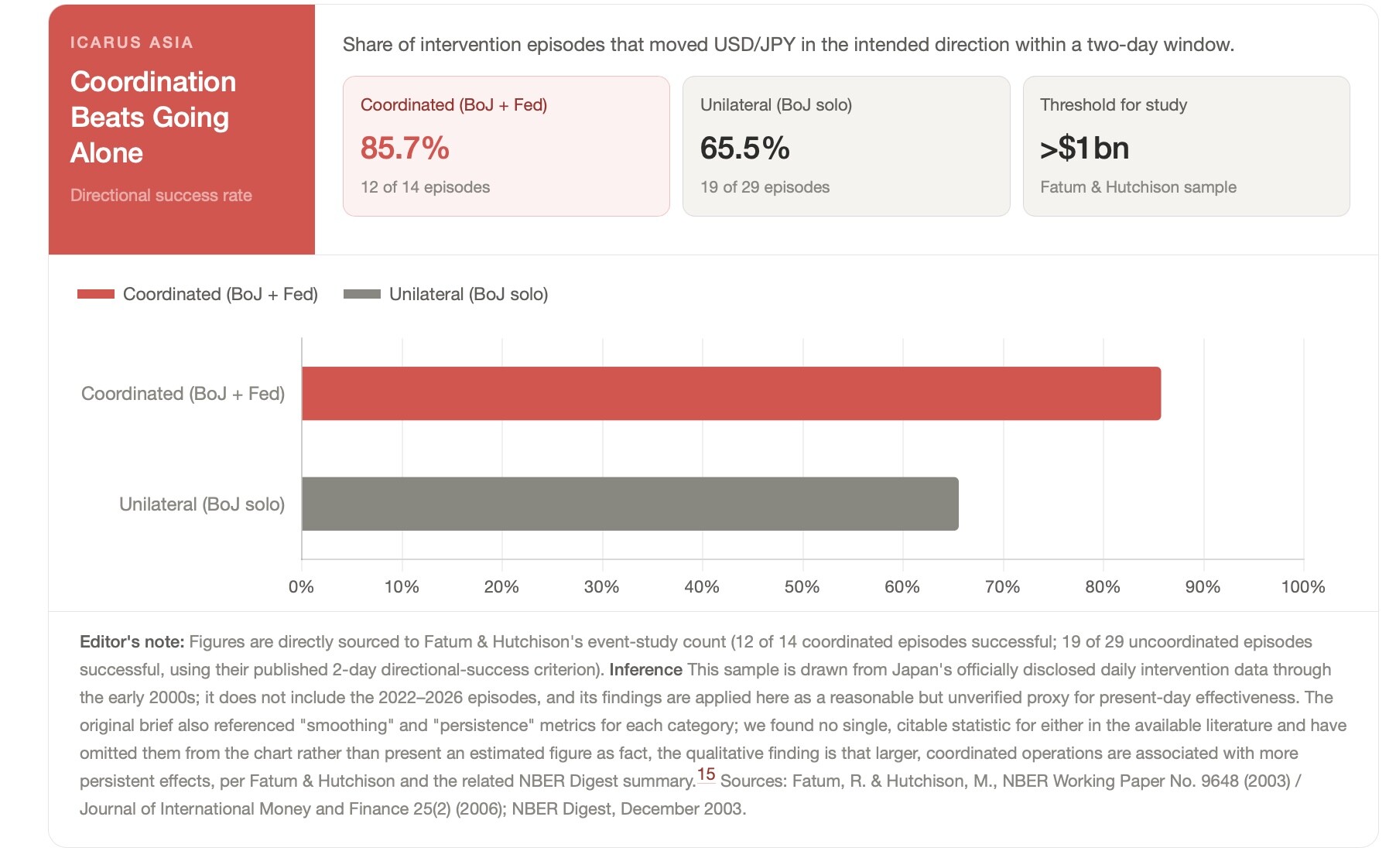
But the Fed is fighting its own inflation fight, driven in part by tariffs and the energy shock, and a weaker dollar would work against that goal. The dollar had already fallen about 10 percent against major currencies in the year to January, even as American officials kept insisting they favor a strong one.
That leaves Japan largely on its own, with a reserve stack that is not as deep as it looks. A large share of the $1.31 trillion sits in U.S. Treasury bonds rather than cash, and selling those bonds at scale to raise dollars would add to the supply hitting an already rate-sensitive Treasury market, a move that risks pushing American yields higher and widening the very gap that is weakening the yen in the first place.
None of this means Japan is out of options, only that none of them work in isolation. A credible path toward a 2 percent policy rate, continued intervention timed for maximum surprise, opportunistic coordination with Washington when the moment allows it, and structural changes to reduce Japan's dependence on imported energy would each chip away at the problem. Together, they might eventually close the gap.
Alone, none of them has, and the yen's next move may depend as much on decisions made in Washington and Tehran as on anything Tokyo does next.
The author is the Head of Research and Analysis for Icarus Asia. He previously reported on foreign-exchange markets for CNBC, Dow Jones and The Wall Street Journal.
Based on "Resolving Japan's Impossible Trinity," a policy brief by Icarus Asia Research, July 2026. Figures and quotations are drawn from that report's sourced material, including Bank of Japan and Ministry of Finance disclosures, the U.S. Treasury's semiannual currency report, and named news organizations cited therein.
DISCLAIMER
Not investment advice. Please consult a registered financial advisor and do your own research.