
News · Markets · US
SEC, CFTC Declare Most Crypto Assets Are Not Securities
A joint interpretation ends a decade of regulatory limbo, establishes a five-part token taxonomy, and for the first time puts the concept of investment contract termination on firm legal footing.
The Securities and Exchange Commission and the Commodity Futures Trading Commission jointly declared Wednesday that most digital tokens are not securities. The two agencies issued a shared interpretation that for the first time draws explicit legal lines around how different types of crypto assets are treated under federal law, spelling out when a token becomes subject to securities regulation and when it stops being so.
The action marks the sharpest break yet with a decade of regulatory practice under which the SEC pursued enforcement cases. Builders and issuers who operated without regulatory guidance found themselves on the wrong end of lawsuits rather than receiving compliance roadmaps. Wednesday's interpretation won't undo those cases, but it establishes a framework that both agencies say they'll apply going forward.
After more than a decade of uncertainty, this interpretation will provide market participants with a clear understanding of how the Commission treats crypto assets under federal securities laws. This is what regulatory agencies are supposed to do: draw clear lines in clear terms."
— SEC Chairman Paul S. Atkins
The SEC's interpretation provides a five-category token taxonomy, addresses the lifecycle of investment contracts as applied to digital assets, and clarifies the legal status of four common blockchain activities: protocol mining, protocol staking, wrapping, and airdrops. The CFTC joined the document to confirm it will administer the Commodity Exchange Act consistently with the SEC's framework and to note that certain non-security crypto assets can qualify as "commodities" under that statute.
The End of Regulation by Enforcement
For the better part of a decade, the SEC's primary tool for crypto oversight was the lawsuit.
Under former Chairman Gary Gensler, who led the agency from April 2021 through the end of 2024, the commission initiated 125 cryptocurrency-related enforcement actions, collecting more than US$6 billion in monetary penalties--nearly four times the amount imposed by the prior administration. The SEC's working theory was that most crypto tokens qualified as securities under the framework established by the U.S. Supreme Court in SEC v. W.J. Howey Co. (1946), a case about Florida orange groves that became the unlikely cornerstone of U.S. crypto regulation.
Under the Howey test, a transaction is an investment contract--and therefore a security --when a person invests money in a common enterprise with the expectation of profits from the efforts of others. The SEC spent years arguing that most token sales met that standard. Critics called the approach "regulation by enforcement," a phrase the agency's own fact sheet used Wednesday when describing the posture it was walking away from.
The problem was circularity: projects were sued for violating rules the SEC had never fully articulated. Courts delivered inconsistent rulings. Builders moved offshore rather than risk prosecution at home.
"For far too long, American builders, innovators, and entrepreneurs have awaited clear guidance on the status of crypto assets under the federal securities and commodity laws. With today's interpretation, the wait is over."
— CFTC Chairman Michael S. Selig
A Map With Five Zones
The centerpiece of Wednesday's action is a taxonomy that classifies crypto assets into five distinct categories, each with a clear verdict on whether it constitutes a security.Release Number 9198-26
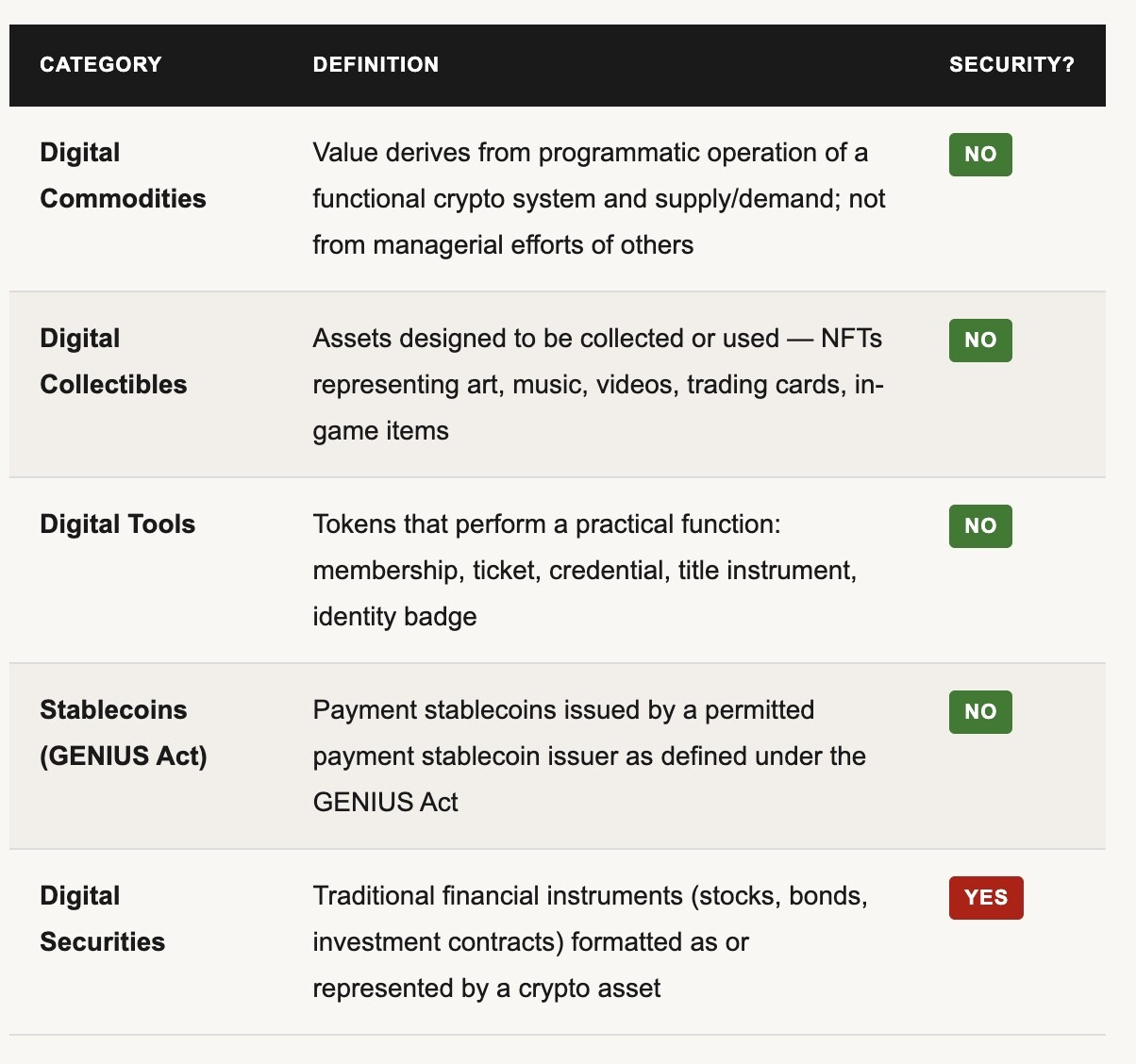
Digital commodities are not securities, according to the SEC. The American securities regulator defines them as crypto assets whose value derives from the programmatic operation of a functional crypto system and supply-and-demand dynamics, not from promises of profits generated by a development team's ongoing work. Bitcoin is the clearest example. The CFTC's participation in Wednesday's interpretation reinforces that position, noting that non-security crypto assets of this type can qualify as "commodities" under the Commodity Exchange Act.
Digital securities, meanwhile, also called tokenized securities, are securities. This category covers traditional financial instruments--stocks, bonds, investment contracts--formatted as or represented by a crypto asset, where ownership records are maintained on a blockchain. Tokenization doesn't change what an instrument is. If it was a security before it was put on a chain, it's still a security.
Investment Contracts: How They Start, How They End
Beyond the taxonomy, Wednesday's guidance tackles one of the thorniest questions in crypto law: what happens to a token that was offered as part of an investment contract but has since matured into something else?
Under the prior regime, the answer was effectively nothing. Once a token was sold under circumstances that created an investment contract, the SEC treated it as permanently tethered to securities law, even after the issuing team had delivered on its promises, decentralized the network, and stepped back from operations. Wednesday's interpretation rejects that permanence.
The SEC now explains that a non-security crypto asset becomes subject to an investment contract when an issuer offers it alongside representations or promises of essential managerial efforts from which a purchaser would reasonably expect profits. More consequentially, the agency explains when that investment contract ends: when the issuer has either fulfilled or failed to fulfill its representations. The token may then shed its investment-contract status and, if its characteristics match, move into one of the non-security categories.
The Legal Architecture Behind the Lines
Wednesday's interpretation didn't arrive in a vacuum.
It builds on a decade of litigation, judicial rulings, and legal scholarship that progressively exposed the limits of applying a 1946 agricultural case to decentralized blockchain networks. To understand how durable the new framework is--and where it remains contested--requires tracing that legal history.
The Howey test has four elements: an investment of money, in a common enterprise, with an expectation of profits, derived from the efforts of others. Courts apply all four conjunctively. The SEC, under Gensler, argued most token sales satisfied every prong. The problem was that courts didn't always agree, and the agency's position shifted case by case, producing contradictory outcomes that applied the same test to functionally similar assets with opposite results.
Legal Background: The Howey Test
SEC v. W.J. Howey Co., 328 U.S. 293 (1946), involved a Florida citrus grove operator that sold land parcels with service contracts to tend the trees and share profits. The Supreme Court held this arrangement was an "investment contract" and therefore a security subject to federal registration requirements.
The four-part test derived from Howey--investment of money, common enterprise, expectation of profits, from the efforts of others--has governed securities analysis for 80 years. Its application to digital assets, which frequently lack a central enterprise or a single "other" whose efforts drive value, has been contested in every major crypto enforcement case brought since 2017.
The most consequential judicial intervention before Wednesday came in July 2023, when Judge Analisa Torres of the Southern District of New York issued a split ruling in SEC v. Ripple Labs. Torres held that XRP sold directly to institutional buyers under written contracts constituted investment contracts and therefore securities. But XRP sold programmatically on open exchanges--to buyers who had no knowledge of Ripple's promises or managerial efforts--did not. The "efforts of others" prong, Torres reasoned, couldn't be satisfied when a buyer had no idea who was on the other side of the trade or what that counterparty had promised to do.
Torres held that XRP sold directly to institutional buyers under written contracts constituted investment contracts and therefore securities. But XRP sold programmatically on open exchanges--to buyers who had no knowledge of Ripple's promises or managerial efforts--did not. The "efforts of others" prong, Torres reasoned, couldn't be satisfied when a buyer had no idea who was on the other side of the trade or what that counterparty had promised to do.
Read further into the ruling: SEC v. Ripple: When a Security Is Not a Security and A Ripple-Turned-Tidal Wave: SEC v. Ripple Labs as an Inflection Point in the Regulatory Approach to Innovation in Complex Systems
The Ripple ruling's secondary-market logic directly informs what Wednesday's interpretation codifies.
When a token circulates freely on open exchanges and its value is driven by network utility and market forces rather than a central team's efforts, the Howey test's fourth element becomes difficult to satisfy. Wednesday's guidance formalizes that analysis into a regulatory framework rather than leaving it to case-by-case litigation.
The other foundational legal moment was a 2018 speech by then-SEC Division Director William Hinman, who suggested that ether was not a security because the Ethereum network had become "sufficiently decentralized." The concept was immediately seized on by the industry as a roadmap for escaping securities classification. The problem, as legal scholars noted at the time, was that "sufficient decentralization" appears nowhere in the Howey test, the Securities Act of 1933, or the Exchange Act of 1934. Hinman's speech was a personal view, not agency policy. The SEC later formally disavowed it.
Wednesday's interpretation is the most direct legal successor to Hinman's thinking--but it grounds the concept in existing law rather than leaving it free-floating. Rather than asking whether a network is "decentralized," the SEC now asks whether the issuer's representations or promises have been fulfilled. That's a question Howey can actually answer: if there are no remaining promises about managerial efforts driving expected profits, the investment contract has ended. The result is similar to what Hinman described, but the reasoning is anchored in the statutory text.
Barely Legal? Investment Contract Termination
The doctrine that an investment contract can terminate--and that the underlying asset can shed its securities status--has limited prior judicial support. Howey itself addressed formation, not dissolution. Wednesday's interpretation advances a theory of contractual fulfillment: when the issuer completes the obligations that induced the investment, the contract ends and the token reverts to non-security status.
Whether courts will adopt this reasoning will depend on the interpretation of adjudicating officers. The American judicial gives judges a fair amount of leeway in the matter of interpretation relative to other jurisdictions, such as under the British common law system.
Critics note that the Securities Act's registration requirements attach at the time of the original offering, not the current status of the asset. Pending enforcement cases, where registration violations allegedly occurred years ago, may not be resolved by the new framework. The SEC's interpretation does not address retroactivity explicitly.
A Framework Built on Shifting Legal Ground
Wednesday's action is an interpretive guidance document, not a formal rule. That distinction carries significant legal weight.
A formal rule making under the Administrative Procedure Act requires notice-and-comment: the agency proposes a rule, the public responds, and the agency considers those responses before finalizing. Interpretive guidance, by contrast, can be issued immediately. It clarifies existing law rather than creating new law. It doesn't require the same procedural safeguards, and courts give it less deference than formally promulgated rules.
The practical consequence is durability risk.
An interpretation can be revised, withdrawn, or superseded by a future SEC chair without going through the full rulemaking process. A future administration that views Wednesday's framework as insufficiently protective of investors could replace it with guidance that reads most crypto assets as securities--and could do so as quickly as Wednesday's guidance was issued. That's precisely why both chairmen framed the interpretation as a bridge to Congressional legislation rather than a permanent solution.
Investor advocates have raised a separate concern.
The prior regime's aggressive enforcement, whatever its procedural flaws, forced issuers to disclose information to investors that they now may not be required to provide. Under securities law, registered offerings require detailed prospectuses, audited financials, and ongoing reporting. Non-security tokens carry none of those obligations. Moving most crypto out of the securities framework reduces the information available to retail buyers making investment decisions in a notoriously volatile market.
The SEC's response, implicit in Wednesday's document, is that the taxonomy is not designed to protect investors less--it's designed to protect them accurately. The agency's view is that applying securities law to assets that don't function as investment contracts was never actually protective. It created compliance burdens for projects that weren't raising investor capital in the traditional sense, while doing nothing for investors trading on secondary markets where registration requirements don't apply anyway.
A further legal question concerns the CFTC's jurisdictional expansion. By confirming that non-security crypto assets can qualify as commodities under the Commodity Exchange Act, the CFTC gains a substantial foothold in spot crypto markets--an area where its statutory authority has historically been limited. The CEA gives the CFTC clear authority over commodity futures and derivatives but not over spot market transactions, except to police fraud and manipulation. Wednesday's interpretation doesn't expand the CFTC's statutory authority; it confirms which assets fall within the authority it already has. But as Congress works to formalize the jurisdictional split, the CFTC's role in Wednesday's guidance positions it as the dominant regulator for the largest segment of the crypto market.
Mining, Staking, Wrapping, Airdrops
The interpretation also resolves several enforcement theories that had left corners of the crypto ecosystem in sustained legal limbo. Protocol mining--the process by which participants validate transactions and earn newly issued tokens--does not involve the offer and sale of a security. Protocol staking, the analogous validation process used in proof-of-stake networks, gets the same treatment. So does wrapping, the practice of locking one token to create a synthetic version that functions on a different blockchain.
Airdrops, or free distributions of tokens to wallet holders, don't involve an "investment of money" under the Howey test. That finding removes a specific pressure point that had made issuers nervous about using airdrops as a distribution mechanism, even when nothing was being sold. The legal reasoning is straightforward: if no money changes hands, the first element of Howey cannot be satisfied, and the transaction cannot be an investment contract.
The Legislative Bridge
Both chairmen framed Wednesday's action as a complement to, not a replacement for, the bipartisan Digital Asset Market CLARITY Act, which passed the House in July 2025 and would codify the jurisdictional split between the two agencies into statute. The GENIUS Act, already signed into law, handles stablecoins. The CLARITY Act's path through the Senate remains contested — the Senate Banking Committee's competing draft, the Responsible Financial Innovation Act, takes a narrower approach and gives the SEC broader authority — but both chambers agree that regulatory clarity for digital assets is overdue.
"This effort serves as an important bridge for entrepreneurs and investors as Congress works to advance bipartisan market structure legislation, which I look forward to implementing with Chairman Selig in the near future."
- Atkins
Legislation would close the durability gap that interpretive guidance leaves open. It would also resolve the jurisdictional ambiguities that Wednesday's interpretation addresses in administrative terms but cannot settle in statutory ones. Until Congress acts, the framework published Wednesday is the operative map for how both agencies will treat crypto assets and for the industry, after a decade of operating without any map at all, that is not nothing.
What Happens Next?
The interpretation will be published in the Federal Register, giving it official standing.
Market participants--issuers, exchanges, custodians, and investors--are advised to review it against their specific activities and token structures to understand how the new framework applies to them. The document covers a wide range of common activities, but edge cases will inevitably arise, and how the agencies' staff apply the guidance in no-action letters and informal guidance requests will define the framework's practical contours over time.
Pending enforcement cases present the most immediate legal question. The SEC has dozens of open matters involving token issuers charged with conducting unregistered securities offerings. Some of those issuers will argue that Wednesday's interpretation confirms their tokens were never securities. The SEC is unlikely to drop cases wholesale, but the interpretation provides a new legal argument for defendants that wasn't available before Wednesday--and for some, it may be compelling enough to change settlement dynamics.
For the crypto industry, Wednesday's guidance does something more fundamental than shift legal posture. It restores a basic expectation: that American regulators will tell you what the rules are before they sue you for breaking them. That expectation sounds modest. For the past decade in crypto, it wasn't something anyone could take for granted.
The author is the Head of Research and Analysis at Icarus Asia, a Hong Kong-based premier risk and advisory firm. He was formerly the global Managing Editor of Forkast News, then Asia’s leading news publication covering the cryptocurrency industry.
Sources