
News · Credit · US
The Private Credit Party Just Hit The Skids
Ordinary investors were told they could access Wall Street's most exclusive loans, with a quarterly exit if they needed out. Now, as federal prosecutors circle and redemption gates snap shut, that promise is unraveling.
Ordinary investors were told they could access Wall Street's most exclusive loans, with a quarterly exit if they needed out. Now, as federal prosecutors circle and redemption gates snap shut, that promise is unraveling.
For years, the pitch was irresistible.
Private credit — the kind of direct lending that big Wall Street firms once reserved for pension funds, endowments, and sovereign wealth funds — was now available to wealthy individuals, retirees, and high-net-worth families through a new class of investment vehicles called perpetual business development companies. These funds promised the returns of the private markets with something institutional investors had never been offered: the ability to get out every quarter if you wanted to.
The fine print was always there, buried in the offering documents. Redemptions could be capped at 5 percent of the fund's assets per quarter. Managers could reduce that threshold. In extreme circumstances, they could decline redemptions entirely.
Most investors and their financial advisors appear not to have dwelled on those clauses. Quarterly liquidity windows, in practice, had always worked smoothly. Why would they not continue to?
In the first quarter of 2026, they found out.
Pulling up the drawbridge
Across the private credit industry, investors who asked for their money back were told, essentially, to wait. BlackRock — the world's largest asset manager, with more than $11 trillion under management — activated gates for the first time in the history of its flagship non-traded credit fund, the $26 billion HPS Corporate Lending Fund, after investors submitted $1.2 billion in withdrawal requests in a single quarter, an amount equal to roughly 9.3 percent of the fund's net asset value. BlackRock paid out $620 million and held the rest.
Blackstone, which runs the largest such fund in the industry at $82 billion, faced redemption requests representing nearly 8 percent of its assets in the same quarter — also a record. To meet the demand, Blackstone raised its withdrawal cap to 7 percent and injected $400 million of its own corporate and employee money to fill the gap. Blue Owl Capital, a third major manager, halted redemptions at one of its retail vehicles outright and began selling loan assets to generate the cash its investors needed.
These were not small, obscure funds. Together they represent the flagship retail-facing products of three of the most powerful alternative asset managers in the world. The fact that all three reached for their gates in the same quarter — some for the first time ever — sent a signal through the financial industry that has been difficult to ignore.
"The semi-liquid promise was always theoretical," said a private banker who manages client allocations in private credit funds for family offices in Hong Kong and who asked not to be identified discussing client matters. "What we found out in Q1 is that it works until the moment it needs to."
Practically unsinkable?
To understand how this happened, it helps to understand what private credit is and why individual investors were invited into it.
Private credit refers to loans that are negotiated directly between a lender — typically a large asset management firm — and a borrower, usually a midsize company that cannot access the public bond market or prefers not to. Because these loans are not publicly traded, they have no daily market price. Their value is determined quarterly by the manager and independent valuation agents using financial models. Investors do not see continuous price discovery the way they would with a stock or a public bond.
Private credit refers to loans that are negotiated directly between a lender — typically a large asset management firm — and a borrower, usually a midsize company that cannot access the public bond market or prefers not to
For most of private credit's history, this opacity was considered a feature, not a bug.
Institutional investors — pension funds, endowments — accepted the illiquidity because they had long time horizons and received a premium yield for their patience. They did not need to exit on short notice. They understood what they owned.
What changed, beginning roughly in the early 2020s, was the push to bring those yields to a broader audience. Asset managers, seeking new sources of capital after institutional markets became crowded, began packaging private credit loans into vehicles registered under the Investment Company Act — a regulatory framework designed for retail investors. These "perpetual BDCs" raised capital continuously from individual investors and offered periodic redemption windows, creating the impression of liquidity in a market that, at its core, does not have any.
The model attracted enormous capital.
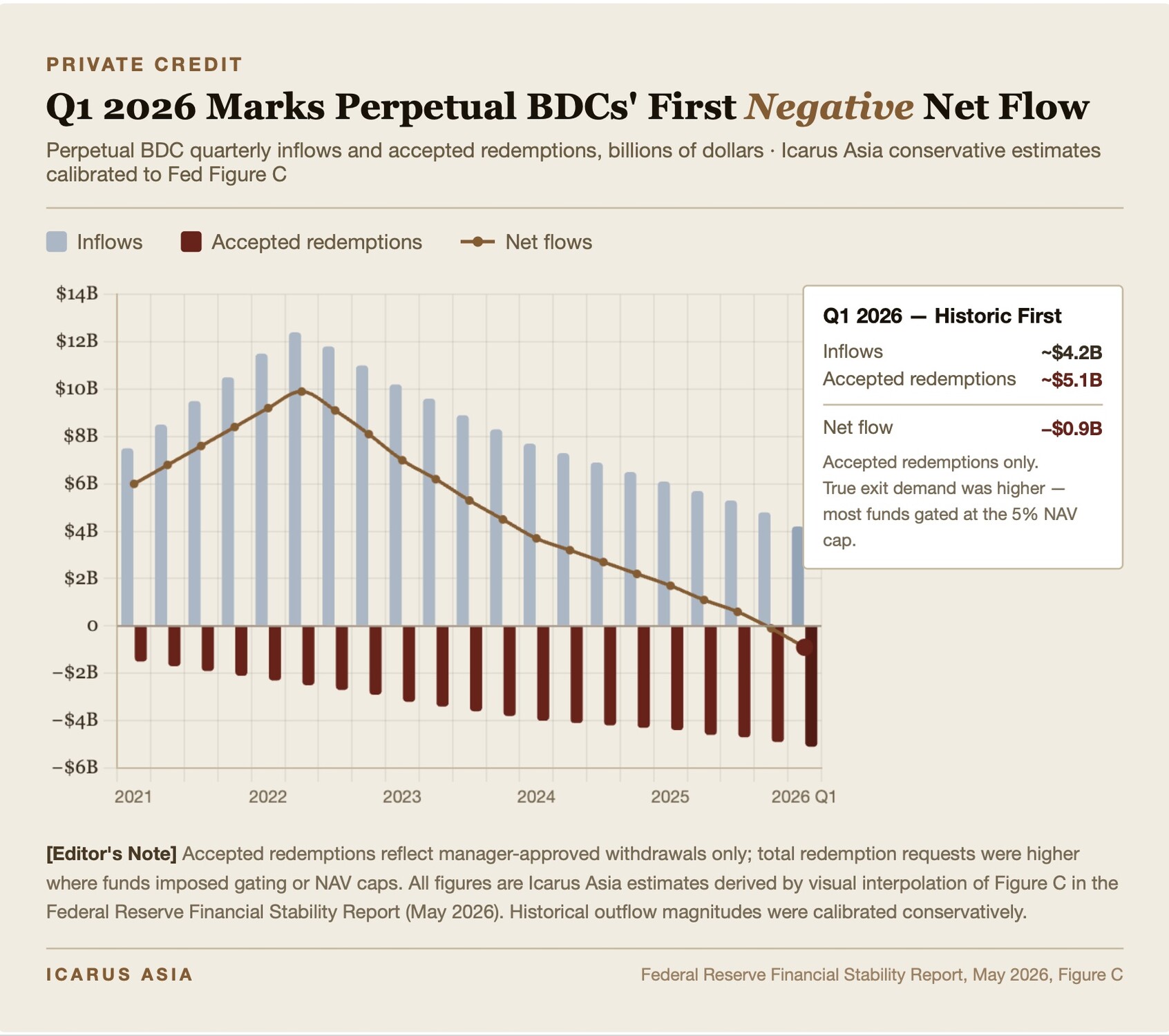
By early 2026, perpetual BDCs held $306 billion in gross assets and $161 billion in net assets. A related structure, called interval funds, added another $119 billion in gross assets. Together, these semi-liquid vehicles represented roughly 20 percent of all private credit assets under management in the United States, according to the Federal Reserve's May 2026 Financial Stability Report.
Now, that report noted in language that was measured but unmistakable, redemptions at perpetual BDCs had exceeded new inflows in the first quarter of 2026 — the first time that had happened in the history of these vehicles.
When the tide goes out
The loss of confidence did not arrive without warning. It had been building in the loan portfolios themselves.
In late January, BlackRock's publicly traded credit fund — a separate, exchange-listed vehicle called BlackRock TCP Capital Corp., known by its ticker TCPC — filed a disclosure that was unusual by any standard. Rather than waiting for its scheduled quarterly earnings release, the fund announced midstream that it expected to slash its net asset value — the per-share measure of what investors own — by 19 percent.
The culprit was a concentrated set of loans underwritten at the peak of the credit boom, in 2020 and 2021, when money was cheap, valuations were stretched, and covenants on loans were, in many cases, nearly nonexistent. TCPC said six portfolio companies drove about 67 percent of the Q4 2025 NAV decline, or about $1.11 per share, and that roughly 91 percent of the quarter's NAV reduction came from investments underwritten in 2021 or earlier. The six companies were Edmentum ($0.38/share), Razor ($0.24/share, fully written to zero), SellerX ($0.22/share), Renovo/HomeRenew ($0.15/share, written to zero), Hylan ($0.06/share), and InMobi ($0.06/share).
Among the most striking cases was Razor Group, an Amazon product aggregator that had merged with another BlackRock debtor, Infinite Commerce Holdings, in August 2025. By the time TCPC filed its fourth-quarter results, the combined position had been written entirely to zero — a loss that, by the company's own account, had not been visible in the prior quarter's reported figures.
The sudden disappearance of value in a single reporting cycle is what critics of the private credit model call the "cliff-edge" phenomenon. Because private loans are not priced continuously — unlike a publicly traded bond that fluctuates in value every day as market conditions change — deterioration can accumulate inside a portfolio for months or quarters without appearing in any reported figure. Then, when a company files for bankruptcy, or a restructuring collapses, or a lender simply runs out of room to extend optimistic marks, the loss surfaces all at once.
Because private loans are not priced continuously — unlike a publicly traded bond that fluctuates in value every day as market conditions change — deterioration can accumulate inside a portfolio for months or quarters without appearing in any reported figure.
"The desire to maintain attractive reported NAVs and secure performance-based incentive fees incentivizes managers to delay marking down distressed loans until bankruptcy or restructuring makes further concealment impossible," as one analyst characterized the dynamic in a widely circulated note.
PIMCO strategist Lotfi Karoui, writing earlier this year, found that marks for the same loan held across different BDC portfolios diverged, on average, by five points by year-end 2025. "These gaps," he wrote, "are difficult to reconcile with the notion of arm's-length fair value determinations for identical assets."
When they come for you
The fee angle is not lost on regulators.
In a private credit fund, management fees and performance fees are calculated on net asset value, and on the income generated by loans. If a loan is marked too high for too long, the manager collects fees based on a value that investors' money is not actually earning. When the markdown finally comes, the investors absorb the loss. The fees already paid are not refunded.
If a loan is marked too high for too long, the manager collects fees based on a value that investors' money is not actually earning. When the markdown finally comes, the investors absorb the loss.
This concern has been stated publicly and repeatedly by Jay Clayton, who served as chairman of the U.S. Securities and Exchange Commission during the first Trump administration and has since become one of the most prominent external voices on private asset valuation standards. In November 2025, Clayton told an audience that federal regulators were actively scrutinizing how private asset managers value their portfolios.
"People should know," he said at a Managed Funds Association, "that the financial regulators and the department are looking at those." This past week, speaking at the alternative assets lobby group's conference while downplaying concerns about a broader crisis in private credit, he was explicit about the specific worry: "If people are mismarking in order to generate fees, that's always been a no-no." The comments were reported by Fortune and Bloomberg News.
Bloomberg reported on May 15 that the Manhattan US Attorney's office — the Southern District of New York, led by U.S. Attorney Damian Williams — has in recent months been seeking information about TCPC, and that executives of the fund have been questioned.
BlackRock has not been accused of any wrongdoing.
A spokesperson declined to comment. A representative of the Southern District of New York did not respond to a request for comment. Investigations at this stage routinely conclude without charges.
Still, the emergence of a federal inquiry into how a private credit fund values its illiquid loans crystallized a question that had been circulating in the industry for months: Were the numbers accurate?
When AI obliterated the moat
Part of what made the loan valuations so difficult to assess — and, critics would argue, so easy to stretch — was the underlying nature of many of the assets.
Software became the dominant sector in private credit portfolios over the past decade, for reasons that seemed compelling at the time. Software businesses typically operate with high gross margins, low physical capital requirements, and subscription revenues that renew automatically. In an era of low interest rates and robust venture activity, private equity firms bought dozens of software companies and financed many of those acquisitions with private credit loans. The BDCs and direct-lending funds that underwrote those loans enjoyed high yields on assets that appeared structurally durable.
Then generative artificial intelligence arrived, and the thesis began to shake.
Software that charged premium prices because it was irreplaceable is now confronting the possibility that it can be replaced — by AI-native tools, built faster and sold cheaper, that replicate core functionality without the legacy infrastructure costs. The recurring revenue that justified the premium loan multiples depends on customer retention, and retention depends on a product's continued superiority. That superiority is no longer guaranteed.
The exposure is significant.
The HPS Corporate Lending Fund carries 19 percent of its portfolio in software loans. TCPC carries 30.5 percent. In the first quarter of 2026, TCPC recorded $11 million in software portfolio markdowns specifically attributable to AI disruption risk, slower growth expectations, and market multiple compression. Fitch Ratings, which maintains a "deteriorating" outlook for the BDC sector as a whole, does not expect AI to drive systemic defaults in the immediate term, but notes it poses an ongoing threat to recovery rates and enterprise values in future years.
The timing matters.
Many of these software loans were originated in 2021, at the peak of the private equity buying frenzy, when multiples were highest. TCPC's management acknowledged that 91 percent of its fourth-quarter NAV reduction came from deals underwritten in 2021 or earlier. Those are precisely the loans most likely to carry the largest gap between their current economic value and their still-optimistic marks.
The Toll on Earnings — and Investors
The credit stress is compounding a separate problem: a basic squeeze on fund income.
Since September 2024, the Federal Reserve has cut interest rates five consecutive times, bringing the upper bound of the federal funds rate to 3.75 percent. Private credit loans are predominantly floating-rate — their interest payments adjust up or down with benchmark rates. As rates fell, the income those loans generated fell with them.
Average investment yields for rated BDCs declined to 10.1 percent at the end of 2025, from 11.1 percent the prior year. Average net investment income fell to 5.4 percent of portfolio value, from 6.3 percent. In a business where income is the product being sold to investors, this compression matters enormously. By year-end 2025, eleven of the rated BDCs that Fitch reviewed in its April 2026 peer analysis were no longer generating enough net investment income to fully cover the dividends they were paying — meaning they were, in effect, returning investors' own capital to them and calling it yield.
By year-end 2025, eleven of the rated BDCs that Fitch reviewed in its April 2026 peer analysis were no longer generating enough net investment income to fully cover the dividends they were paying — meaning they were, in effect, returning investors' own capital to them and calling it yield.
A quieter but more troubling signal sits in the industry's rising reliance on so-called payment-in-kind, or PIK, income. Rather than paying cash interest, some borrowers are instead issuing additional debt as interest — a mechanism that records income in the fund's financials without any cash actually changing hands. Across the rated BDC universe, PIK income reached 8.1 percent of total interest and dividend income in 2025. A high PIK share indicates that a meaningful and growing portion of reported earnings is not cash that investors can spend, but a promise of future payment from borrowers who cannot afford to pay today.
The Industry Responds
The large alternative asset managers are moving to contain the damage, in ways that reflect the seriousness of the situation.
KKR announced a $300 million stabilization package for FS KKR Capital Corp., a $12.3 billion publicly traded BDC the firm manages. The package includes a $150 million preferred equity injection from KKR itself and a $150 million tender offer for common shares — measures designed to close the gap between FSK's trading price and its book value, a gap that had widened uncomfortably as credit concerns mounted. KKR also agreed to waive its own incentive fees on the fund for four consecutive quarters, a step that sacrifices the firm's own economics to signal credibility to skeptical shareholders.
Apollo Global Management has reportedly chosen a different path at MidCap Financial Investment Corp., its $3 billion publicly traded BDC. Non-accrual loans at MFIC surged to $167 million in the first quarter of 2026, up from $48.5 million a year earlier. Rather than absorb the cost of working through those credits over what could be years of restructurings, Apollo is reportedly shopping the fund's management contract to other firms — an unusual move that amounts to a strategic exit from a platform that has become difficult to defend.
BlackRock has brought HPS Investment Partners executives — acquired in a $12 billion deal that closed last July — directly into TCPC's management structure. Three of the fund's seven investment committee seats are now held by HPS professionals, including direct lending head Vikas Keswani. The intention is to give TCPC access to a larger origination platform and the expertise to navigate credit workouts. Whether that integration can counteract the legacy portfolio that caused the crisis in the first place is a question the market is still pricing.
TCPC's most recent quarterly results, reported May 7, showed a fund working to stabilize but still losing ground on NAV. The fund earned $0.21 per share in adjusted net investment income — narrowly beating analyst expectations — but its net asset value fell a further 4.9 percent, to $6.72, from $7.07 the prior quarter. A year ago, TCPC's NAV was $9.18 per share. It has now fallen 27 percent in twelve months. The fund's new loan originations in the quarter totaled $22.5 million at an average yield of 8.3 percent — replacing positions that had yielded 11.2 percent. The math of that replacement cycle will suppress income for the foreseeable future.
The Broader Count
TCPC is far from alone.
According to data compiled by SOLVE, 54 business development companies reported at least one new non-accrual loan in the first quarter — a loan on which the borrower has stopped making payments, or is at such elevated risk of default that the manager has stopped recognizing its income. Those new non-accruals totaled $1.4 billion on a cost basis, representing 27 percent of the $5.1 billion in aggregate non-accruals across the entire BDC universe. That one quarter's additions equaled more than a quarter of all existing bad loans.
54 business development companies reported at least one new non-accrual loan in the first quarter — a loan on which the borrower has stopped making payments, or is at such elevated risk of default that the manager has stopped recognizing its income.
Octus, a credit data service, identified 31 additional borrowers added to non-accrual status in early May 2026 filings, including Medallia, a software company placed on non-accrual by the Blackstone Secured Lending Fund and marked at 60.3 cents on the dollar. Jamie Dimon, the chief executive of JPMorganChase, has publicly invoked what credit professionals call the "cockroach theory" — the observation that in any distressed credit cycle, the first defaults visible above ground are rarely the last.
Combined fundraising for public and private BDCs has fallen 22.6 percent from its March 2025 peak, to $4.8 billion, according to data from Robert A. Stanger & Company, Inc., who distribute these products to clients are re-examining their allocations, asking questions about loan quality and redemption terms that many were not asking a year ago.
What Comes Next
The Federal Reserve, in its May report, concluded that the systemic risk from the redemption pressures is "limited and manageable" for now.
The ten largest perpetual BDCs, which control roughly 80 percent of the sector's assets, maintain bank credit lines and cash sufficient to cover at least three quarters of redemptions at the 5 percent cap. The central bank acknowledged, however, that continued redemptions and deteriorating sentiment "could lead to a reduction in credit availability for some borrowers, especially those with relatively higher credit risk."
That last phrase describes the midsize companies — the businesses with 200 or 500 or 2,000 employees, not large enough for the public bond market, too complex for a traditional bank — that have come to rely on private credit as their primary source of financing. If the BDCs and direct lenders that serve them begin to pull back, whether by raising standards, cutting new originations, or managing down leverage ratios, the effects could reach well beyond the investment portfolios of high-net-worth individuals.
The semi-liquid BDC was designed as a bridge between two worlds: the superior risk-adjusted returns of private credit, and the accessibility that ordinary capital markets provide. For several years, the bridge held. Now, the question is whether the structure beneath it was ever as sound as the prospectus said.
For now, the exits are still technically open. But they are narrowing. And behind them, federal prosecutors are asking a question that the industry has not had to answer before: Were the prices right?
The author is the Head of Risk and Analysis at Hong Kong-bases Icarus Asia, a risk and advisory firm.
Sources
Bloomberg: "BlackRock Private Credit Fund's Valuations Being Probed by DOJ," May 15, 2026 (paywall)
Fortune: "BlackRock Private Credit Fund's Valuations Are Probed by DOJ," May 17, 2026
Fitch Ratings: US BDCs Face Persistent Earnings Pressure and Asset Quality Risks, April 22, 2026
Fitch Ratings: Downgrades BlackRock TCP to BB, Places on Rating Watch Negative, January 30, 2026
Octus: BDC Weekly Roundup — 31 Borrowers Added to Nonaccrual, May 2026
SOLVE Fixed Income: BDC Filings Reveal New Non-Accruals in Q1 — A Key Indicator of Stress, 2026
Wealth Management: "KKR, BlackRock, Apollo Work to Fix Struggling Private Credit Funds"
Disclaimer: BlackRock has not been accused of wrongdoing. Forward-looking analysis labeled represents extrapolation from cited data, not reported fact.