
News · Rates & FX · US
Scott "I am the House Now" Bessent Tried to Duel with the Bond Market. It's Pushing Back.
A $6 billion buyback was supposed to calm the $29 trillion bond market. Instead the 10-year yield closed at its highest level since 2023, a reminder for even the exalted that math has a way of teaching hubris.
On a Tuesday evening in Washington, in front of a friendly crowd at a Breitbart News event, Treasury Secretary Scott Bessent tried to explain what his department had been doing to the bond market for the past three weeks, and why it hadn't worked the way he wanted.
"My job is to try to push things back towards equilibrium," Bessent said. "I don't believe that I can change the equilibrium price," he added. "But nothing's ever in equilibrium."
It was, in its way, an admission.
Six weeks earlier, Bessent's Treasury had moved to steady a bond market that had been selling off for months, doubling the size of its long-end buyback operations and buying older, harder-to-trade government bonds to smooth out the plumbing of the world's largest debt market.
Yields fell that day. Then they climbed right back.
By September 9, when Treasury went further and tripled the size of a single operation to $6 billion, the benchmark 10-year yield didn't fall at all. It rose to 4.8528 percent, the highest close since November 2023, a level that made the government's own borrowing more expensive on the same day it tried to prove it had the market under control.
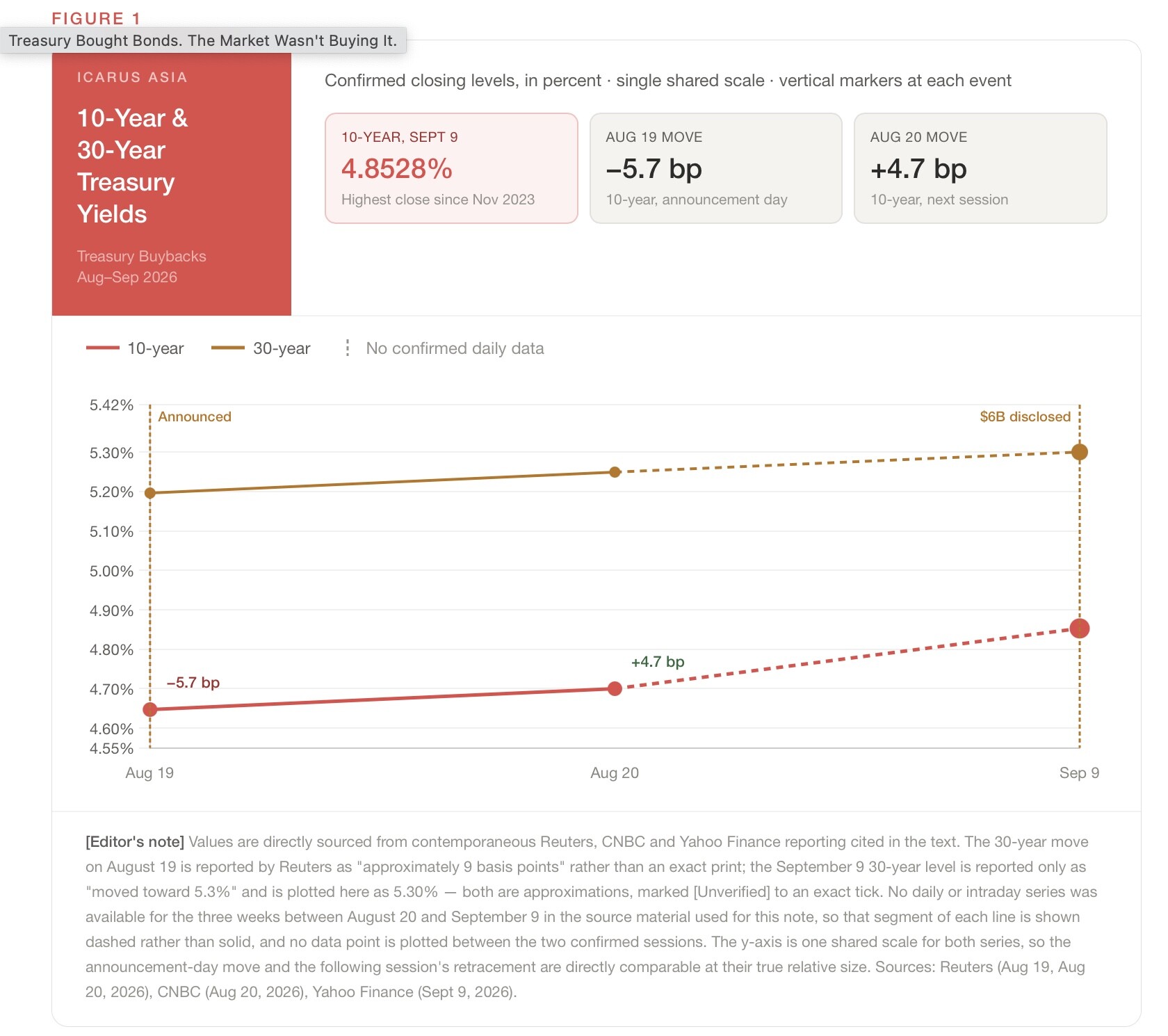
The gap between what Bessent intended and what the market did is now the subject of research notes from Hong Kong to New York, most of them converging on the same conclusion: a bond-buying program built to smooth out liquidity in a $29 trillion market was never going to be big enough to change where yields settle, and the past three weeks are the clearest evidence yet.
When you let the Genie out of the Bottle
"Treasury had created something it now had to keep feeding," Steven Zeng, CFA, a Deutsche Bank strategist, told The Wealth Advisor after the September announcement, describing a program that had escalated from $2 billion to $4 billion to $6 billion in under a month without ever catching up to what traders had started to expect.
That expectations problem is, in the retelling of several analysts, the real story. When Treasury doubled its buyback ceiling on August 19, the surprise itself did the work.
The 10-year yield fell 5.7 basis points in a single session, the sharpest move the long end had seen in weeks. But surprise is a resource that spends down fast. By the next morning, the 10-year had already given back 4.7 basis points, and Reuters described a market once again worried about inflation and the government's debt load, the same worries that had pushed 30-year yields to a 19-year high just days before the announcement. Whatever the buyback had fixed, it hadn't fixed that.
Treasury dressed up the program, from the start, as something narrower than a rate-suppression tool.
Its own release in August said the point was to add liquidity in market sectors where it was "receiving substantial volumes of high-quality offers," bureaucratic language for buying up older bonds that had become hard to trade, not propping up prices on the securities investors actually watch.
Treasury's own borrowing estimates, published August 2, put privately held net borrowing at $739 billion for the July-to-September quarter. A $6 billion purchase is a rounding error against that number, about a hundred-and-twenty-third of it. A handful of research shops, including Icarus Asia, the Hong Kong-based research house whose analysis first laid out the ratio in detail, flagged it within hours of the September disclosure.
Rebecca Patterson, a senior fellow at the Council on Foreign Relations, put the skepticism in blunter terms.
Buybacks, she argued, are "more signal than substance." Even at double the size Treasury had committed to, she wrote, the purchases "would be absorbed into broader supply and demand dynamics driving prices and yields," dynamics that, in her reading, come down to a debt-to-GDP ratio pushing past 110 percent across the advanced world and a shrinking pool of foreign buyers willing to hold it.

Foreigners still own something like 30 percent of outstanding Treasury debt, Patterson noted, which means Washington's fiscal trajectory is no longer only Washington's problem to manage. No amount of secondary-market tidying changes that math.
Not Exactly a Fool's Errand
None of this makes the buyback program pointless, exactly.
Treasury has run more than fifty of these operations since 2024 and failed to hit its maximum purchase size only twice, evidence that there is real, if narrow, demand from dealers eager to offload older, less liquid bonds.
What the past three weeks demonstrated is the size of that word "narrow."
A program that can tighten a spread in a specific 17-year-old Treasury note is not the same tool as one that can talk down the yield everyone actually prices mortgages and corporate debt against. Conflating the two, as market chatter did through most of August, was always going to end in a disappointment like September 9.
Bessent, for his part, has not backed away from the comparison to a market running a temperature.
He rejected the idea that the purchases amount to quantitative easing, telling the Breitbart audience that Treasuries were still outperforming European government debt even after the selloff, and framing the recent moves as speculative excess rather than a verdict on U.S. fiscal policy.
Whether that language passes muster at the next quarterly refunding, on November 4, is the question every Wall Street desk covering rates will be asking.
Treasury has said the larger operation sizes hold until then. What happens after is, by its own admission, still being decided in real time.
Nothing, as the secretary put it, is ever in equilibrium.
The author is an Executive Director and Head of Research and Analysis at Icarus Asia, a Hong Kong-based financial research and strategic advisory firm.
DISCLAIMER: Strictly not investment advice. Please do your own research and consult with a registered financial advisor.
Sources
Bessent, Scott. Interview by Hannah Knudsen. "Exclusive — Secretary Scott Bessent: U.S. Bond Market Under Trump 'Best Performing in the World,' 'Inflation Expectations Are Flat to Down.'" Breitbart News, Sept. 8, 2026.
Brettell, Karen. "US Treasury to buy up to $6B in Sept 10 buyback operation." Reuters, Sept. 9, 2026. (Reuters wire copy; reproduced by Virginia Business, whose page carries the reporting credit.)
Icarus Asia Research. "Treasury Bought Bonds. The Market Wasn't Buying It." Sept. 10, 2026.
Patterson, Rebecca. "What the Treasury's Buyback Surprise Says About the Bond Market." Council on Foreign Relations, Aug. 20, 2026.
Reuters. "US yields head lower after Treasury offers liquidity support." Aug. 19, 2026.
Reuters. "US Treasury buyback briefly eases bond rout as debt worries persist." Aug. 20, 2026.
U.S. Department of the Treasury. "Treasury Announces Increased Sizes of Nominal Long-End Liquidity Support Buybacks Beginning September 9." Press release, Aug. 19, 2026.
U.S. Department of the Treasury. "Treasury Announces Marketable Borrowing Estimates." Press release, Aug. 3, 2026.
The Wealth Advisor. "Bessent Tripled Treasury Buybacks. The Bond Market Still Wanted More." Sept. 9, 2026.