
News · Rates & FX · US
The Fed's New Chair is Rewriting the Rulebook on Inflation
Kevin Warsh wants to change how the Fed measures prices. Critics say he is choosing the gauge that happens to justify cutting rates.
Kevin Warsh wants to change how the Fed measures prices. Critics say he is choosing the gauge that happens to justify cutting rates.
When Kevin Warsh took the oath of office as the 17th chair of the Federal Reserve Board on May 22, 2026, he inherited a central bank at war with itself, and an inflation problem that stubbornly refused to behave.
Headline consumer prices were running above 3 percent. The Fed's own preferred core measure was stuck there too. But a different gauge, one Warsh had publicly championed weeks before his confirmation, told a far sunnier story. Inflation, by this reading, was essentially under control at 2.3 percent. The gauge is called the trimmed mean.
In Washington, where numbers are never just numbers, the one Warsh chose to elevate has become a flashpoint. Whether he is pursuing monetary precision or clearing a path for politically convenient rate cuts ahead of the November 2026 midterm elections is now the central question about his tenure.
President Donald Trump installed Warsh, 46, at the Fed after the most divisive confirmation vote in the central bank's history, a 54-45 party-line split. Trump has made no secret of wanting lower interest rates, a stimulus that could lift his party's prospects at the polls. And Warsh, who served as a Fed governor during the 2008 financial crisis, has signaled he intends a sweeping overhaul of how the institution operates, what he calls a "regime change." Inflation measurement is where that transformation begins.
The trimmed mean has legitimate academic roots.
Developed by economists at the Federal Reserve Bank of Dallas and published since 2005, it works by stripping out the most extreme price moves in any given month, the categories that spiked or cratered the most, then calculating inflation from what remains. The logic is defensible. A single month's surge in airfares or a collapse in used-car prices should not distort the Fed's view of whether prices are broadly rising.
"What I'm most interested in is what's the underlying inflation rate, not what's the one-time change in prices because of a change in geopolitics or a change in beef," Warsh told senators during his April confirmation hearing. "The measures I prefer are looking at things that are called trimmed averages. We take out all of the tail-risks, all of the one-off items, and we ask ourselves whether the generalized change in prices is having second-order effects on the economy."
He called the standard core PCE measure, the one the Fed has used for decades, a "rough swag," a phrase that drew sharp rebukes from Democratic senators. Sen. Jack Reed of Rhode Island was blunt: "I must commend you on the way you can circularly go around questions and not answer them. It's a skill. Unfortunately, it's not a good skill for the chairman of the Federal Reserve Board," Reed told Warsh, according to CNBC.
I must commend you on the way you can circularly go around questions and not answer them. It's a skill. Unfortunately, it's not a good skill for the chairman of the Federal Reserve Board - Sen. Jack Reed
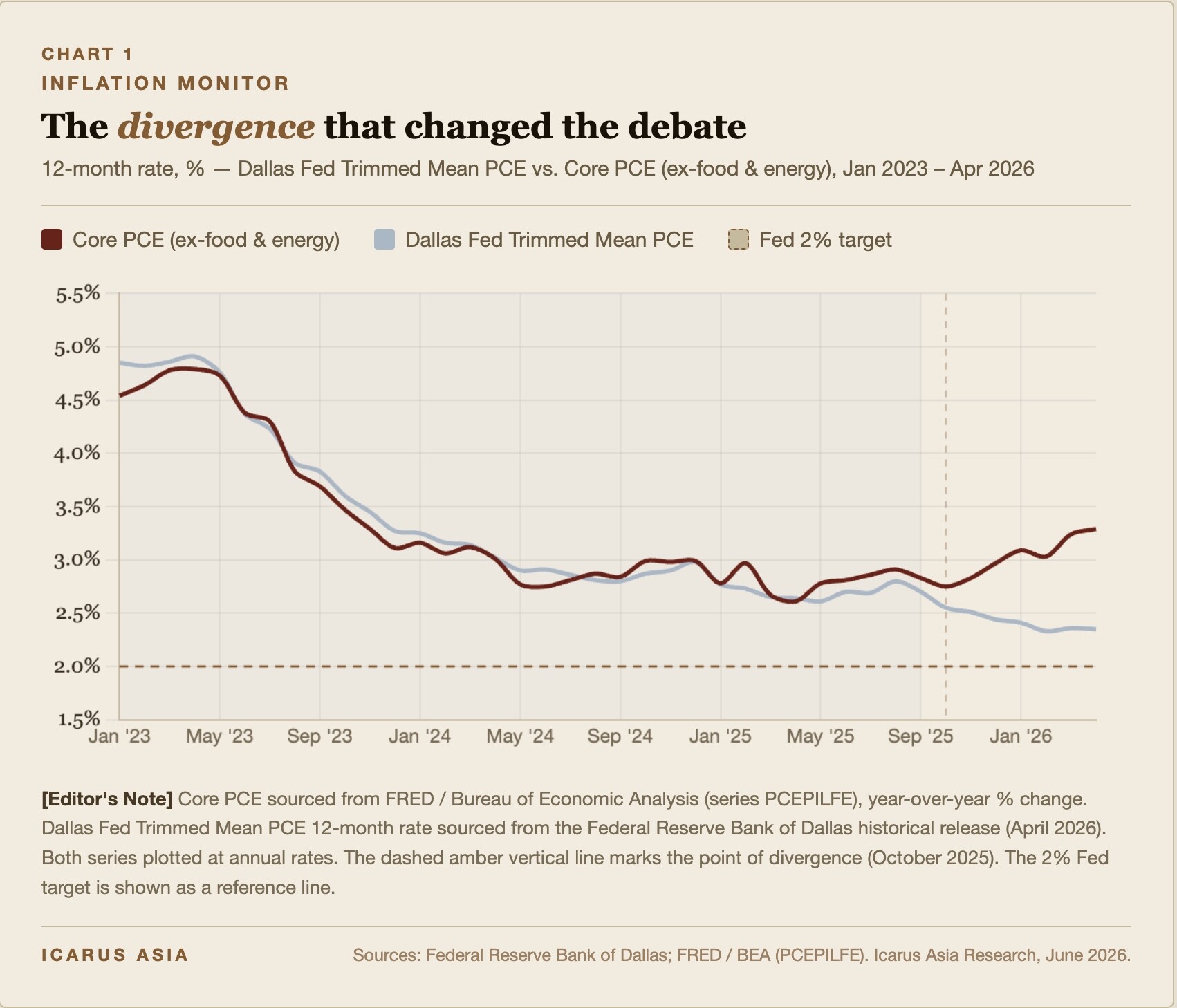
The gap between the two measures is 0.7 percentage points, meaningful at a central bank that adjusts rates in quarter-point steps. As of February 2026, the Dallas Fed's trimmed mean showed inflation at 2.3 percent on a 12-month basis. Core PCE, which excludes food and energy but otherwise tracks all prices, stood at 3 percent. A separate Commerce Department report later pegged overall PCE inflation at 3.8 percent for April. By the standard metrics, the Fed is well above its 2 percent target. By Warsh's preferred gauge, it is nearly there.
Bank of America economist Aditya Bhave noted the immediate policy implication: under a trimmed mean framework, inflation "does look softer," with the 12-month mean at 2.3 percent and median at 2.8 percent as of February. But Bhave warned the switch carries risks. Food and energy prices, currently excluded from core PCE, would matter more under the new system. A spike in oil, precisely what is now occurring due to conflict in the Middle East, could bleed into the trimmed mean in ways that would force Warsh's hand.
"To preserve Fed credibility and avoid optics of cherry picking, Warsh will need to stick with his preferred metrics even when they are outpacing the core," Bhave told CNBC. Bhave added a pointed observation: "This is ironic because Warsh also argued yesterday for looking through one-off, supply-driven price increases."
To preserve Fed credibility and avoid optics of cherry picking, Warsh will need to stick with his preferred metrics even when they are outpacing the core. - Aditya Bhave, Bank of America economist
The Dallas Fed's own researchers acknowledged the measure's limitations publicly, and they did so just as Warsh's confirmation hearings began. In an April 16 analysis titled "Skewness warrants caution as Trimmed Mean PCE inflation eases," economists Tyler Atkinson, Jim Dolmas, and Rebecca Zarutskie warned that the divergence between core and trimmed mean (which widened sharply after September 2025) may be giving a misleading signal, precisely because of tariffs.
The problem is structural.
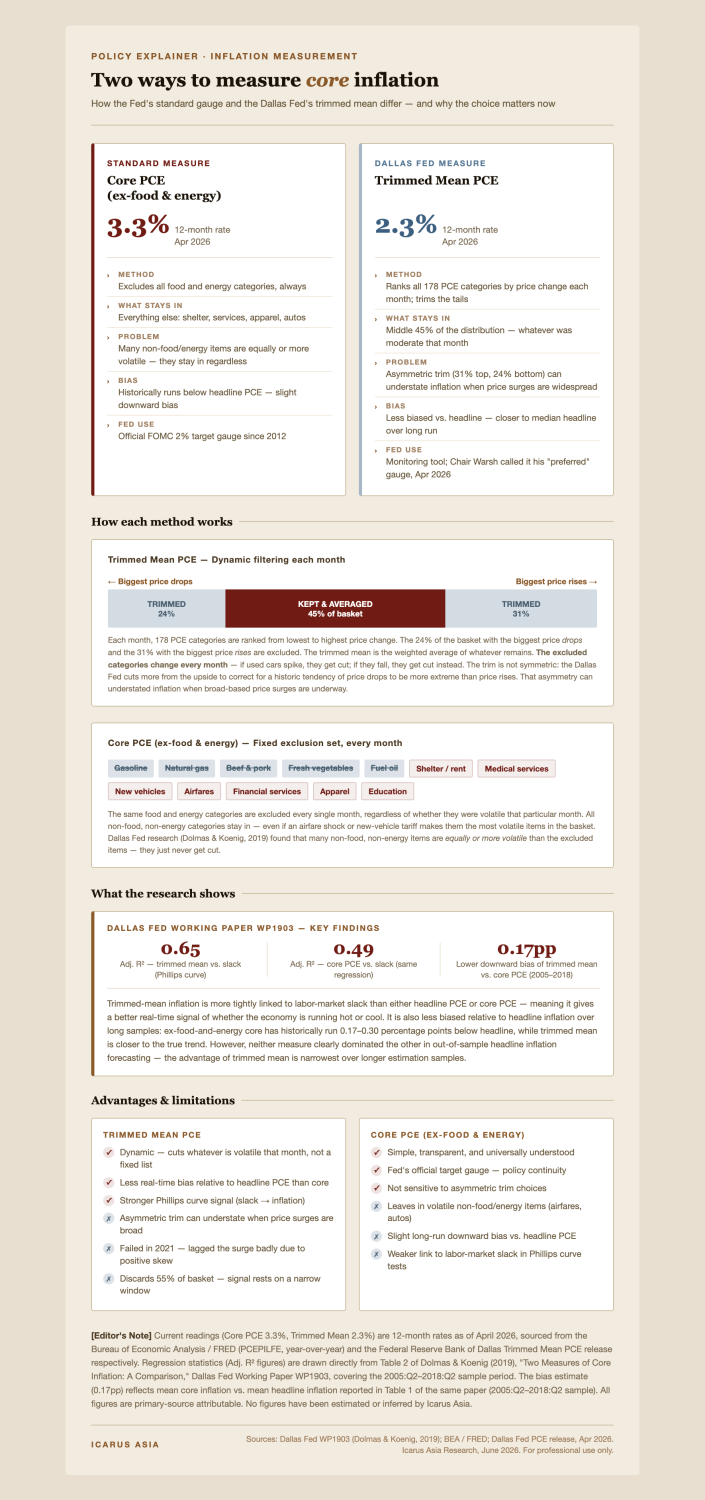
The Dallas Fed's trimmed mean was calibrated between 1977 and 2009, a period when price distributions were negatively skewed: big price drops were more extreme than big price increases. To correct for that historic bias, the index was designed to cut more from the top of the distribution (31 percent) than from the bottom (24 percent). But when tariffs cause a wave of price increases, that same asymmetric trimming cuts out disproportionately more of the upward moves, understating inflation as a result. The Dallas Fed researchers noted explicitly this happened during the 2021 inflation surge, when the trimmed mean badly lagged the actual rise in prices.
"This likely contributed to the delayed rise of the trimmed mean during the inflation spike of 2021," the Dallas Fed researchers wrote.
The critique from outside the Fed has been sharper still.
Employ America, a left-leaning economic think tank, published a detailed analysis arguing that Warsh's preferred gauge is "conveniently the most dovish signal" and that its methodology is poorly suited to the current moment. The group noted that the Dallas Fed's measure discards more than half of the consumer spending basket each month and relies heavily on lagging housing components that do not track actual market rents.
"The timing of this pivot is awfully convenient," wrote Vikas Patel and Skanda Amarnath of Employ America, citing Warsh's prior criticism of data dependence and his record during the 2008 crisis of citing upward inflation numbers even as financial markets were melting down. "We hope that the emphasis on the Dallas Fed Trimmed Mean gauge is not borne of a political convenience to cherry-pick 'the most dovish inflation summary gauge available."
We hope that the emphasis on the Dallas Fed Trimmed Mean gauge is not borne of a political convenience to cherry-pick 'the most dovish inflation summary gauge available - Employ America
Employ America's own symmetric trimmed mean measures (which trim equally from both ends and exclude lagging housing data) showed inflation running closer to 3 percent in early 2026, not the 2.3 percent Warsh cited. A market-based, ex-housing version showed "more material acceleration" in inflation through the same period.
None of this has escaped Warsh's colleagues inside the Fed, many of whom were appointed under prior administrations and have shown little inclination toward easing policy. Kansas City Fed President Jeff Schmid said that with inflation running above the 2 percent target for more than five years, "Now is not the time to let down our guard," according to published remarks. Several other officials have recently stressed the need to keep rate-hike options open.
Markets have priced in no rate cuts for the rest of 2026. Futures traders assign a 61 percent probability that the federal funds rate will be higher at year-end than it is today, according to 24/7 Wall St., a finance blog. Trump's hope that his handpicked Fed chair would deliver lower borrowing costs before the midterms is already colliding with the economic reality of sticky prices and a restive committee.
The question hanging over Warsh is whether his embrace of trimmed inflation is a principled methodological position he will defend when the numbers move against him, or a framework of convenience, adopted when it pointed where he and his patron in the White House wanted to go.
Riccardo Trezzi (PhD), a former Fed economist who runs an inflation research firm, framed it this way in The Wall Street Journal: "The question is whether 'looking through' becomes a principled framework or simply a way to down-weight inconvenient inflation prints when needed."
Warsh would not be the first central banker to find that the measuring stick he chose, once adopted, does not stay where he put it.
The author is the Head of Research and Analysis at Icarus Asia, a Hong Kong-based risk and advisory business.
DISCLAIMER: This is not investment advice. Please consult with a registered financial advisor and do your own research.
Sources
Kevin Warsh confirmation hearing — key moments · The Wall Street Journal
Warsh confirmed as Fed chair as Trump allies warn on rate cuts · The Washington Post
Kevin Warsh gave his preferred way for measuring inflation. It could come back to bite him · CNBC
Warsh pushes his plan for 'regime change' at Senate hearing · CNBC
Skewness warrants caution as Trimmed Mean PCE inflation eases · Federal Reserve Bank of Dallas (Atkinson, Dolmas, Zarutskie, April 2026)
So You Want to Talk About Trimmed Mean Inflation? · Employ America (Patel & Amarnath, April 2026)
Trump's Midterm Nightmare: Fed Chair Kevin Warsh May Soon Raise Interest Rates · 24/7 Wall St.
Trump swears Kevin Warsh in as Fed chair, seeking interest rate cuts · CNBC
Dolmas, J. & Koenig, E.F. (2019). "Two Measures of Core Inflation: A Comparison." Dallas Fed Working Paper WP1903.
Dallas Fed Trimmed Mean PCE historical data release, April 2026. · Federal Reserve Bank of Dallas
FRED series PCEPILFE (Core PCE Price Index). · Bureau of Economic Analysis via St. Louis Fed