
News · Rates & FX · US
Trump Wants Low Rates. His Own Policies Won't Let Him Have Them.
President Donald Trump wants interest rates at zero. His own foreign policy is making that impossible.
President Donald Trump wants interest rates at zero. His own foreign policy is making that impossible.
The Federal Open Market Committee voted 11-1 on March 18 to hold the federal funds rate at 3.50% to 3.75%, the second consecutive pause after three quarter-point cuts closed out 2025. The lone dissent came from Fed Governor Stephen Miran, who wanted a cut.
The committee's post-meeting statement was unusually pointed.
It cited "elevated" uncertainty about the economic outlook and said "the implications of developments in the Middle East for the U.S. economy are uncertain." It also repeated, twice, that it was "attentive to the risks to both sides of its dual mandate."
That phrasing was not accidental.
What the Dual Mandate Means, and Why the Fed Kept Saying It
Congress created the Federal Reserve in 1913 after a series of bank panics nearly collapsed the financial system. The original job was narrow: provide emergency liquidity to stop bank runs. Over the following century, Congress expanded the Fed's role considerably. Today it runs monetary policy, oversees the stability of the financial system, regulates payment systems, and enforces consumer protections.
But the Fed's most visible and politically sensitive job is monetary policy, which Congress directs it to conduct in pursuit of two goals: maximum employment and stable prices. This is the "dual mandate." In practice, it means the Fed has to keep unemployment low and inflation close to its 2% target. Those two goals often pull in opposite directions.
When the Fed cuts interest rates, borrowing gets cheaper. Businesses invest more, consumers spend more, and economic activity picks up. That's good for employment. But cheap money also pushes up prices, particularly for assets like stocks and real estate. When the Fed raises rates to cool inflation, it slows the economy and can cost jobs.
This tension is not theoretical.
Brent crude futures for delivery in May, an industry trademark, is trading significantly higher, frequently surpassing US$113 to US$116 per barrel while West Texas Intermediate (WTI) settled above US$100 for first time since 2022.
Inflation is projected to hit 4.2% this year. Cutting rates would pour fuel on a price spiral. Holding rates steady protects the inflation mandate but does nothing for an economy that lost 92,000 jobs in February and saw 2025 job gains revised down from 584,000 to just 181,000.
By emphasizing the dual mandate, the Fed was telling anyone who cared to listen: we answer to Congress, and Congress told us to keep prices stable. Not the White House. Congress.
Why the Fed Is Independent (And Why That Matters)
The Federal Reserve's independence from the executive branch was not an accident.
The legislators who wrote the Federal Reserve Act recognized that presidents would always be tempted to keep interest rates low and the economy running hot, particularly close to election years. Cheap money feels good in the short term. The inflation that follows does not.
To guard against that, Congress built structural separation into the Fed's design. The Board of Governors, based in Washington, D.C., serves staggered 14-year terms. The 12 Regional Reserve Banks operate with a degree of autonomy. And the FOMC, which sets interest rates, draws its voting members from both the board and the regional banks. No single president can reshape the institution in a single term.
The law also says the president can only remove a Fed governor "for cause." In the Fed's 112-year history, no president had ever tried--until last August.
The Campaign Against Powell
Trump's frustration with the Fed is not new.
It goes back to mid-2019, during his first term, when Chair Jerome Powell raised rates and began reducing the liquidity the Fed was injecting into the financial system. When Powell indicated the Fed had limited tools to offset the risks generated by Trump's trade agenda, Trump responded on Twitter by asking whether Powell was "a greater enemy" of the American people than China's Xi Jinping.
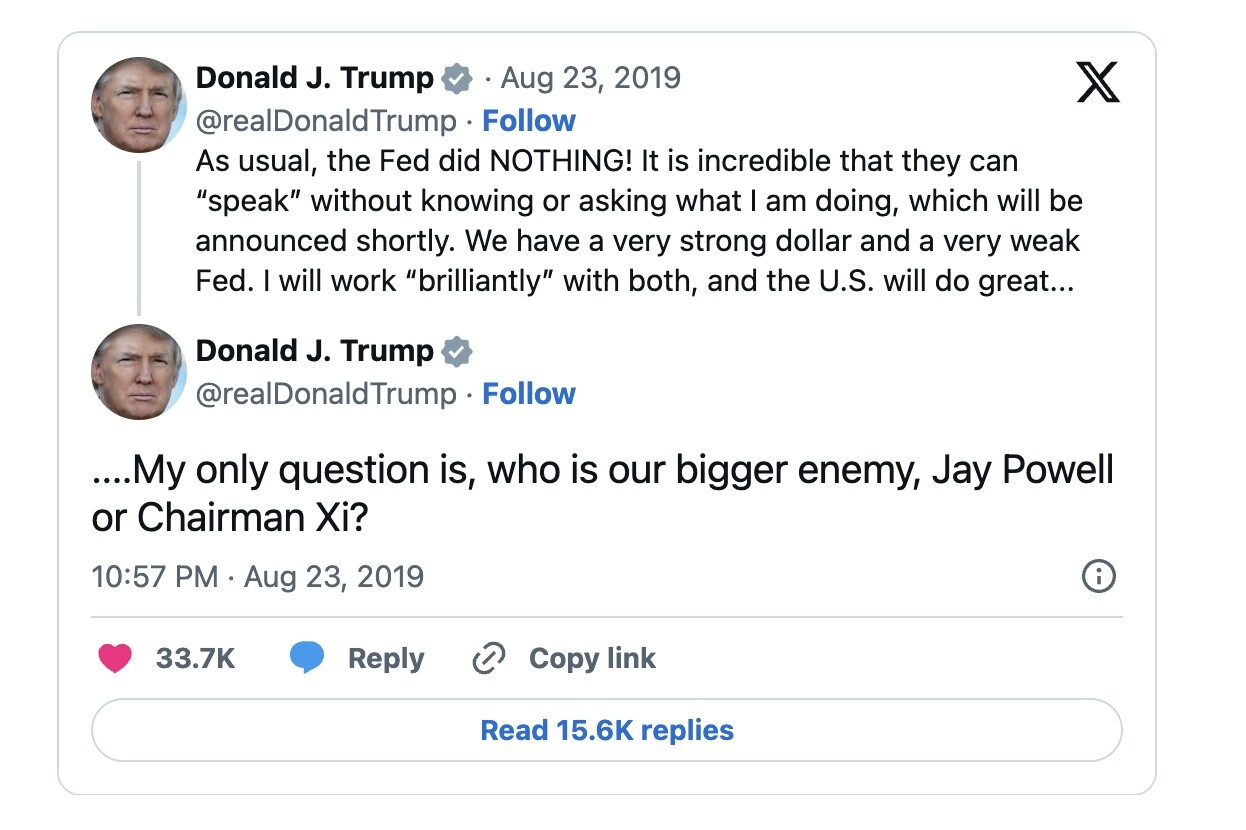
Trump later told The Wall Street Journal he "maybe" regretted appointing Powell, accusing the chair of "taking pleasure" in raising rates.
This time, he has gone considerably further.
In January 2026, a grand jury convened by DC U.S. Attorney Jeanine Pirro--a Trump appointee--issued subpoenas to the Federal Reserve Board seeking records about cost overruns on the renovation of the Fed's headquarters building in Washington. The stated justification was that Powell may have misled Congress in testimony about those renovations.
The Fed challenged the subpoenas in secret proceedings that only became public on March 13, when U.S. District Judge James Boasberg unsealed a ruling quashing them.
The ruling was blistering.
Boasberg found that the DOJ had produced "essentially zero evidence to suspect Chair Powell of a crime." He wrote that the investigation fit a "pattern" of Trump using the Justice Department against perceived adversaries. "Being perceived as the President's adversary has become risky in recent years," Boasberg observed. "In his second term, Trump has urged the Department of Justice to prosecute such people, and the Department's prosecutors have listened."
"Being perceived as the President's adversary has become risky in recent years."
The judge noted that Trump had spent years publicly attacking Powell, calling him "TOO ANGRY, TOO STUPID, & TOO POLITICAL" and saying he wanted to "fire his ass." When that pressure failed, the administration found a different lever. A political appointee suggested the Fed renovation issue could be a path toward investigation and possible removal, and prosecutors followed through.
"In sum, the President spent years essentially asking if no one will rid him of this troublesome Fed Chair," Boasberg wrote. "He then suggested a specific line of investigation into him, which had been proposed by a political appointee with no role in law enforcement, who hinted that it could be a way to remove Powell. The President's appointed prosecutor promptly complied."
When Boasberg had asked a DOJ prosecutor at a sealed hearing what evidence existed of fraud in the renovations, the prosecutor replied: "We do not know at this time. However, there are 1.2 billion reasons for us to look into it."
Boasberg was not persuaded. "But buildings often go over budget," he wrote. "That fact, standing alone, hardly suggests that a crime occurred." He noted that the Fed's own inspector general had audited the renovation and raised no concerns about fraud.
Pirro called Boasberg an "activist judge" and announced plans to appeal. The DOJ filed a motion for reconsideration. The Fed's lawyers, in a filing unsealed on March 27, urged Boasberg to reject it, arguing the U.S. Attorney's Office had failed to meet even the basic threshold for reconsideration. A decision on the motion is pending.
Meanwhile, Republican Senator Thom Tillis of North Carolina, who sits on the Banking Committee, has vowed to block Kevin Warsh's confirmation to succeed Powell until the criminal probe is dropped. "This ruling confirms just how weak and frivolous the criminal investigation of Chairman Powell is," Tillis said. "We all know how this is going to end."
The Lisa Cook Case
The subpoena fight is not the only front.
In August 2025, Trump announced on Truth Social that he was firing Lisa Cook, a member of the Federal Reserve's Board of Governors and the first Black woman to serve in the position. Biden appointed Cook in 2022; she was confirmed to a full 14-year term in 2023.
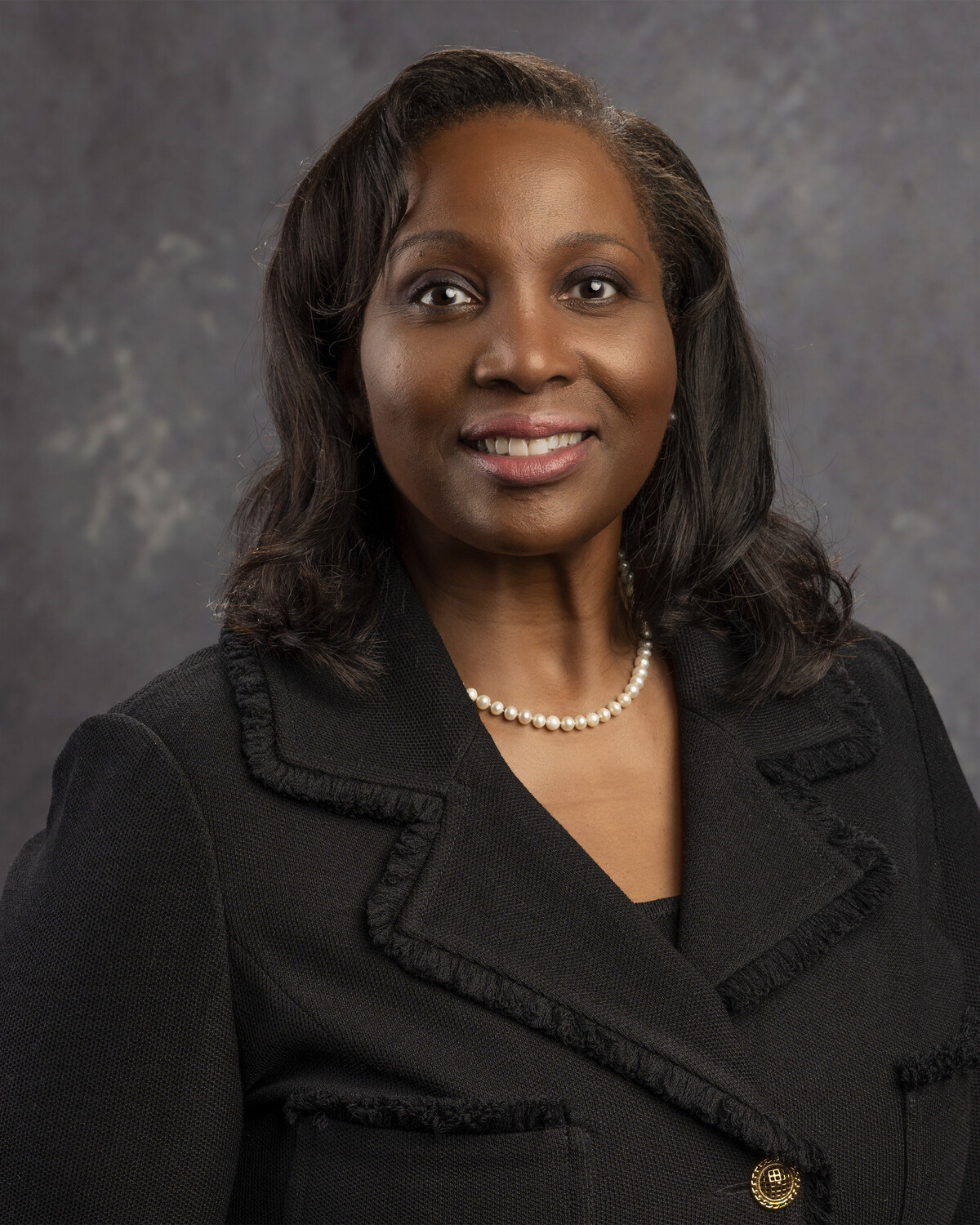
Trump did not cite her stance on interest rates. Instead, he pointed to allegations from Federal Housing Finance Director Bill Pulte that Cook had made false statements on mortgage applications before she joined the Fed. Cook denied the allegations. Her lawyers called them "manufactured charges" and a pretext for politically motivated interference with the central bank.
No president in the Fed's history had attempted to remove a governor. Cook sued.
A federal district judge in Washington, Jia Cobb, issued a preliminary injunction blocking the removal, finding that Cook had "a strong showing that her purported removal was done in violation of the Federal Reserve Act's 'for cause' provision." The D.C. Circuit upheld the injunction. In October, the Supreme Court declined to grant the Trump administration's emergency request to remove Cook immediately, scheduling oral arguments for January 2026 instead.
The two-hour argument on January 21 went badly for the administration. All nine justices-- liberal and conservative--expressed skepticism about the president's claim of unreviewable power to fire Fed governors.
Justice Brett Kavanaugh warned Solicitor General D. John Sauer that his argument "would weaken, if not shatter, the independence of the Federal Reserve." Kavanaugh added that such a precedent would "incentivize presidents to come up with trivial misdeeds or old and inconsequential allegations" to get rid of independent officials who won't do the president's bidding.
Justice Neil Gorsuch asked whether the required process for removal amounted to "just a meeting across a conference table finished with, 'You're fired'?"
Powell sat in the courtroom throughout the arguments. He later called Trump v. Cook "perhaps the most important legal case in the Fed's 113-year history."
A decision is expected by summer.
If Cook and Powell were both removed, Trump would be in a position to appoint a majority of the Fed's seven-member board and, at least in theory, exert more direct influence over interest rate decisions.
A bipartisan group of former Fed chairs and top officials understood the stakes.
Former chairs Ben Bernanke, Janet Yellen, and Alan Greenspan, along with former Treasury Secretaries Henry Paulson and Robert Rubin, signed a brief urging the Supreme Court to protect the Fed's independence. They also issued a separate statement about the DOJ's subpoena campaign: "This is how monetary policy is made in emerging markets with weak institutions, with highly negative consequences for inflation and the functioning of their economies more broadly. It has no place in the United States whose greatest strength is the rule of law."
"This is how monetary policy is made in emerging markets with weak institutions, with highly negative consequences for inflation and the functioning of their economies more broadly. It has no place in the United States whose greatest strength is the rule of law."
The FT Dispute
Add to this the Treasury Department's formal demand that the Financial Times retract a report claiming Secretary Scott Bessent discussed increasing Fed oversight using the Bank of England as a model. Acting Assistant Secretary Elliott Hulse said Bessent "never made such comments publicly or privately" and escalated the complaint to FT parent company Nikkei Inc.
Whether the FT or Treasury has the stronger claim here is not yet clear.
Governments have denied stories before, then gone quiet when events proved the reporting correct. But the complaint itself is telling: even the suggestion that a Cabinet secretary was discussing structural changes to Fed oversight was treated as a serious enough threat to warrant an aggressive public response.
The Energy Problem
Even if the political pressure campaign succeeded--if Powell resigned, if Cook were removed, if Warsh were confirmed and immediately pushed for cuts--the math would not cooperate.
Brent crude is up between 72% to 76% year-to-date as of mid-March, despite a coordinated release of 400 million barrels from emergency reserves on March 11. WTI posted its strongest monthly gain since May 2020. U.S. gasoline prices hit US$4 per gallon, their highest since 2022.
The cause is the Strait of Hormuz, which is closed for the first time in history.
About 20% of the world's oil supply normally passes through the strait, a narrow waterway between Iran and Oman connecting the Persian Gulf to the open ocean. Iran's blockade, a consequence of the broader conflict, has created an energy shock that dwarfs previous disruptions.
Analysis of data from Strait Intel, a real-time tracking dashboard built by Polish software firm Bison Infra, shows no meaningful easing of the blockade on crude shipments. Iran has selectively allowed some vessels to pass, but high maritime insurance rates make transit unviable even without a direct military threat. The exceptions are narrow: Chinese bulk carriers underwritten by state-run firms and reinsured by the Chinese government, shadow fleet operators connected to Russia, and some Greek ships. The strait is officially closed for commercial traffic.
A March 20 analysis by Lutz Kilian, Michael Plante, and Alexander Richter at the Dallas Fed modeled how long the closure might persist. Using the three-quarter duration of the 1973 oil supply disruption as a baseline, they found a 58% probability that the strait remains closed in the third quarter of 2026, declining to 35% by the fourth quarter.
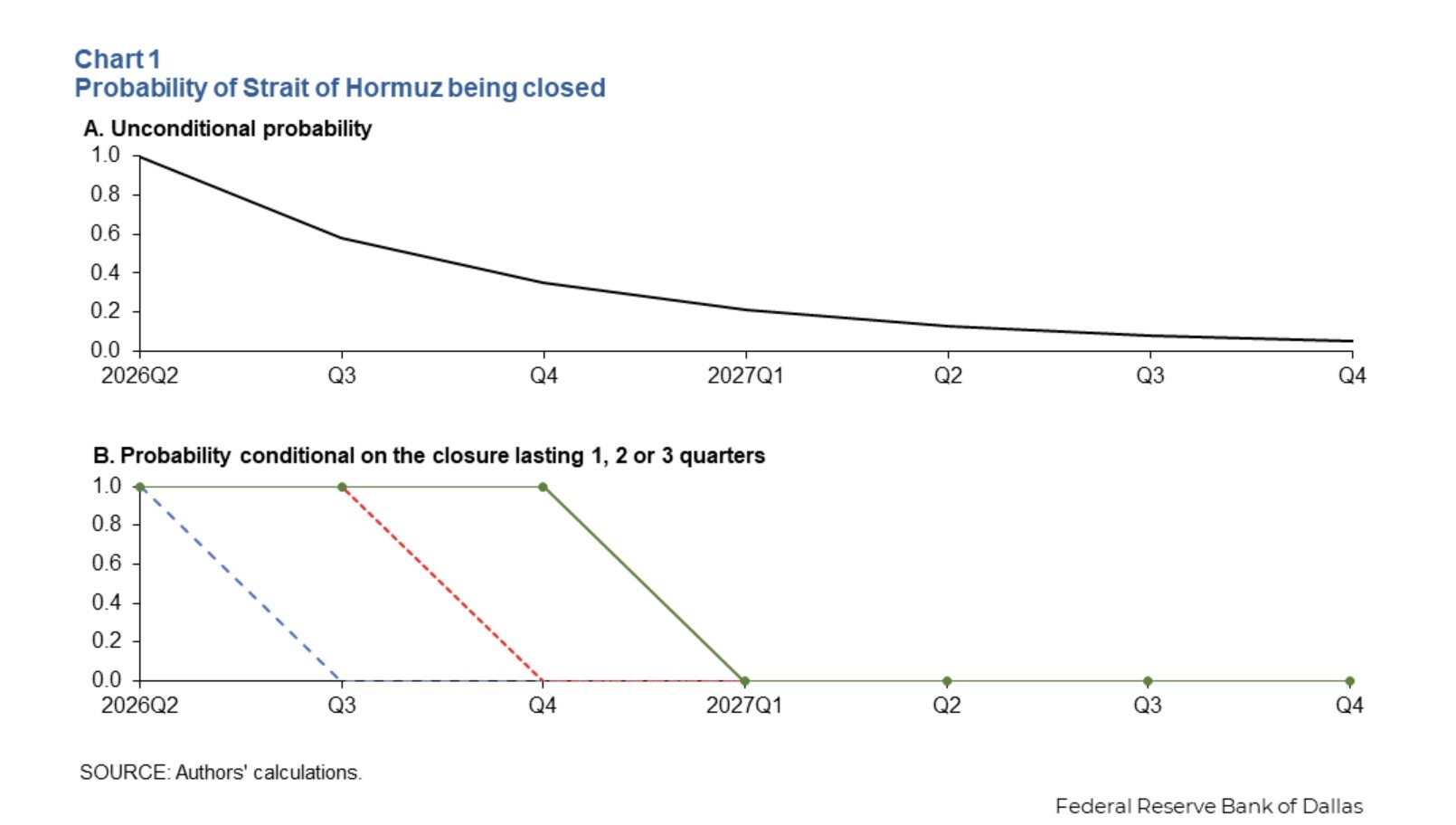
But they made a distinction that matters. Past disruptions--the 1973 Yom Kippur War, the 1979 Iranian Revolution, the 1980 Iraq-Iran War, the 1990 Persian Gulf War--each removed 4% to 6% of global oil supply. The current shortfall is nearly 20%. This crisis is three to five times more severe than any historical precedent.
The damage extends beyond crude.
Qatar's Ras Laffan LNG complex, one of the world's largest, reportedly lost about 17% of its export capacity, cutting an estimated 12.8 million tons per year and potentially reducing output for three to five years, according to Reuters. Analysts estimate as much as 35 million tons of LNG could be lost this year. QatarEnergy declared force majeure on some contracts. Reuters modeling by Kavya Balaraman and Ashitha Prasad showed oil prices staying elevated across multiple scenarios.
The Organization for Economic Cooperation and Development's (OECD) inflation projection is more than double the Fed's 2% target, taking into account the increase in energy costs as a result of the conflict. Annual economic growth is expected to slow to 2% from 2.1% in 2025. The Fed's own March 18 Summary of Economic Projections was more optimistic, estimating PCE inflation at 2.7% by year-end, though some of that optimism rests on the assumption that the Iran situation resolves quickly.
Trump has suggested the U.S. may "blow up" Iran's electric plants and oil wells if a deal is not reached and the strait is not reopened.
Whether Iran blinks is an open question.
What isn't open is the arithmetic: elevated oil and gas prices feed directly into the inflation the Fed is mandated to control, and controlling inflation means keeping rates higher for longer.
As Powell noted at the March press conference, it's "too soon to tell" what the full economic effect of the Middle East conflict will be. He quipped that "if we were ever going to skip an S.E.P., this would be a good one" -- a rare moment of dry humor from a chair who has spent his final months under criminal investigation.
In his first public appearance since the press conference, Powell said any response by the Fed to the war in Iran will depend on the American public's perceptions of its economic impact.
“The tendency is to look through any kind of a supply shock,” he told the audience at Harvard University. “But a critical, essential aspect of that is you have to carefully monitor inflation expectations,” he added, according to Yahoo Finance.
The Warsh Question
All of this runs into the Senate confirmation of Kevin Warsh, Trump's nominee to replace Powell. Warsh has argued that widespread adoption of artificial intelligence could lower production costs enough to deliver low inflation and low interest rates simultaneously.
That argument is at odds with the current data.
The OECD's 4.2% inflation projection and the Fed's own upward revision to 2.7% PCE inflation both move in the opposite direction. The Fed's March dot plot still showed one rate cut this year, but markets are pricing in roughly a 75% chance of no change at all in 2026, with some probability assigned to a hike.
Even without the energy shock, Warsh's confirmation is stalled.
Tillis has said he will not support any Fed nominees while the DOJ investigation of Powell continues. That deadlock on the Banking Committee would prevent Warsh from getting a full Senate vote. Pirro's office shows no sign of dropping the probe.
The Contradiction
Trump wants cheap money.
He also wants to maintain military pressure on Iran, continue tariff policies that raise consumer prices (Powell noted at the March press conference that inflation in the goods sector "remains elevated" due to tariff effects), and install a Fed chair who believes AI will solve the inflation problem before monetary policy has to.
Those positions don't fit together.
If energy prices stay elevated and inflation runs above 4%, the Fed cannot cut rates without abandoning the mandate Congress gave it. If the Fed abandons that mandate under political pressure, the U.S. joins a category of countries where central bank independence is negotiable. The former Fed chairs and Treasury secretaries who signed that brief and joint statement were not being dramatic. They were describing a pattern they have seen elsewhere, with consequences they have documented.
Powell's term as chair ends in May. He has said he hasn't decided whether he will continue serving on the Board of Governors, where his seat extends until early 2028.
"I have carried out my duties without political fear or favor, focused solely on our mandate of price stability and maximum employment," Powell said in the video he released after the subpoenas were served. "Public service sometimes requires standing firm in the face of threats."
Whether the next chair will say the same will be a huge tell on the Fed's independence.
-- The author is the Head of Research and Analysis at Icarus Asia, Hong Kong's premier risk and advisory firm.
Sources
Federal Open Market Committee statement, March 18, 2026. federalreserve.gov
Federal Reserve Summary of Economic Projections, March 18, 2026. federalreserve.gov
CNBC, "Fed interest rate decision March 2026: Holds rates steady." cnbc.com
Charles Schwab, "FOMC Cuts Rates" (March 18, 2026 analysis). schwab.com
ADM, "FOMC Releases Updated Projections at March 2026 Meeting." americandeposits.com
CNN, "Federal judge quashes Justice Department subpoenas of Fed Chair Jerome Powell." cnn.com
CNBC, "DOJ to appeal judge's block of subpoenas to Fed in Jerome Powell criminal investigation." cnbc.com
NPR, "Judge blocks Justice Department's criminal probe of Federal Reserve." npr.org
CNBC, "Federal Reserve urges judge to deny bid to revive Jerome Powell probe subpoenas." cnbc.com
CNN, "Prosecutor told judge no evidence existed to criminally pursue Powell." cnn.com
The Hill, "Judge blocks DOJ subpoenas targeting Fed and Powell." thehill.com
CBS News, "Judge quashes subpoenas sent to Federal Reserve as part of DOJ's Powell probe." cbsnews.com
MSNBC, "Why Judge Boasberg's ruling on DOJ's Jerome Powell investigation is bigger than one case." msnbc.com
CNBC, "Fed Governor Lisa Cook seems safe from Trump firing after Supreme Court arguments." cnbc.com
NPR, "Supreme Court doubtful of Trump claim he can fire Fed governors by fiat." npr.org
SCOTUSblog, "Trump v. Cook: an explainer." scotusblog.com
SCOTUSblog, "Supreme Court appears likely to prevent Trump from firing Fed governor." scotusblog.com
ABC News, "Supreme Court sharply critical of Trump moves on Fed." abcnews.go.com
Al Jazeera, "US Supreme Court appears reluctant to let Trump fire Fed's Lisa Cook." aljazeera.com
Fox Business, "March FOMC: Fed holds interest rates steady." foxbusiness.com
Kilian, L., Plante, M., & Richter, A.W. "The Strait of Hormuz Closure: Oil Market Implications." Federal Reserve Bank of Dallas, March 20, 2026.
Strait of Hormuz shipping data via Strait Intel / Bison Infra.
Reuters scenario modeling on oil prices by Kavya Balaraman and Ashitha Shivaprasad.
Organization for Economic Cooperation and Development, U.S. economic outlook, 2026.
QatarEnergy force majeure declarations on LNG contracts.
Financial Times report on Treasury Secretary Scott Bessent and Fed oversight.
Treasury Department response to FT report, Acting Assistant Secretary Elliott Hulse.
Trump social media post, August 23, 2019. x.com/realDonaldTrump/status/1164914610836783104
The Wall Street Journal, Trump interview on Powell appointment.
Joint statement by former Fed chairs and Treasury secretaries, via the Associated Press.
Fox News, "Supreme Court appears ready to keep Lisa Cook on Federal Reserve board." foxnews.com
Yahoo Finance, "Powell issues an 'essential' reminder about why inflation expectations are so important" finance.yahoo.com